
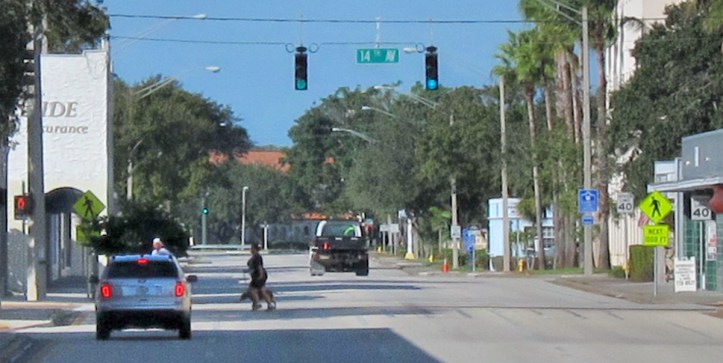
That Vero Beach clings to its “Twin Pairs” long after the downtown superhighway has outlived its usefulness is reminiscent of the story of a young husband who wondered why his wife would first trim off the ends of a roast before putting it in the oven. Finally, he asked her why she whittled down perfectly good meat before cooking it. “I’m not really sure why I do that,” she said. “I guess because I learned it from my mother.”
While attending a family reunion the following summer, the man inquired of his mother-in-law why she had taught her daughter to trim a roast down before cooking it. “Well, that’s what my mother did,” she said. “Why don’t you ask her?”
So the curious young man sought out his wife’s grandmother, and put his vexing question to the family matriarch. “They’re doing what!” his wife’s grandmother said. “I used to cut a roast into smaller pieces because I had only a small roasting pan.”
In many ways, individuals, organizations and communities will often persist in behavior and policies that no longer serve them. Such is the case with Vero Beach’s unwillingness, so far, to seriously reconsider the necessity of having seven lanes of traffic speeding through downtown.
Leaders trying to help their organizations achieve greater efficiencies, higher productivity and more creativity, are seldom more frustrated than when they hear the oft-repeated excuse, “We’ve always done it that way.”
Business owners and residents in downtown Vero Beach, as well as local leaders who are supportive of efforts to revitalize the downtown area, must find it equally frustrating when pundits and others defend the continued existence of the seven lanes of superhighway cutting through downtown by repeating the claim that “it’s always been that way.”
Downtown Vero Beach has not always been bifurcated by seven lanes of what amounts to an interstate highway funneling traffic between US Highway One and 20th Avenue, and often at speeds excessive for a mixed use area including residences, professional offices, retail stores, restaurants and government buildings.
Business leaders, along with the Main Street organization, have long advocated rethinking the wisdom of retaining a traffic plan that has outlived its original rational.
Back in the early 1970s, when Interstate 95 ended at Vero Beach, traffic planners conceived of the “Twin Pairs” as a way of efficiently funneling traffic between US Highway One and the interstate. Decades have past since Interstate 95 was extended south to Indrio Road, and later to Miami. Today, the “Twin Pairs” remain, like two deep cuts scarring what could otherwise be an attractive and vibrant downtown befitting one of Florida’s otherwise most attractive coastal communities.
Clearly, maintaining an efficient flow of traffic through the city’s major east-west corridor is a legitimate concern. If it could be shown that traffic bottlenecks would be caused by reducing the number of lanes in the one-way sections of State Road 60 through downtown, then a case could be made for maintaining the status quo.
But no such case can be made. Studies show that proposed traffic calming measures, including narrowing the “Twin Pairs” to two lanes each, providing for on-street parallel parking and landscaping to create separation between the roadway and sidewalks, would have profound benefits for the downtown area, with little negative consequence to traffic flow.
According to the results of a study recently conducted by Kimley-Horn and Associates, slowing traffic to 35 miles per hour would add just 20 seconds to the average drive through downtown.
Traffic calming measures implemented in other communities have demonstrated that the benefits far outweigh the minimal impact of travel times. In Lake Worth, for example, the one-way sections of US Highway One running through that city were reduced to two lanes with on street parking and landscaping. The results have been positive.
“If traffic is moving at 50 miles per hour, you don’t have a downtown,” says one businessman frustrated that the debate over the “Twin Pairs” has dragged on for years.
“Downtown will never be developed to its potential so long as a virtual interstate is cutting the city in half like a swollen river,” says another.
In addition to professionals and shop owners who deride the “Twin Pairs,” residents in the downtown area are not exactly fans of the city’s super highways either.
The perennial debate over what to do about the “Twin Pairs” may be coming to a head. Based on the results of the Kimley-Horn and Associates study, a working group that has been studying the “Twin Pairs” issue will soon be presenting its recommendations to the Planning and Zoning Commission and to the City Council.
The group’s proposals are sure to meet with opposition. Some will contend that lane reductions, parking and landscaping are not necessary. The best way to slow traffic, they say, is simply to reduce the speed limit. But the problem with that solution can be summed up in one word – enforcement.
Experts maintain that wider lanes and more lanes lead to higher speeds, regardless of enforcement efforts. Posting slower speed limits, they say, is not a practical solution.
In a community saddled with one of the highest unemployment rates in the state, one might expect to find more support for improving the business climate by revitalizing downtown.
Economic development, after all, involves more than recruiting new businesses to the area. As essential as that effort is, it is equally important to pursue all reasonable means of supporting existing businesses.
The need for the “Twin Pairs” in their current configuration has long sense passed, and yet they remain, blighting what could otherwise become a more attractive, thriving and vibrant downtown area.
The time has come to take seriously the need to make long overdue changes to the seven lanes of virtual interstate now serving as a drag strip through downtown Vero Beach.
 Indian River Guardian
what does it take for some people to realize the simplicity of this equation ? The pairs greatly impede foot traffic which in turn deters people from using the downtown area to its full potential , Lake Worth is a perfect example . Does anyone really have to speed through this area? The downtown area is on its way back to realizing its full potential ,promoting more pedestrian traffic as well as additional parking would be a great step in that direction.
No one has said it better,long overdue, downtown will remain suspended in the past along with it’s unfulfilled economic potential until what needs to be done is finally attended to.
The current aesthetic value is near zero.
And thank you Mark, for another beautifully written and well thought out article.
Truthful consideration – why does Miami have anything to do with our local planning? Seven50 is part of HUD and DOT financing — dangling the carrot of improvement. Vero has done a great job to date, let us keep our own planning and representatives that we voted in because we trust them! Why sell out?
Both roads could be easily “shrunk” and parking could be drastically improved, simply by painting diagonal parking lines on either side – or at least on one side. This creates the illusion of “tightening” the strip, which would slow traffic. (You don’t speed through a downtown area when the possibility of encountering cars backing out of spots exists.) Four lanes would become two, and parking would become so convenient that more people would want to come into town to shop.