
Former Vero Beach City Councilman Brian Heady, sometimes controversial, always outspoken and never one to mince words, is writing a book about the sale of Vero Electric. He said he hopes to publish “Liars, Cheats and Thieves” by April.
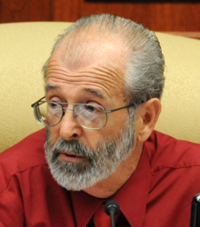
In a recent interview, Heady catalogued his concerns about the sale of the city’s electric system to Florida Power & Light. As the deal is currently structured, he thinks it costs the city too much, with the net proceeds expected to be just $7 million out of an offer valued at nearly $200 million.
Heady directs some of his harshest criticism at the plan to relocate the substation at a cost to the city of an estimated $8 million. “Just for the sake of discussion, let’s assume we’re talking about your money and my money, and not the public’s money. Why would we do something that would cut in half our proceeds without giving us any corresponding benefit?”
“That,” Heady said, “is exactly what the city is doing by spending $8 million of the proceeds from the sale to move the substation. It’s doesn’t make any sense. After the power plant is taken down, that substation can be located anywhere. It may not even be necessary. There is no benefit to the city’s taxpayers to move it.”
Beyond his questions about how the deal is taking shape, Heady said he thinks the Council’s biggest mistake was to adopt as official policy a commitment to sell the electric system. “Why would you put yourself on the hook like that when the facts and the numbers weren’t yet on the table?”
According to Heady, when he was first elected to the Council, he reached out to FPL and initially supported exploring on what terms the city’s electric utility might be sold, primarily in order to lower electric rates for some 34,000 customers. He said his objective at the time was to explore the city’s options, which is why he voted against Councilman Craig Fletcher’s motion to make it the official policy of the city to sell the electric system.
Heady is not the first to question the wisdom of the city first committing to sell the system before entering into exclusive negotiations with FPL. Especially since the city signed a letter of intent with FPL that precludes negotiations with other parties, the city’s stated commitment to sell, some argue, simply served to weaken its negotiation position.
Heady said he envisioned a process in which the city manager and the city’s transactional attorney would work at the direction of the Council to craft a deal that would lower rates for all of the city’s electric customers. The objective, he said, was not to clear off the power plant site in order to make it available for commercial development. Certainly, he says, it was not his intention to sell the electric system under any and all circumstances.
The Council has never formally voted to direct City Manager Jim O’Connor or the transactional attorney to negotiate a deal that includes relocating the substation. Just the same, O’Connor said it is at the Council’s direction that the sales agreement calls for FPL to move the substation, and at a cost of $7 million in sale proceeds plus an additional $1 million in land value.
Heady said he now wonders how the push to move the substation became official policy, since the Council has never formally voted on the question.
“The problem with the process is that it is not under the direction of elected officials who are accountable to the public,” Heady said. He sees the deal being worked out by O’Connor and the city’s transactional attorney, John Igoe, without much direct input from the Council.
“In the past, when I’ve spoken with Igoe about a question, he’s said he will get with his client about it. But who is his client? He’s not communicating with the Council members one-on-one, at least no such conversation show up in his invoices,” Heady said.
O’Connor and Igoe, Heady contends, are working at the pleasure of a three-person majority on the Council – Craig Fletcher, Tracy Carroll and Pilar Turner, and without much direction. He said O’Connor and Igo are charged, not with negotiating the best deal possible for the city and its taxpayers, but with simply finding a way to get the city out of the power business, regardless of the cost.
“What you have is a city manager who is following orders from three Council members who committed early on to selling the electric system before they ever knew what the numbers would be,” Heady said.
Others have also raised questions about how and why the deal calls for some $8 million to be spent relocating the substation. Councilmen Jay Kramer and Richard Winger have both said moving the substation is not a key to making the deal work. Former mayor Warren Winchester said he plans to raise the issue at next week’s Council meeting.
If he were on the Council today, Heady said he would be inclined to more fully explore the potential for a partial sale. “Jay Kramer gave the Utility Commission a thorough presentation of how a partial sale might work, and they gave it all of 30 seconds of consideration.”
Heady is also critical of the planned March referendum, because, he said, at that point the full details of the deal will not be worked out. “Fletcher, Carroll and Turner will use the referendum for political cover. That’s its only purpose,” he said.
 Indian River Guardian