
BY MARK SCHUMANN
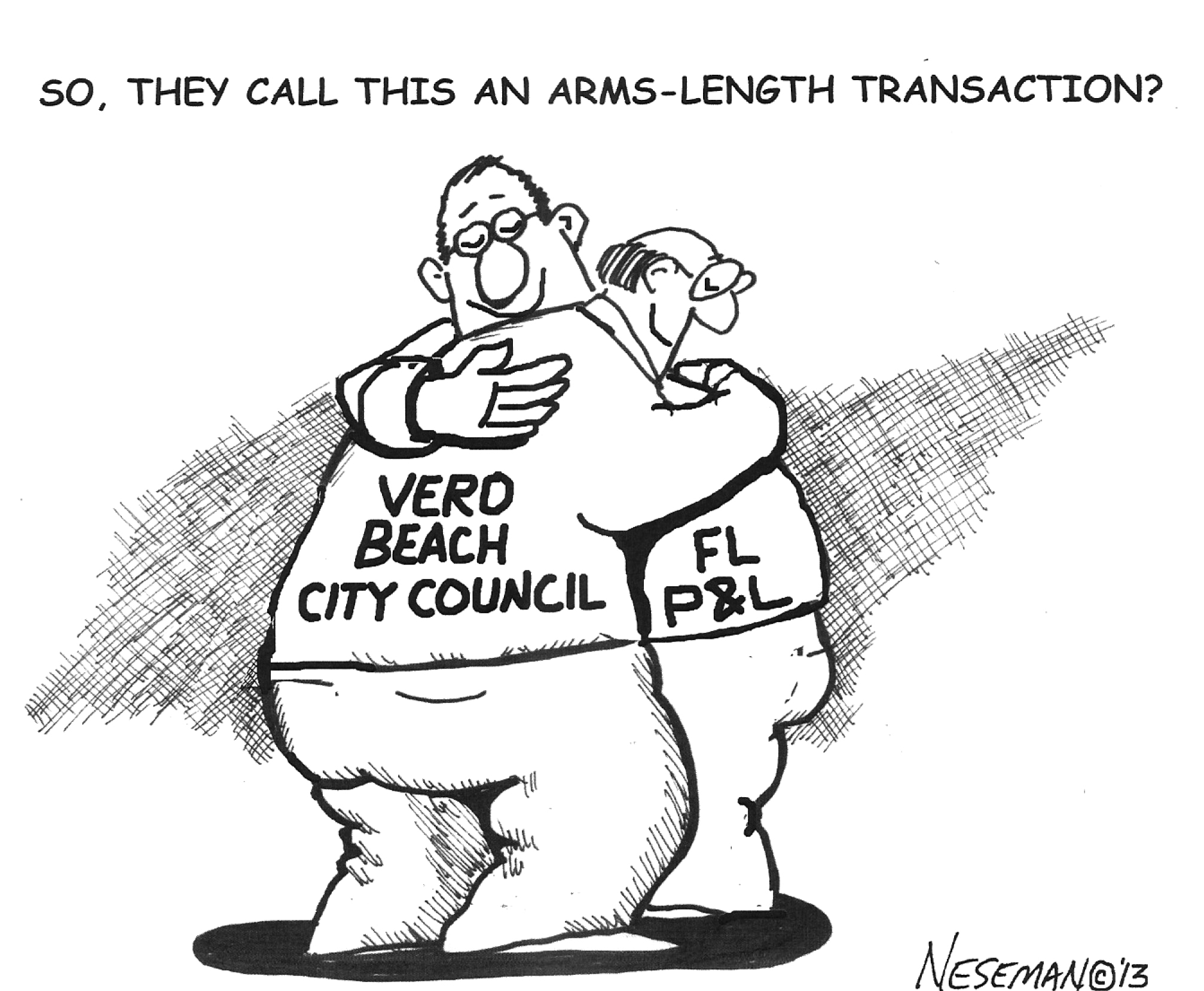
Describing the collaborative relationship between the city’s staff, its transactional attorneys and their “counterparts” at Florida Power & Light, Mayor Craig Fletcher several months ago said, “They are like family.”
It is concerning that Fletcher would characterize as familial the relationship between two parties to what is supposedly an arm length transaction.
If the city’s staff and transactional attorneys were serving the interests of residents and taxpayers, then the best thing that could be said about them would be, not that they were “like family,” but that they drove a hard bargain and pressed for the best agreement possibly for the city.
This is no time to be “like family.” In fact, one axiom about negotiating is that you should sell with emotion and buy in cold blood. While FPL’s team seems determined to fulfill their responsibility to get the best terms possible for their shareholders, it is by no means clear that the city is equally well represented.
The city’s transactional attorneys, who have racked up charges of more than $750,000 while so far having failed to resolve major issues with the Florida Municipal Power Association, are, by all appearances, calling the shots and determining the city’s negotiating strategy.
Wanting not to repeat the same mistakes made by previous counsels, the city’s transactional attorneys were hired with the clear stipulation they would work for and report to the Council, rather than answering to city staff.
And yet, with three Council members having already rolled out the red carpet for their chosen buyer of Vero Electric, they are making a mockery of laws requiring publicly owned assets be sold through competitive bidding. As a result, the city is left negotiating position of weakness.
By establishing as official city policy a commitment to sell the electric system, Council members Tracy Carroll, Craig Fletcher and Pilar Turner conveniently gave FPL the upper hand, for as they say, “In negotiations, the one who cares the most loses.”
Carroll, Fletcher and Turner are so eager to get the city out of the electric business that they seem ready to hand the system over on practically any terms FPL would propose.
Want the city to turn over the valuable 4.6-acre former postal annex site for a substation, without even without so much as a revision clause? “It’s all your.”
Want to cut the sale price by $3.5 million? “No problem.”
Want the city to guarantee all the terms of the agreement for three years? “Sounds reasonable to us.”
Want the city to spend $20 million on long-term capital projects between now and late 2016, which is the most likely closing date? “We’ll do that.”
Want to claim as a part of the purchase price $17 million in transmission upgrades and $7 million in new substation equipment necessary for the long-term operation of your new business in Vero Beach? “We’ll go along with that.”
Offering a deal that will net the city just $5 million out of a total offer valued at $197 million? “We’ll take it!”
Beyond the many exceedingly generous provisions the transactional attorneys have conceded to FPL, they made a bighearted offer to the Orlando Utility Commission as well. The OUC is to receive $34 million in cash to assume the city’s FMPA entitlements and another $20 million to let the city terminate a 20-year wholesale power contract some 16 years early. Yet, even if the deal cannot close until late 2016, the OUC will still receive $20 million.
Who, if anyone, is looking out for the city; and who, if anyone, in managing the $500-an-hour transactional attorneys?
The Council troika appears ready to sign an agreement that looks less like a shrewd business deal and more like a gift to a family member.
If the Internal Revenue Service takes a close look at the appraised value of Vero Electric, which is almost $200 million, and then sees that the city is likely to receive just $5 million net proceeds, the city just might get stuck paying a “gift tax” on the difference. At least that’s what can happen when “family” members cut deals such as the one the city’s transactional attorneys negotiated with FPL.
 Indian River Guardian