
BY MARK SCHUMANN
 Tens of millions of Americans who formerly shared in the prosperity of what had been a “great middle class” are now among the ranks of what the New York Times calls” the new poor.”
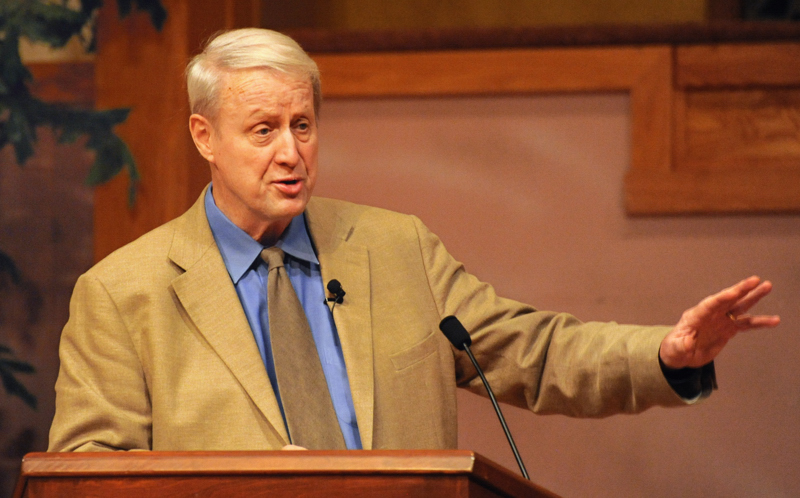
The causes of the steady, four-decade decline in the standard of living for middle class Americans was addressed by author and Pulitzer Prize-winning journalist Hedrick Smith, who spoke at the Emerson Center yesterday as a participant in the Celebrated Speakers Series.
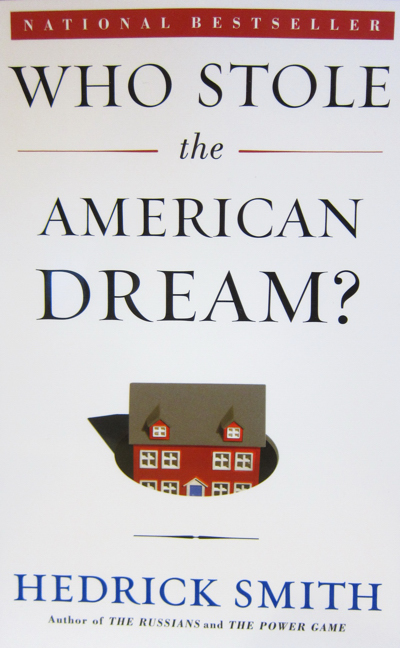
In a lecture which Smith characterized as a “reporter’s talk,” the former reporter and editor for the New York Times, and award-winning documentarian for the Public Broadcasting System, offered a thorough outline of his recently published book, “Who Stole the American Dream?”
Adjusted for inflation, middle class wages have remained flat since the late 1970s, Smith said.
If real wages haven’t increased along with gains in productivity, then what has fueled expansion in the consumer economy?
According to Smith, before the housing crash $6 trillion in wealth shifted from home equity, as middle class Americans borrowed against the increased value of their homes to help pay for college tuition, health care, and to keep up with the rising cost of living in the face of stagnant wages.
“Who Stole the American Dream?” tells the story of how the United States went from middle class prosperity to the present hyper-concentration of wealth, and from politics that works to the current dysfunction in Washington, which many now see as broken government.
One of the most profound changes that has impacted the middle class, and Smith would argue has ultimately dragged down the entire economy, is a deep and profound shift away from a business ethic of stewardship and responsibility that balanced the interests of all stakeholders, not just stockholders.
“Stakeholder capitalism” has now given way to “shareholder capitalism,” as more and more executives are incentivized through stock options to focus on short-terms gains in share prices, often at the detriment to the long-terms interests of their companies, their workforces, and ultimately the economy.
Smith points to Germany’s prosperity as an example of how private and public collaboration, and management and labor cooperation can contribute to sustained economic growth. By placing a priority on retaining manufacturing jobs, rather than giving companies an incentive to practice “global reallocation,” Germany’s rate of wage growth since 1985 has been five times faster than that of the United States.
Consumer demand fuels economic growth, Smith said; and as Germany has discovered, increases in real earnings for middle class workers is far more likely to lead to economic expansion than tax policies and business practices that only serve to further concentrate wealth. “It is time to return to the virtuous circle,” Smith concluded, referring to an economic concept that is counter to the theory of “trickle down economics.”
In addition to setbacks caused by self-centered business practices , and by the debilitating influence of lobbyists, Smith says America’s middle class is also sliding backwards because it no longer exercises power.
In the the Civil Rights Movement, and in other mass movements such as the Labor Movement, the Women’s Movement, the Environmental Movement, and the Consumer Movement, common Americans banded together to affect major changes in society and in government policy. “Middle class Americans have got to make some choices,” Smith said, arguing that it may be time for a “peaceful political revolution.”
The next Emerson Center event will be “Ragtime, Romance & Roses,” featuring top Ragtime pianist Bob Miller. Miller will appear at the Emerson Center Thursday, February 14 at 7 p.m. For information call 778-5249.
 Indian River Guardian