
BY MARK SCHUMANN
VERO BEACH – After receiving 3-2 approval by the City Council Tuesday evening, the proposed sale of Vero Electric to Florida Power & Light will now go before city voters in a March 12 referendum.
Both sides have geared up for a short, three-week campaign, with signs already appearing on lawns and in road right of ways around the city.
Before taking the expected 3-2 vote, with Council members Tracy Carroll, Craig Fletcher and Pilar Turner supporting the agreement, and Jay Kramer and Richard Winger opposing it, 20 members of the public spoke for more 90 minutes, some supporting the sale, and others raising questions about the deal.
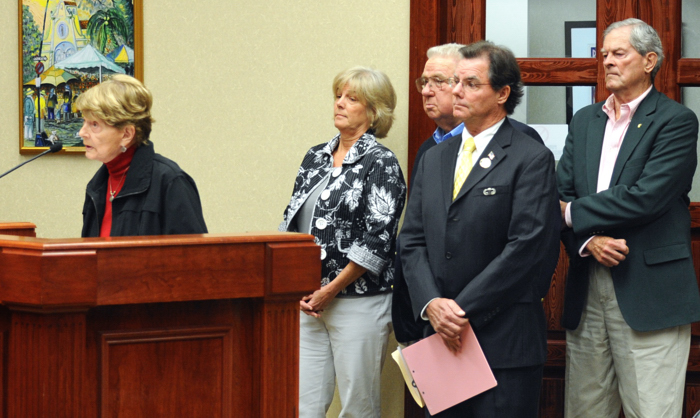
Four former Council members flanked former City Councilwoman Caroline Ginn, as she spoke. “This is a horrible contract, Ginn said, raising concerns about the amount the city will net from the sale, which FPL has valued at $179.6 million.
Finance Commission Chairman Peter Gorry estimates that, because of the cost of buying its way out of long-term wholesale power agreements, the city will have no more than $3 million left in proceeds.
Other opponents of the sale questioned FPL’s ability to provide the same level of service. They also question the lack of a formal bidding process, and the absence of a specific plan for closing the expected $3 million budget gap the city will face after the sale. Other’s raised concerns about FPL’s plans to install smart meters.
Proponents of the sale, including County Commissioners Bob Solari and Tim Zorc, and utility activists Glenn Heran, Mark Mucher and Charlie Wilson, all stressed the economic benefits of the expected savings in electric rates.
Heran, who has worked with Steven Faherty for five years promoting the sale, said the rate differential between the city and FPL is now $23 million, or approximately 28 percent, for Vero Electric’s 34,000 customers.
Opening the Council’s discussion following public comment, Winger said, “There is a huge elephant in the room. That elephant is the FMPA (Florida Municipal Power Agency). Either we resolved the FMPA issues, or there is no deal.”
Winger said there is “no chance,” the city will be able to end its participation in the FMPA’s All Requirements Project before October 1, 2016. Kramer raised the same concern. Both he and Winger said there are ways the city could act more quickly to lower rates, including selling the city’s county customers to FPL.
“There are alternatives, including a partial sale,” Kramer said. “There are different ways to get rates down.”
Kramer has long argued the city could have begun more than a year ago to renegotiate its wholesale power agreement with the Orlando Utilities Commission, a move he thinks would enable the city to decommission the power plant, and thus lower rates. He has also argued that a partial sale would enable the city’s 22,000 county customers to get lower rates much sooner than they will, if the deal cannot close until late 2016.
Turner countered Winger and Kramer, arguing that the city has never been and never will be able to compete with FPL rates. She also stressed her confidence that the FMPA will cooperate by giving the city a waiver to exit the All Requirements Project early.
FPL spokespersons, and some city officials, say they remain confident the deal can close in early 2014, but opponents insist they are being unrealistic. The sales agreement was amended last month to allow for a three-year closing window, in the event the city is unable to exit the All Requirements Project early.
With Kramer and Winger both nodding their heads to indicate their disagreement with her, Turner also questioned the viability of a partial sale. She said that, saddled with the power plant, the city could not afford to give up 60 percent of its customers. Kramer and Winger both maintain the power plant can be decommissioned in a partial sale.
“This is a great plan,” added Carroll, following Turner “We have a way out of these contracts.”
Referencing Kramer’s presentation last month to the Utilities Commission, in which he outlined the potential for a partial sale, Carroll said, “No viable option came out of that.”
Others, including Kramer, have argued that because the Utilities Commission is now “stacked” with members who support selling the full system to FPL, the concept of a partial sale never received serious consideration by the commission.
Mayor Fletcher concluded the Council’s deliberations simply saying he thinks it is time to move ahead with the sale.
 Indian River Guardian