
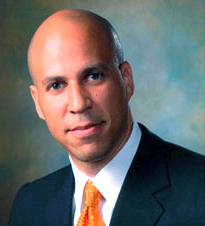
 Newark, New Jersey mayor, Cory Booker, spoke at Riverside Theatre yesterday, February 25, as part of the Distinguished Lecturer Series. His message was simple – nothing is more important to America’s future than the education of its youth.
“We live in a knowledge-based society and our most valuable resource is not oil or gas – it is our children. We cannot continue to be the world’s number one democracy with a 24th ranked education system.”
That was the bottom line of Booker’s talk and nowhere was that problem more obvious than his own city of Newark. “When I became mayor in 2006, our entire property tax levy in Newark was used for public safety.”
The city had many problems and no money to deal with them. One of his first acts was to institute an 8.3% property tax increase, one of the largest in Newark’s history. Then he went about tackling the crime rate. Over the next two years, Newark led the nation in reduction of violent crime.
But he knew from the start that addressing the problem-plagued Newark school system would have to take top priority if the city was to reverse its decades-long downward spiral. “Not all the schools were failing though. Charter schools were doing well and St. Benedict’s Preparatory School was turning out accomplished students who went on to be college graduates. So I went to Father Ed at St. Benedict’s to find out how he did it.”
Father Ed is the Reverend Edwin D. Leahy, who happened to be in the audience at Riverside Theatre. Booker went on to say, “He and the charter schools proved that every child can learn, regardless of race or background. There were these islands of excellence all around the city in addition to traditional public education. I didn’t care about the mechanism of delivery of education, only the outcome.”
He wanted to build on those positive outcomes, but how could he change a district school system that was failing? “I found out that 92% of the school system’s budget was out of teachers’ and principals’ control. They were compliance bureaucrats filling out forms and that had to change.”
So he decided to form partnerships. “I went to the Ford Foundation and they told me they had a brilliant idea to improve the education system – if kids work harder for longer hours, they will do better. So we started by extending the school day. In our system, time had been the constant and achievement the variable. It should be just the opposite – achievement is the constant and time is the variable.”
Facebook founder Mark Zuckerberg helped Booker’s cause with his controversial donation of $100 million in a matching grant. It raised a number of issues, but that was not the point of Booker bringing it up. In fact, it was almost an aside. The point was, “He could only come out on a Saturday and was disappointed he would not see a class. But I took him to a school where they have mandatory Saturday math classes.”
Booker also needed to address the teachers’ contract. “Teachers shouldn’t be treated like assembly line workers, but as professionals. There also had to be some mechanism to reward good performance and have consequences for poor performance.”
That was easier said than done, so he brought Republican Governor Chris Christie and American Federation of Teachers president Randi Weingarten together and remarkably, they agreed to make the changes Democrat Booker had requested. His experience led him to quip, “Now I’m ready for the Middle East.”
Booker’s introductory talk lasted about 30 minutes, then he took questions. One question was what can we learn from education efforts in other countries in Asia or in Germany? “For one thing,” said Booker, “there is more reverence for teachers. They are paid better. These other countries also demand quality and competitiveness from their education system. STEM courses – science, technology, engineering, math – are so important to every advanced country’s future yet we lag producing graduates in those areas. Germany has an excellent trades training system so all students are prepared for the future even if they don’t do to college. However, college should be an aspiration for the majority of kids. If not, they should be equipped with the skills to have good jobs that pay a middle class income.”
Another question concerned the high cost of education with so many other pressing priorities. “If you think the education system is expensive, try ignorance. Father Ed at St. Benedict’s spends much of his time trying to raise funds while the district school doesn’t have to ask for money. He produces one of the highest quality educations in our state for one of the lowest costs – about $8,000 per student compared to the public schools receiving $20,000 per student. We need to look at what we’re spending money on and how much of it doesn’t bring results. Online education is becoming very popular. My alma mater, Stanford, offers courses online and those students outperform the on campus students.”
How important is early stage education? Booker cannot stress it enough and adds it should start prenatally. “About 40% of pregnant mothers in our city have no prenatal care or if they do, only in the late stages. In a child’s first year, 80% of the brain is developed.
“Home is the real indicator of student success. We need to address parenting issues, which is a serious cultural problem. In Newark, 70% of babies are born to single mothers and 60% of them have a high school education or less. They are often working two jobs and kids are watching four to six hours a day of television.
“There is also a lack of black male role models. Traditional black colleges have up to three times as many female students as male. Too many men are in prison. They get out with no skills and can’t get a job because they were just in prison. We tell those men if you want to be a good dad, join our fraternity, Delta Alpha Delta Sigma, or DADS. It’s a program helping men become better fathers. We have mentor dads to work with them, parenting class, group activities with kids and even co-parenting classes. The state recidivism rate in New Jersey is 62%, but in our DADS program, it’s 7%.
“McKinsey & Company did a study back in 2009 on how the education gap between minorities and whites affected our GNP. They estimated between $1.3 and $2.3 trillion in productivity. We are now a nation of minorities and if we fail to educate them the drag on our economy will grow greater and greater. McKinsey concludes that we will have a permanent recession if this isn’t reversed.
“What will the country look like 25 years from now?” Booker asks. “Will this be the first generation of kids with lower literacy rates, higher obesity rates and lower average wages? Is this the needle point where our country starts to decline? It will not happen because of external threats. And this is not a Republican or Democrat cause – it is THE American cause in our generation.”
 Indian River Guardian