
 BY MARK SCHUMANN
Addressing the question of whether the sale of Vero Electric to Florida Power & Light can take place before late 2016, Florida Municipal Power Association attorney Fred Bryant was quoted in the press last week saying, “It is going to be a difficult, long process. It will probably take every bit of October 1, 2016, to accomplish this – if it can be accomplished at all.”
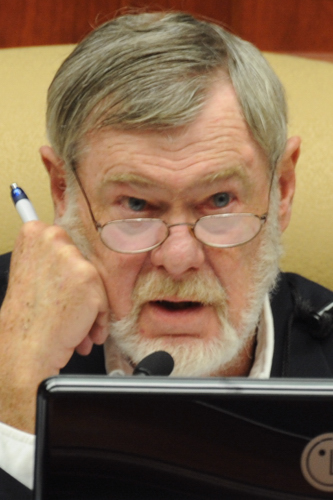
Referencing Bryant’s comment, as well as an audio recording of Bryant’s recent presentation to the FMPA executive committee, which is now available on the city website, Finance Commission Chairman Peter Gorry raised his own concerns yesterday about what a delayed might cost the city and its electric customers.
Gorry received more than a little pushback from fellow commission member Glen Brovont and from Mayor Craig Fletcher. “The deal has been approved by the Council, and we can’t be pouring water on it now,” Brovont said.
I’m just pointing out that there are issues,” Gorry replied.
“Don’t get yourself wrapped around this axel,” Fletcher said, as he came to the podium to advise Gorry that discussing the question of when the deal can actually close is beyond the Commission’s responsibility.
“This isn’t what I picture this committee’s job as. I think you are getting way off line here. The negotiations are going to take place. They are not going to include this committee, and they are going to be very closed, and it’s a mute question until we get a final piece of paper from the FMPA,” Fletcher said.
Perhaps the Mayor is unaware that the Finance Commission mission statement states in part “…shall initiate its own proposals, make recommendations, and provide alternatives to the City Council..”

The tense exchange at yesterday’s Finance Commission meeting was reflective of the community-wide debate being waged in advance of the March 12 referendum.
Gorry said he believes the deal is a reasonably good one, assuming a January 1, 2014 closing. But if the transaction cannot take place until late 2016, he thinks the proposed contract leaves much to be desired.
Voters listening to the City Council threesome of Tracy Carroll, Craig Fletcher and Pilar Turner could easily get the false impression that approval of the March 12 referendum would lead to lower electric rates any time soon.

Further confusing the public, Florida Power & Light representative Ryan Fair continues to dismiss concerns that a closing cannot take place until late 2016, if at all.
Mayor Craig Fletcher is obfuscating the truth by claiming that only “ancillary” issues remain to be resolved. Meanwhile, blue and white signs are sprouting up all over town promising a “YES” vote is a decision for lower electric rates.
Ironically, the opposite seems true. If voters approve the deal, they will essentially be choosing to pay higher electric rates for nearly four more years, if not longer. With passage of the referendum, the city, its transactional attorneys and FPL seem likely to take themselves and the community on what may turn out to be nothing more than a wild goose chase.
Anyone who still doubts that the sale will be held up to at least late 2016, might do well to listen to the audio recording of FMPA attorney Fred Bryant’s presentation to the organization’s executive committee last Thursday.
Approximately 20 minutes into the meeting, Bryant outlines the hurdles to be overcome in enabling the Vero Beach-FPL deal to go forward without putting at risk the integrity of FMPA contracts and the statue of its tax-exempt revenue bonds.
Because the sale will likely remain stalled until late 2016 or beyond, the city’s 22,000 county customers will pay, based on the current rate differential, some $62.7 million more in electric rates over the next four years than they would if the city acts now to sell its county customers to FPL.
Despite claims to the contrary, the sale cannot take place until late 2016, if it can happen at all, and voters should be clear about this fact.
Just as importantly, voters should understand that it is becoming increasingly doubtful the deal will ever take place, at least not on terms substantially similar to the proposed asset purchase and sale agreement voters are being asked to approve.
If the final structure of the agreement is not “substantially” similar to the contract voters will decide on March 12, then, at the very least, the deal will face challenges in court. It might even have to come back to voters in an another referendum.
The city and FPL cannot be unaware of the insurmountable hurdles ahead, and yet they are hardly being forthright with the public about this fact.
Councilwoman Pilar Turner continues to insist the Florida Municipal Power Agency has promised to cooperate with the city to help enable the sale to go forward. But Turner has failed to acknowledge that the FMPA is also insisting its contracts be honored.
The FMPA contracts do not provide for the transfer of the city’s FMPA entitlements under a deal where the electric system is sold to one party and its power entitlements to another, as the Vero Beach-FPL contract is structured.
Under the terms proposed, Vero Beach will sell its electric system to FPL, while paying the Orlando Utilities Commission some $74 million to assume its FMPA power entitlements.
Because FMPA’s revenue bonds are backed by the customer base of its member municipal utilities, the consortium’s contracts do not contemplate or allow for a bifurcated sale, such as Vero Beach is proposing.
Still, the FMPA appears willing to agree to such a transaction, so long as all of its other members agree that no precedent is being set. Further, FMPA wants assurances from its other member that they will not seek a similar waver, if an investor owned utility offer to buy them out. The problem for Vero Beach is that receiving unanimous approval by the FMPA membership seems all but impossible.
 Indian River Guardian