
BY MARK SCHUMANN
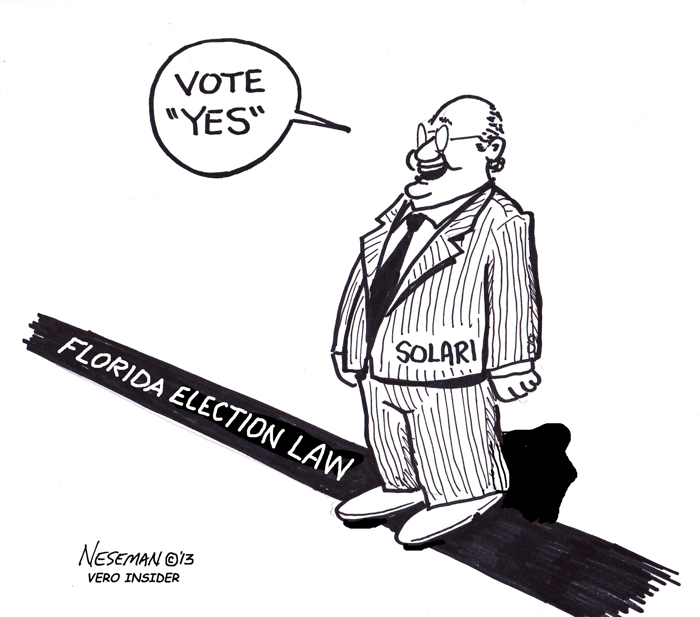
During last week’s County Commission meeting, held at public expense and recorded for broadcast and rebroadcast at public expense, Commissioner Bob Solari took advantage of his position on the dais to advocate for passage of tomorrow’s referendum on the proposed sale of Vero Electric to Florida Power & Light.
Solari’s “shout out” for a “yes” vote was also communicated in a memo to his fellow commissioners, a memo produced and copied at public expense and then included in backup materials for the March 5 meeting of the County Commission.
If Solari’s actions were not in violation of Florida election law, he was certainly skirting the line.
Florida law prohibits the expenditure of public funds for political advertising or electioneering communications concerning issues, referendums, or amendments that are to come before voters.
In October 2011, in advance of a special call meeting of the City Council to “inform” the public on the so-called lease referendum, City Attorney Wayne Coment wrote to the Council, “There should be no expression of a local government or a person acting on behalf of local government advocating support or opposition concerning an issue, referendum, or amendment that is subject to the vote of the electorate.”
Coment’s advice to the members of the City Council was that they should refrain from expressing advocacy for or against an issue in a meeting that is being held at public expense and is being recorded at public expense for broadcast and rebroadcast.
County Attorney Alan Polackwich sees it differently. In his opinion, Solari’s comment did not fit the definition of a political advertisement or an electioneering communication.
In response to an inquiry from InsideVero, Chris Cate, media contact with the Florida Department of State Division of Elections, defined political advertising as “something that expressly advocates in a communications media.”
Whether Solari’s advocacy from the dais for passage of tomorrow’s referendum in Vero Beach was within the law seems to depend on whether the Florida Elections Commission would consider broadcast and rebroadcast of his comments during on cable television as an advertisement disseminated via a “communications media.”
Cate said it is for the FEC to determine if the broadcast and rebroadcast of Solari’s “shout out” constituted a political advertisement. When contacted for an opinion, FEC council declined to answer a hypothetical question, or to address a matter than might come before the commission in the form of an official complaint.
 Indian River Guardian