

- Patty McKay teaching her class of kindergartners at Glendale Elementary.

BY MARK SCHUMANN
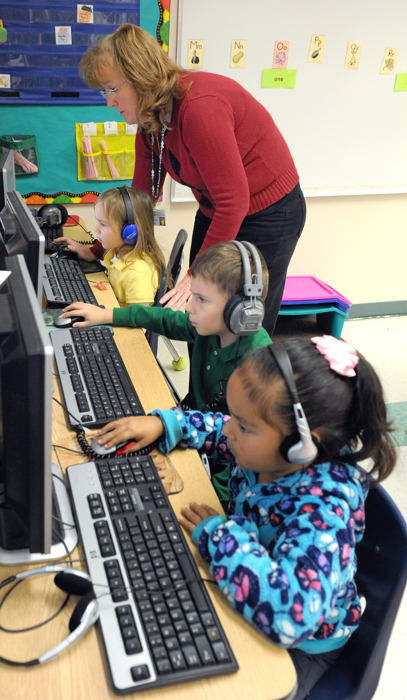
To better understand the challenges today’s teachers face, I recently spent a day with Patty McKay and her class of kindergarteners at Glendale Elementary.
When I arrived, Miss McKay was standing at the front of the room pointing to the letters of the alphabet. Fifteen adorable, bright, funny, fidgety children were sitting at Miss McKay’s feet sounding out each letter one at a time. I took a seat in a chair sized for a six-year-old and listened – closely. “If we spend the whole day on this exercise, maybe I’ll leave here a better phonetic speller,” I thought to myself.
As the children and Miss McKay sounded their way through all 26 letters of alphabet and a few diphthongs, I thought of the Learning Alliance’s “Moon Shot Moment” objective. This local group’s ambitious goal is to enable 90 percent of Indian River County’s third graders to read at grade level by 2018.
It then occurred to me that when the children in Miss McKay’s class are completing third grade in 2016, some percentage of them will likely be struggling to read. It’s important for these kids to learn to read. Otherwise they will have difficulty making it in an increasingly competitive, high-tech job market. Who knows what work world awaits them some 16 years from now? Hopefully each of them will have an opportunity to go to college. Wishful thinking, I know.
More than seventy percent of the students at Glendale Elementary qualify for free or reduced lunch, making Glendale a Title One school. Supplemental Title One funds from the U.S. Department of Education help local school districts meet the needs of at-risk and low-income students with the objective of closing achievement gaps.
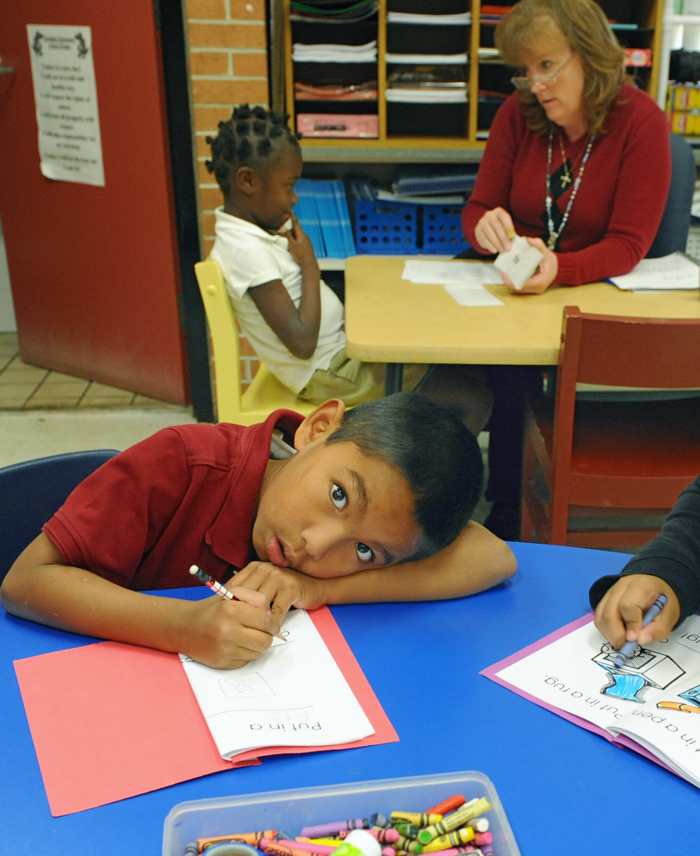
Miss McKay said her students come to her with a lot of varied needs. She recalled one boy who entered kindergarten as a self-selective mute. The boy would cling to her through much of the day, and was only able to begin writing his name near the end of the school year. Gradually he began making sounds, and has come a long way in his development. He has progressed so well, in fact, that he was recently named Glendale’s student of the month.
How can you measure the rewards of nurturing a child afraid to speak, coaxing out his first courageous word? For all the rewards, though, the job is also challenging. Along with four of her colleagues who are also teaching kindergartens at Glendale, McKay has the unique challenge of taking in students who are essential unknown to teachers and administrators. “In kindergarten you don’t know what you’re getting. It’s their first years of school,” said Miss McKay.

The day before I showed up from class, Miss McKay had been at the school until 7 p.m. preparing for a new section of the reading curriculum. “I’ve never worked harder in my life,” added the 17-year veteran in the classroom.
After completing the exercise of sounding out letter, Miss McKay gave a shorthand command known to her students, and they immediately popped up off the floor and scurried to different corners of the room to work on individual exercises.
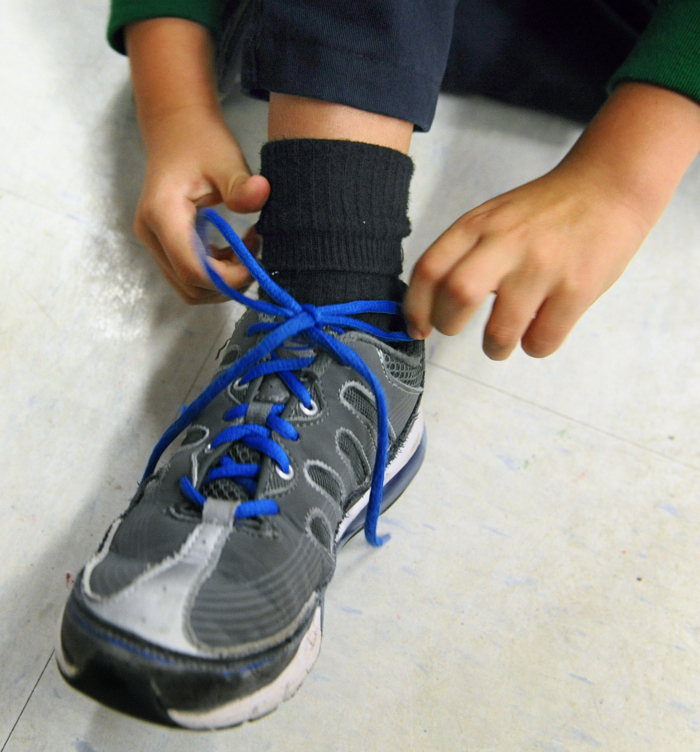
“These kids are a bit energetic,” I though to myself, wondering how an adult can keep up with them day in and day out. One little boy had recently learned how to tie his shoes. I lost count of how many times he untied and retied his shoes, several times for the benefit of my instruction.
 After letting the kids work on their own for about 30 minutes, Miss McKay said “meet me on the carpet,” and all 15 of her charge gathered together for an exercise in learning the days of the week. I know the days of the week, but sometimes I just don’t know what day of the week it is. Life has its cycles.
At 11:30 we lined up single file and marched to the lunchroom. As I sometimes did in high school student, I slipped out to the parking lot, this time to get cash to pay for lunch.

While Miss McKay’s class ate lunch, she returned to her classroom to prepare for the afternoon, and probably to take in a few moments of quiet. It seemed to me she deserved some space, so I stayed in the lunchroom full of kindergarteners, all the while wondering how the adults working lunch duty had avoided losing their hearing. What a contrast this was to experiences I’ve had visiting monasteries, where meals are taken in silence.
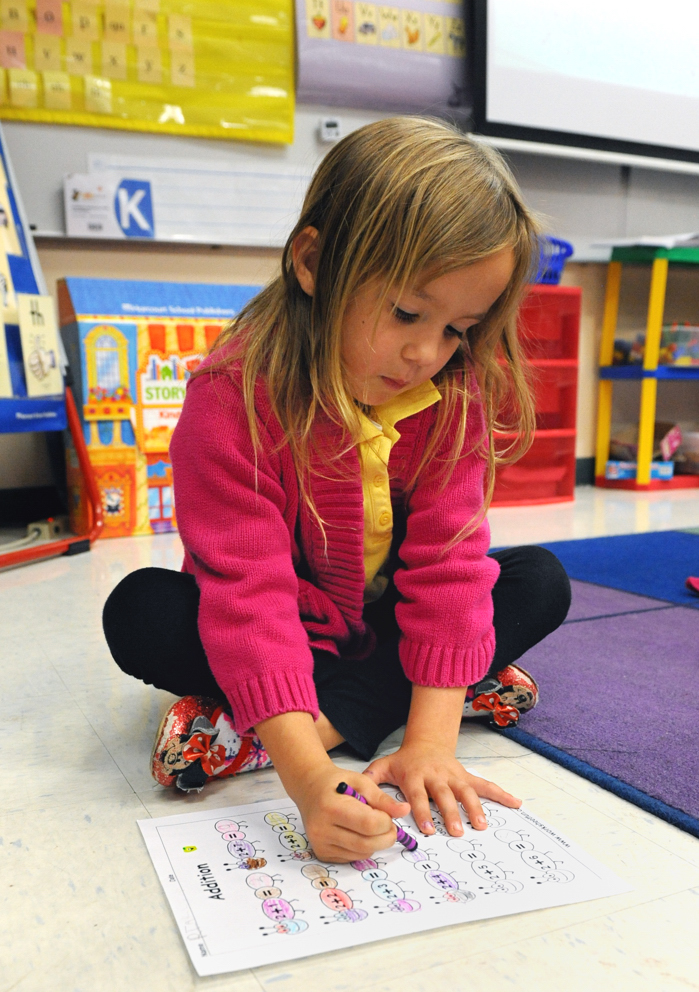
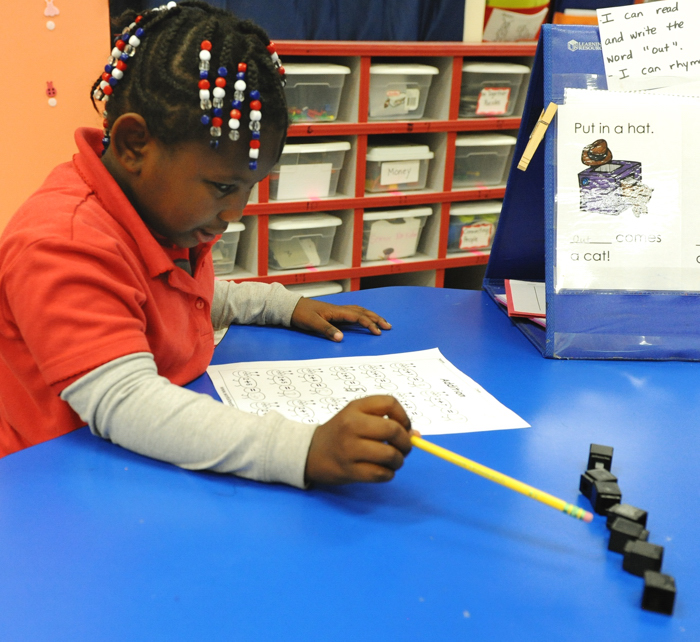
After lunch, we all marched back to Miss McKay’s classroom. It was time to work on addition. I learned, for example, how to add 2 plus 12 using little cubes. You simply count out two cubes and set them to one side. Then, after counting out twelve more cubes, you put all the cubs together in front of you in a row and count them all together. There you go: 14.
One girl asked me to help her. After we had worked through a few equations, I felt like I was getting the hang of it, though I was a little anxious when Miss McKay checked our work.
About 30 minutes before dismissal, we all went out to the playground, where all five platoons of kindergartners worked off some pent up before heading home. Miss McKay and I sat together on a bench where we could watch the children play, while she shared with me more about the challenges and joys of teaching.

On the administrative side, schools are implementing new evaluation tools for teachers and a new standardizes test for students as well. McKay said that as pre-kindergarten programs focus more on preparing kids academically, they are placing less emphasis on teaching basic social skills, leaving kindergarten teacher to provide more of that work.
Today’s educators have assumed a long list of responsibilities beyond teaching reading, writing and arithmetic. As Jamie Vollmer, author of “Schools Cannot Do It Alone,” said when he spoke in Vero Beach recently, as a nation we cannot compete successfully in the new world economy if we continue to let so many of our young people fall through the cracks.
Vollmer also made the case that most teachers, like Miss McKay, are competent, dedicated and hard working. But they cannot raise and educate the next generation on their own.
Having spent time working with teachers in their classrooms, Vollmer said he is convinced that as a group they are as hard working, competent and motivated as those in any other profession.
Vollmer said one challenge in building consensus for meaningful reform is to help the broader community understand how improving education can benefit everyone – by reducing crime rates, cutting indigent health care costs, bringing down unemployment and in other ways preserving and improving the quality of life.
“There is both a moral and practical motivation for improving schools,” Vollmer said, “and we need to help people understand why changing the system is the right thing to do.”
When the school day ended last Thursday afternoon, I still had time to attend the last half of a Planning & Zoning Board meeting being held at City Hall.
As I left Glendale Elementary, though, I just couldn’t make the steering wheel of my car turn toward town. I guess I didn’t want to loose the bloom of the day spent with little people whose minds are full of wonder. Author Robert Fulgham was right. Everything we really need to know we learned in kindergarten.
 Indian River Guardian