
 BY MARK SCHUMANN
 Delivering on a campaign pledge to make restoring the health of the Indian River Lagoon a top priority, first-term Indian River County Commissioner Tim Zorc has invited scientists, regulators, environmentalists, activists, business and political leaders and the broader community to a symposium to be held Tuesday, March 26.
The day-long event will begin at 8 a.m. in the County Commission chambers, and will feature speakers from the Indian River Farms Water Control District, Harbor Branch Oceanographic Institute, the St. John’s Water Management District, the Florida Fish and Wildlife Conservation Commission, the Ocean Research and Conservation Association, among others.
The symposium will be open to the public, with registration available at at the county web site: http://www.ircgov.com.
As John Orcutt, a volunteer with ORCA, proposed recently at another lagoon symposium sponsored by Harbor Branch, it is time for the County Commission to take the lead in restoration efforts. Each of the county’s municipalities can offer support, but only the commission is in the position to coordinate effective action.
The Indian River Lagoon is vital – and it is in trouble. Within the past few years, nearly half of the lagoon’s vital seagrass beds have died. To the north of us, in Brevard County, pelicans are mysteriously dying. Long-time anglers know all to well the lagoon is in trouble. Evidence abounds that we are killing off this vital, irreplaceable natural resource. In is time to act. In fact, these next few years may prove to be a turning point for the Indian River Lagoon and the thousands of species of plants and animals living in this, one of North American’s most diverse
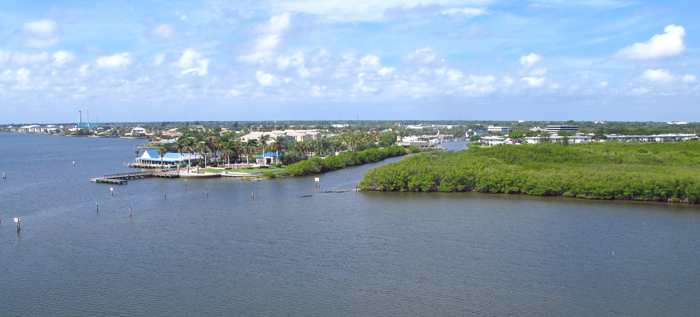
Much is at stake. The Indian River Lagoon is the life-blood of our community, and it serves as the single most distinguishing typographical feature of the Space and Treasure Coast, setting our area apart from other coastal regions.
Blending sea water with fresh water flowing from the St. Johns River, Lake Okeechobee and from countless drainage canals and watersheds from Volusia County to Martin County, the 156-mile-long estuary is both of vital importance to the ecology and to the local economy.
A 2008 study valued the lagoon’s economic impact at just over $2 billion. Boaters, sport fishermen and bird lovers come from around the world to enjoy the lagoon. These visitors help support the boating, fishing and tourist industry.
Seventy-five percent of the lagoons saltwater marshes have been lost to mosquito impoundments. This method of controlling mosquito breeding has eliminated many fish nursery grounds.
The discharge of nutrient and phosphorus-laden fresh water from the St. Johns River marshes, Lake Okeechobee and from drainage canals has depleted shellfish habitat and caused algal blooms killing sea greases that are a vital link in the lagoon’s food chain.
Indian River County alone lost 43 percent of its sea grass beds in the past two years. The loss of some 33,000 acres of sea grass in such a short time is alarming scientists and others monitoring what had until now been only a gradual decline of the lagoon.
Now the warning signs are alarming, and a growing consensus seems to be building that something must be done soon to save this vital natural resource.
Working with federal, state and local governments, the St. Johns Water Management District is implementing a comprehensive plan to save the lagoon.
Effluent discharges from more than 40 wastewater facilities have been eliminated. For example, Vero Beach is now using a deep injection well rather discharging treated water into the lagoon.
Another local effort to reduce human impact on the lagoon is Indian River County’s Spoonbill Marsh project. Opened in the summer of 2011, the 69-acre man-made wetland enables the county to filter 1 million gallons a day of brine, a byproduct of the county’s water treatment process. Brine water, which is left over from the osmosis water treatment process, is high in salt, phosphorous and nitrogen. The county for years pumped 750,000 gallons a day of brine into the Indian River near the Wabasso Bridge.
More than 650 acres of environmentally sensitive land fronting six miles of the lagoon have been purchased and preserved by the Indian River Land Trust since 2009. The Land Trust is currently negotiating to purchase another 150 acres along the lagoon.
In addition to these local efforts, more than 30,000 acres of mosquito impoundment salt marshes have been reconnected to the lagoon along the 156 miles of the estuary. From 2006 to 2009 some 2 million cubic yards of muck were removed from the St. Sebastian River.
Despite these efforts, the lagoon appears to be in rapid decline. The sea grasses are dying, and populations of snook, spotted trout and other popular game fish are dwindling.
There appears, however, to be rapidly growing support locally to take more action to save the lagoon, evidenced by Zorc’s planned symposium.
Commissioner Bob Solari has also been a strong supporter of reversing the flow of the drainage canals in order to drastically cut the discharge of phosphorus and nutrients into the lagoon.
The basic idea would be to create large reservoirs in the western county to receive storm water runoff that now flows to the lagoon unfiltered. The reservoirs would both filter water and provide a water supply. Solari He will speak on this concept on the 26th.
Volunteer organizations, in addition to the Indian River Land Trust, are also stepping up. The Rotary Club of Vero Beach earmarked the proceeds from its recent Nautical Flea Market to preserving sea grasses near the Moorings.
The Indian River Lagoon Coalition is steadily gaining new members, and candidates for political office, though they may address a range of issues, are never remiss to underscore their commitment to saving the lagoon.
Though we have known for years the lagoon could not forever absorb all of our polluted runoff, perhaps the recent loss of 53 square miles of sea grass finally got everyone’s attention.
 Indian River Guardian