
BY NICK THOMAS
When we discuss the way forward for preserving Indian River County’s shoreline, it is helpful to distinguish the term “beach” from the term “dune.”
Based on reviews of old Vero Beach postcards and memories of long-time locals, our beach itself is more or less where it has always been, despite statements to the contrary. And that is largely because we as a community have always understood, intuitively perhaps, that when we talk about protecting our beaches, we are really talking about protecting our dunes.
So with that understanding, let’s look at what has been done most successfully over the past decades to protect and renourish our dunes. Then we can ask whether those approaches are the best way forward given the costs of business as usual and given the present conflict between our City and County regarding which entity should pay for efforts going forward.
What we know is that in recent decades we have depended on two primary methods to rebuild our dunes when they have been eroded or threatened: Either we pay a non-local contractor to float in dredging equipment and pump sand onto the beach from offshore where it exists in great quantities or we pay a local contractor to truck sand in from local mines.
Most recently, the latter method was employed, not because it was deemed better or more cost-efficient, but rather because during dire economic times, it provided employment (and political largess) to locals. During the process, unfortunately, there were considerable cost overruns, damage to our county roads from the thousands of dump-truck runs and, in an embarrassment to all involved, a final dispute over a small sum of money. The quality of the trucked-in sand has also been questioned.
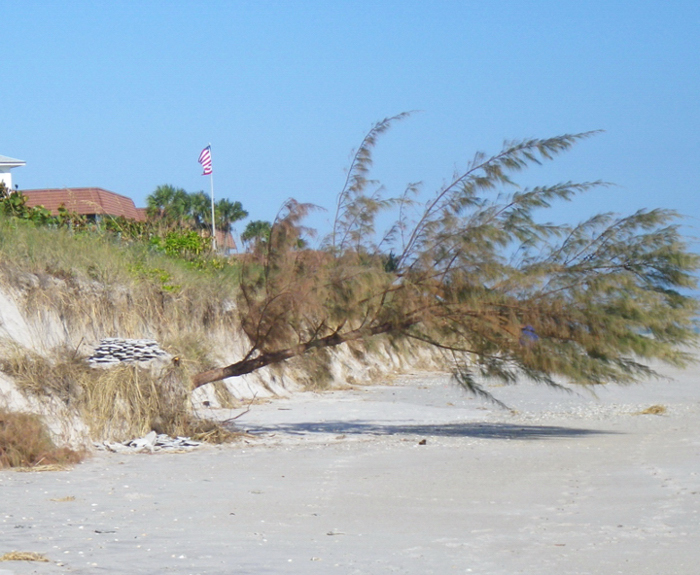
With either method, once new sand hits the beach, we use heavy equipment – bulldozers and loaders – to move the sand around and rebuild the dunes. That was the case when the Hurricanes of 2004 gnawed away at Humiston Park, and it was the case last fall when Hurricane Sandy undercut the dunes beneath the boardwalk at Conn Beach and threatened the stability of Ocean Drive.
Given that we are fools for, as the gospel writer St. Matthew says in Chapter 7, verses 24-27, building our homes on shifting sands, we should probably pause and consider the best way to move forward.
Surveying the world for better practices, there are generally three approaches to coastal protection, none of which is perfect.
ARTIFICIAL DUNES
In the first method, barrier-island communities try to build bulwarks against the forces of nature.
In south Florida, notably at the Breakers Hotel in Palm Beach, developers erected a seawall to stop erosion of the hotel property. And while that approach has worked generally (with periodic upkeep), the net result is the disappearance of the beach itself as the tides and currents sweep the sand southward and the seawall itself blocks the beach from being replenished from the north
The same general approach has been used from Japan to the Netherlands and around the globe, using seawalls, as well as structures made from boulders or “geotubes,” which are large packages of sand encased by a tough fabric.
While often unsightly, these methods generally work to fortify or replace the dunes, which does protect the beachfront properties and the real estate that sits inland. The problem is that these methods do little to protect the beach itself.
In a variation on the bulwark theme, communities throughout the world, particularly in the Netherlands, have fashioned perpendicular jetties or “groynes” that extend out into the ocean to prevent sand from being washed away. That strategy, however, creates winner and losers, with areas up-current benefiting from widening beaches, and those down-current seeing their shorelines eroded. This method can also lead to poor water quality on the beaches and the unwanted accumulation of litter and seaweed.
BARRIERS FOR THE BARRIER ISLANDS
For communities with tourist-supported economies that are concerned with protecting both their beaches and their ocean-front properties, a popular method has been the use of off-shore barriers or artificial reefs such as large submerged rocks, enormous submerged geotubes (they’re the size of school busses in Queensland, Australia) or, as is the case with the Central Beach area of Indian River County, PEP (Prefabricated Erosion Protection) reefs. The intent of these structures is to absorb energy from ocean waves before the waves reach shore, thereby protecting beaches and dunes from the full impact of the waves.
As for our local PEP reefs, while studies regarding their performance have been mixed over the years, and while they may provide some erosion protection during the quiet intervals between storms, it is clear in our case that they do little to protect dunes during major storms. Our PEP reefs were installed in 1996, and they were in place when the dunes defending Humiston Park were entirely breeched by Hurricanes Frances and Jeanne in 2004.
FENCES, VEGETATION AND SAND SCRAPING
Far less expensive are methods that attempt to work with nature.
For instance, beach-front communities throughout the world have made use of simple picket fencing along the dune line that serves both to discourage beach visitors from venturing onto the existing dunes, and to disrupt the flight of wind-blown sand, bringing it to rest on the dune. This method, over time, can help increase both and height and width of the existing dunes.
While these fences are inexpensive by comparison to trucking or pumping sand, there is a cost associated with their installation, and they need to be cleaned and maintained over time. The fences can also interfere with other dune renourishment efforts.
Somewhat less successfully, communities have made efforts to aggressively plant and maintain dune vegetation which, like the fences, can serve to catch wind-blown sand and also, via their root system, stabilize the dunes themselves. While this approach should always be part of an overall dune protection program, there is little evidence that vegetation alone can make the difference between the survival or elimination of existing dunes resulting from a major storm.
By far the most promising method for Indian River County beaches, both in terms of cost and effectiveness, is the process of sand scraping – using heavy equipment to harvest sand from the beach itself to fortify adjacent dunes. While this approach may appear counterintuitive, it is worth understanding that beaches, at least in our environment where ample sand exists off shore, are replenished by wave action on a nearly continuous basis. The same is not true of the dunes.
Dunes are built by the action of blowing sand from the beach onto the dune. That process happens far more slowly. By “borrowing” sand from their beaches to maintain their dunes, communities up and down the eastern seaboard of the US have found a reliable, albeit not perfect or permanent, method to balance their need for cost efficiency with effective dune management.
Successful sand-scraping projects have been undertaken at Popham Beach State Park in Maine; Plum Island in Newbury, Massachusetts; Bethany Beach in Maryland; Kure Beach in North Carolina; and Isle of Palms in South Carolina.
It is important to understand that no method of beach protection is perfect. The question is how to deal most effectively with our desire to build our homes on land ill-suited for that purpose. While sand scraping is a temporary fix that must be repeated often, that method combined with the wise use of sand-collecting fences and dune stabilizing vegetation appears to be the best path forward.
 Indian River Guardian
Fundamental scientific principles and measured data do not support the conclusions offered by Nick Thomas relative to beach scraping and vegetation as “the best path forward”. Beach nourishment is the only way to abate erosion that benefits the nourished beaches and adjacent beaches. Other methods – including beach scaping – adversely affect adjacent beaches by increasing erosion on the adjacent beaches.
One small shore town in New Jersey survived major damage from Hurricane Sandy because of its dunes while the towns adjacent were devastated,indeed the boardwalk abutting the dune line remained virtually intact and homes 100 feet behind were spared.
For over two decades,each year in early January, families toted their Christmas trees to the beach to be buried in the sand. Through the years an estimated 20000 evergreens were interred.
Our son lives in Bradley Beach (population 4300) and some years ago we joined in the annual “Dune Fest” with entire neighborhoods participating , accompanied by Dunkin Donuts,,real bagels, coffee and hot chocolate.. . .