
BY MILT THOMAS
You can take the Dodgers out of Dodgertown, but you can never take the Dodgertown out of Vero Beach.
That was the sentiment back in 2008 when after 60 seasons, the new Dodgers owner, Frank McCourt, moved spring training from Vero Beach to Arizona. The relationship between Vero Beach and the Dodgers had been like a marriage, with Dodgertown the child of that marriage. Like most marriages, it had its ups and downs until the Dodgers left town and took their child with them.
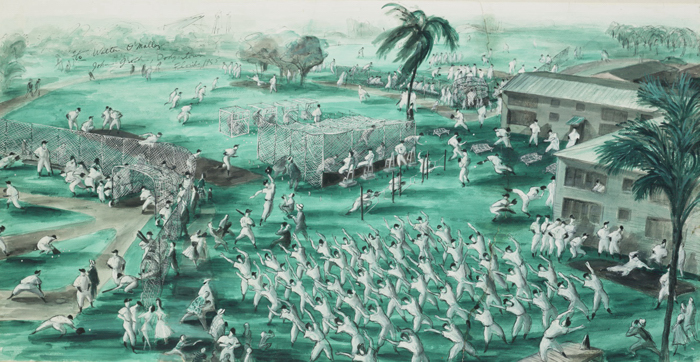
For those who remember and those who never knew, here is a short review of our history with the Dodgers and why it is such an important part of Vero Beach’s identity:
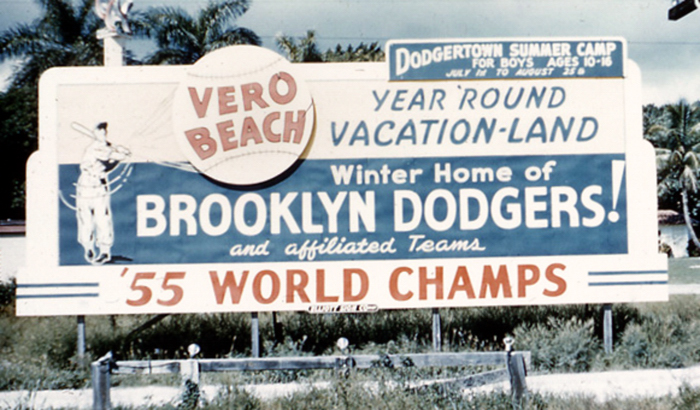
Our relationship with the Dodgers started with local businessman, Bud Holman. After World War II, the Navy returned Vero Beach Airport to the city. Holman played a large part in creating the airport back in 1929 and now he was asked to do something with the sprawling naval air training complex. He heard through a neighbor that the Brooklyn Dodgers were looking for a training site. So he contacted Branch Rickey, president of the Dodgers and one of the great innovators in baseball. Rickey then sent E.J. “Buzzie” Bavasi, (also one of baseball’s great names) down in November 1947 to check out several coastal sites, but the clever Holman never let Bavasi out of Vero.
It was an historic example of how the city and private sector worked together to achieve a shared vision of what Vero Beach could become. The resulting proposal to Rickey even included a name for the facility – Dodgertown.
Dodgertown opened for training in early 1948. Legendary figure, Walter O’Malley, became president of the Dodgers in October 1950 and the O’Malley family would own the team until 1998. Their love of Vero Beach and Dodgertown would help shape the community we enjoy today as well as major league baseball itself. A new baseball stadium was built in 1953 and named Holman Stadium to honor the man for his contributions to the team and to the city of Vero Beach.
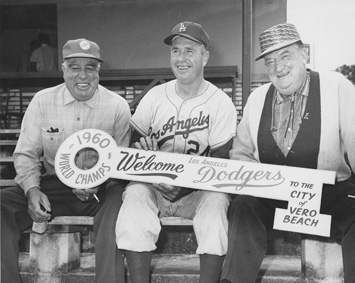
In 1957, O’Malley took the unprecedented step of moving his team to Los Angeles, building the first and finest baseball park of modern times as well as making baseball truly a national sport.
The move did not affect Dodgertown, which helped the team retain its Brooklyn fan base. Over the years, many Dodger fans moved from New York to Vero Beach because they could still see their heroes every spring.
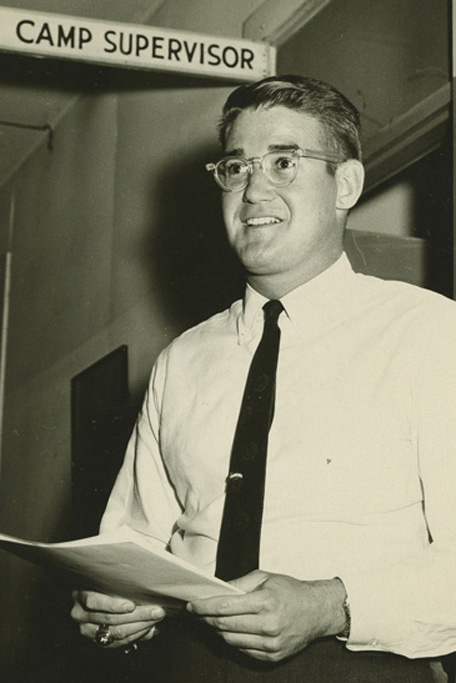
Young Peter O’Malley tells about his early experiences at Dodgertown: “I first came here in the mid-1950s to help with summer camp for 150 kids from the northeast. Then I ran the camp for two years in the 1960s.”
Peter O’Malley served as a director of the Dodgers organization for four years until becoming team president on March 17, 1970. He guided a major renovation of Dodgertown in 1972, building modern villas to replace the old barracks. The expansion continued, including clubhouses for the two golf courses. In 1977 he started the Dodgertown Conference Center and had it managed by Harrison Conference Centers.
Harrison also managed another center up north in the Poconos, where in 1978 a young businessman named Craig Callan worked. “I had just renovated the property, it was during the winter and a person staying at the hotel asked me if I would like a job in Florida. I said ‘talk to me.’ Then he asked how would you like to go work for the Dodgers? I said ‘I’m from Brooklyn, keep talking.’ So I interviewed with Charlie Blaney, who was director of Dodgertown at the time and he hired me. My first job was general manager of the conference center.”
By the way, the director of Dodgertown for nine years before Charlie Blaney was a local golfer, Dick Bird, who would go on to establish Bird Realty and serve on the County Commission.
On March 19, 1998, the Fox Entertainment Group, owned by Rupert Murdoch’s NewsCorp, purchased the Dodgers from Peter O’Malley and his sister, Terry Seidler, for more than $300 million. At the time it was the most ever paid for a U.S. sports franchise and ended baseball’s oldest family dynasty.
Craig Callan, who had been director of Dodgertown since 1988, was promoted to vice president of the Dodgers. “I was given responsibility for overseeing Dodgertown as well as all the minor league facilities in the U.S. and Dominican Republic.”
The new owners did not want to own Dodgertown, which had always been an expense to the O’Malley-owned Dodgers, never a profit maker. They were looking to either sell the facility and lease it back for a token amount or move spring training out west where their fan base was now much larger than the aging Brooklyn base back east.
It became a hot political issue, pitting fiscal conservatives opposed to using tax dollars to support a private enterprise against those who saw Dodgertown as a major tourist attraction and revenue generator as well as an important landmark of the community’s history. In the end, the county and city bought Dodgertown for $19 million and the Dodgers signed a 20-year lease to stay in Vero Beach. Compared to the deals being made around Florida and in Arizona at the time, ours was by all accounts the most taxpayer-friendly. We also now owned what was considered by Baseball America to be the best spring training complex in all of baseball.

Six years later, on January 29, 2004, NewsCorp sold the Dodgers to Boston developer, Frank McCourt, for a reported $430 million. At first, some believed private ownership meant the Dodgers would likely remain in Vero Beach. However, it was soon clear that McCourt had other ideas. Once again, we faced the prospect of losing a commercial pillar of our community.
The move was announced in 2007 to be completed by the end of 2008. The Dodgers were moving to an ultra-modern facility in Glendale, Arizona that would house both the Dodgers and the Chicago White Sox.
At issue now was the team’s responsibility to pay off the bonds, part of its contract with Indian River County. If that had taken place, McCourt would then own the facility and could have sold it to a developer to build a housing development on what many considered sacred land, destroying Dodgertown forever. The county decided to keep the historic complex.
But what would happen to Dodgertown without the Dodgers? They played their final spring training game at Vero Beach on March 17, 2008. As Peter O’Malley tells it, “When the Dodgers left and Dodgertown was shuttered, it was a sad day.”
At first there was a glimmer of hope that another major league team might come in, but the best spring training facility in all of baseball wasn’t enough incentive to lure teams looking for big dollar deals from larger communities.
Craig Callan faced a dilemma. “The new owners decided to move to Arizona and I was asked to give input on the new Camelback Ranch facility. I spent more and more time there as the departure date grew closer. They asked if I wanted to move to Arizona when Dodgertown closed and I really didn’t want to leave Vero, but I worked for the Dodgers.”
During this time, Craig’s wife Cindy gave birth to their son, Liam. “I wanted Liam to grow up here and an opportunity came up with minor league baseball.”
Pat O’Connor, president of Minor League Baseball (MiLB), was an intern at Dodgertown back in the 1980s. “He had a vision,” says Callan, “and when he saw no major league teams were interested, he stuck his neck out and decided to make Dodgertown into the first minor league spring training facility.”
The former Dodgertown was saved, but a rough road would lie ahead.
Could the Dodgertown name return to Vero Beach?
When the Dodgers left town, McCourt ordered all references to the team and Dodgertown removed as well. He robbed our community of a historical landmark and 60 years of goodwill it created. So, the new operators had to come up with a new name and establish credibility just like any startup company.
Callan had a formidable task. “I was in charge of unshuttering the facility and starting a new business. We had to rebrand it. The name Vero Beach was almost universally associated with the facility, so we chose Vero Beach Sports Village.”
Sports Village represented their need to diversify if the facility was to survive. Historically, diversification had actually began many years earlier. The addition of Harrison Conference Centers in 1977 attracted corporate business for meetings, seminars and conventions. The New Orleans Saints and other NFL teams trained there. The Adult Fantasy Baseball Camp became a staple and received considerable press. International professional baseball teams also came.
But without the Dodgers or Dodgertown, it was a different story. “We struggled,” says Callan. “No name recognition, no business, a major recession. We took our hits. In this business you can advertise all you want, but word of mouth through coaches, scouts and others in the business is the key to success. Although we kept improving, Minor League Baseball was thinking they would have to leave.”
Meanwhile, the Dodgers’ McCourt dynasty soon ended. Soon after the move to Arizona, Frank and Jamie McCourt began contentious divorce proceedings. In June 2011, the Dodgers filed for bankruptcy protection. On November 1, it was announced that Frank McCourt would be selling the Dodgers. The next day, Peter O’Malley expressed interest in repurchasing his former team.
According to O’Malley, “We took a very serious look at buying the Dodgers, but the price became bigger than we thought it would, so we passed.” (The team eventually sold for $2.1 billion.)

Back in Vero Beach, Craig Callan was searching for ways to keep Vero Beach Sports Village open. “When Peter O’Malley got wind that the facility might be shuttered again, he and his sister, Terry Seidler, got in touch with Pat O’Connor at Minor League Baseball.
O’Malley relates what happened then. “With Minor League Baseball we thought it could be a good little business, but it was tough. They had three consecutive years of losses and Pat decided his organization needed to get out. I said maybe I can help. I went to Tokyo and saw Hideo Nomo and Chan Park Ho, former Dodger pitchers who were playing in the Japanese league. They loved Dodgertown and had great memories, jumping at the opportunity to help save it. They also had important connections in their home countries.”
Nomo, Park, O’Malley and his sister, Terry, decided to become partners with Minor League Baseball, which decided to stay in for the time being. On January 20, 2012, they formed a new partnership, Verotown LLC with O’Malley as chairman. He says, “My sister and I had many great memories in Vero, but this wasn’t a nostalgia kick. We saw a parallel to McKee Jungle Gardens, a place we used to visit that also ended up shuttered. The community got together with contributors and reopened it as McKee Botanical Gardens and it has been successful. They have a great board and committed volunteers. We saw Dodgertown in the same light, important to the community and worth saving. It should be a destination the community can be proud of just as they are with McKee.”
According to Callan, “Peter wanted to preserve this facility but also take it to the next level, reinvesting profits back into facility enhancements. Be relevant, be significant, as he always says. He would be happy as long as he didn’t lose money.”
Out west, the next generation of O’Malleys decided to buy a major league team even if it they could not have the Dodgers. Two sons of Peter and two sons of his sister, Terry, decided to buy in to the San Diego Padres along with golfer Phil Mickelson and an agreement was reached in August 2012.
But Peter O’Malley, at age 75, was on a mission to save the past. His enthusiasm for Vero Beach and the great years at Dodgertown became palpable.
But it was soon tempered by a dispute with the county over lease terms. Although there were two five year options on the existing lease, the terms placed too great a financial burden on the fledgling business. Callan adds, “We had been negotiating with county staff on a new lease and agreed on most terms, but then negotiations stalled. As required, we sent a letter officially notifying the county we were not going to renew the existing lease. When it became public, the county attorney had to put it on the commission agenda as an update under county attorney matters.”
It was brought up at the March 5, 2013 meeting. “It was supposed to be an update, not a voting item,” says Callan. “But staff had not informed the commissioners about our negotiations, where we had agreed on four out of five points. When we said all profits would be put back into the facility, some commissioners said we could ‘cook the books.’”
With that comment, Callan thought the deal was dead. “The meeting went downhill from there. Don’t ever question O’Malley, who came back on his own with no financial motivation other than to save the facility.”
As O’Malley explains, “The county wanted me to pay for property insurance on the buildings and I said why should I, it’s your buildings. They also wanted me to pay for all improvements. It was too great a burden for a startup business.”
In what was supposed to be an information only meeting, a new lease was rejected by a 3-2 vote. “We were close to leaving town,” says Callan. “Why didn’t someone stop the meeting and let the commissioners know staff had already agreed to most of the changes we requested?”
Afterwards, Commissioner Tim Zorc went out to Callan’s office and found out that staff had worked out most of the new lease. He put it on the April 9 agenda. The commission then approved a new five-year lease with the changes requested by a 4-1 vote.
As of May 5, no final lease has been signed yet as the two parties work out details. However, Callan and O’Malley are confident the county will follow through on their commitments and they are moving ahead with their plans.
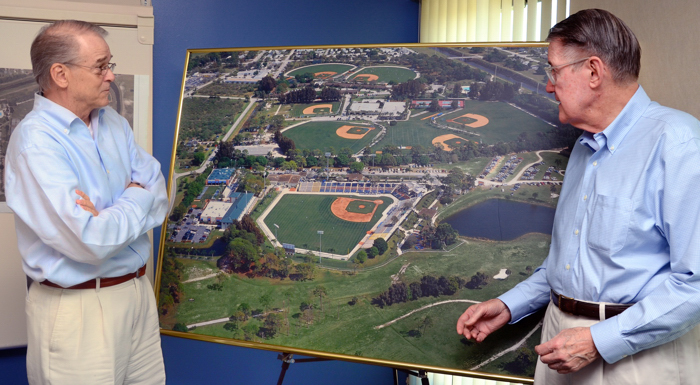
Callan says, “We were first and foremost a professional baseball facility, but now we need to be multi-sport and multi-gender. Before, no one under 14 could play on our standard baseball fields. Now we have fields with shorter base paths and pitcher’s mounds to attract those age groups. The same is true for girls’ softball. In fact, the Florida High School Athletic Association finals will be held here for the next three years. We have a multi-purpose field over by the conference center that is 110 yards by 150 yards so we can go after international soccer teams.”
In addition to baseball and softball, Vero Beach Sports Village hosts professional and college football training, soccer, lacrosse and swimming teams (in conjunction with the North County Aquatic Center).
“There is no facility like this, where a team can eat, sleep, meet, train and play all within walking distance on a dedicated campus.”
Even at this early stage, the economic impact is significant. A study by the Treasure Coast Sports Commission estimated Vero Beach Sports Village had more than a $21 million impact on the Indian River County economy between 2009 and 2012. “Just think of the players, coaches, their families and fans who come here, stay on our grounds or in hotel rooms, eat at local restaurants and spend money to boost our economy. And we are active all year. In the summer, when hotel rooms are empty, we have a tournament and fill the rooms four or five days. That is significant.”
Now, imagine what the facility can do for our local economy if it is called “Historic Dodgertown in Vero Beach?”
“That is Peter O’Malley’s goal,” says Callan. “He realizes the value of history and if we can call our facility Historic Dodgertown, it will bring that history and the role it played in Vero’s history back to life.”
Although the previous Dodgers owner ordered all references to the Dodgers removed, O’Malley has his own family collection of records and memorabilia from those golden years, and is planning to create a museum at Historic Dodgertown, if and when the name change becomes reality.
Minor League Baseball will stay until their lease is up in May 2014, at which time the new five year lease takes effect. “We will still have a working relationship with them,” says Callan. “For instance, we will continue to hold the umpire school. We may look for another partner in the venture, possibly someone local. This is too historic an asset to the community for it to fail.”
Callan and O’Malley have many great plans going forward. They want to make Dodgertown relevant again. Of course, to many of us it has never been irrelevant.
 Indian River Guardian