
The Indian River County Commission yesterday adopted the state model fertilizer ordinance which it had earlier rejected last August.
The Indian River Neighborhood Association, among other organizations, supported County Attorney Alan Polackwich’s recommendation that the Commission adopt the state model fertilizer ordinance.
The blight of the Lagoon, including critically high levels of nutrients, essentially created a mandate for the Commission to act, Polackwich said in his memo of recommendation. According to Polackwich, because the Lagoon is now considered an impaired body of water, given high levels of pollution and loss of seagrass and marine life, the Commission was compelled by state law to act.
The Commission accepted Polackwich’s recommendation, and in doing so was the last local government to pass the ordinance, following Vero Beach, Sebastian and Indian River Shores.
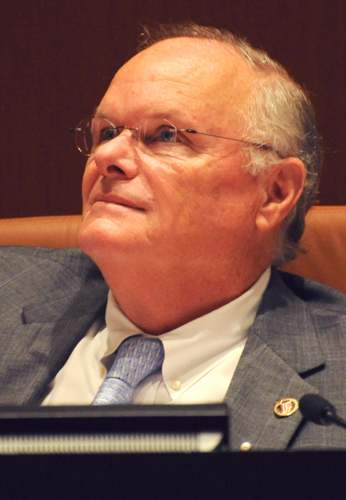
Strongly opposed by Commissioner Bob Solari, the ordinance had earlier be rejected by the Commission. Though Solari had argued the fertilizer ordinance would be ineffective, unenforceable and a government overreach, he joined his fellow commissioners yesterday in adopting it.
The state’s model ordinance is intended to reduce nitrogen and phosphorous levels in the Lagoon.
A second Commission vote on the ordinance must be held no sooner than 10 days after yesterday’s vote, so the ordinance will likely not go into effect until late August.
Indian River Neighborhood statement:
The Indian River Neighborhood Association supports the County Attorney’s recommendation that the Board of County Commissioners adopt the Florida Department of Environmental Protection Model Fertilizer Ordinance with a few suggested additions appropriate for this County that are consistent with the Model Ordinance.
As the County Attorney points out in his Memo of Recommendation, the fact that the Indian River Lagoon is now listed as nutrient impaired, serves as a mandate for action by your Board. Furthermore, the findings at the Workshops held during the past six months by both Harbor Branch Oceanographic Institution and your Board presented overwhelming evidence of the need now to undertaking actions to restore the Lagoon’s water quality.
The Model Ordinance addresses several important steps in managing the contribution of deleterious fertilizers to the Lagoon. Primary among these are the requirements for commercial applicators of fertilizers to be properly trained and certified in their use. While this important requirement meets an IRNA priority, we suggest that your Board consider taking an extra step by establishing a county-sponsored certification/education program at the County’s Institute of Food and Agricultural Services, associated with the University of Florida. This would be a cost-effective way to provide this training because this agency is already prepared to assist and educate nursery and landscape professionals.
We suggest that in addition to Florida Rule 5E-1.003(2) and the references to “UF/IFAS recommendations” regarding the application of nitrogen or phosphorus, that there be specific limitations within the Ordinance consistent with the above references about the amounts of phosphorus and nitrogen that may applied. For example, regarding the application of phosphorus it would be useful to state, as provided in the aforesaid Florida Rule, a limitation of no more than one-quarter pound per 1000 square feet per application or 0.50 lbs per 1000 square feet a year. Specific information such as this would greatly help all applicators of fertilizers to understand exactly what is required.
We also urge you to adopt a meaningful enforcement provision. For guidance we refer you to the provisions found in the Pinellas County ordinance and to the penalties in the County’s Tree Protection Regulations. Special attention must be given to enforcement, not only to an adequate code but also to ensure that there is a dedicated enforcement staff. Without that the adoption of requirements such as those in this proposed new regulation will not help the dire situation we face.
The IRNA strongly recommends that the County take the parallel step of preparing and widely distributing an educational flyer which advises about slow-release fertilizers, the proper timing of applying fertilizers, and other critical information.
A total approach to managing the application of fertilizers is needed to save the Lagoon for pollution from this source.
In summary, the IRNA considers the adoption of an Ordinance such as is proposed to be an important first step.
 Indian River Guardian
Yes, if we can’t blame Bush for algae blooms and dead seagrass in the Lagoon, we can always point the finger at Bob Solari.
Mark, you’re always approaching from the “positive,” aren’t you?
Did Solari not oppose the fertilizer ordinance until doing so became unavoidable? Pointing out that face is not to blame him for the condition of the Lagoon.
It’s not as if the publication you work, Vero’s Voice, accentuates the positive. The current issue includes a bigoted and blister attack on Humanists.