
COMMENTARY
MARK SCHUMANN
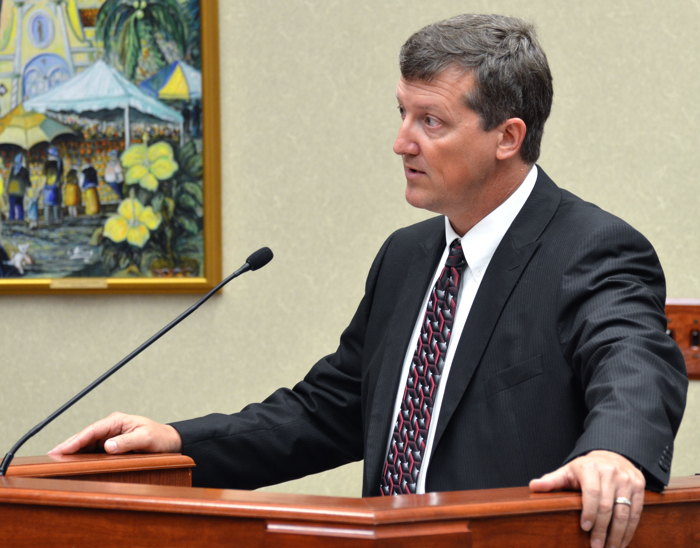
In the fall of 2009, utility activist Dr. Stephen Faherty was presenting financial models developed by utility activist Glenn Heran projecting the city would net as much as $156.5 million on the sale of its electric system.
In an October 8, 2009 interview, then City Council candidate Charlie Wilson said Vero Electric would sell for $150 million. After paying off $60 million in debt, the city would have $90 million in cash to invest, Wilson said.

Neither Wilson’s, nor Heran’s calculations accounted for, or anticipate any cost to terminate a $2 billion, 20-year agreement with the Orlando Utilities Commission. Though the OUC contract did not go into effect until January 2010, the agreement was signed well before the fall of 2009.
Heran has said the financial model projecting net sale proceeds of $156.5 million was just one of several he developed. It was, however, the only model Faherty included in an email sent to then City Council candidate Ken Daige in October 2009, when he sought Daige’s support for the sale.
Wilson’s and Heran’s 2009 models also do not account for the cost of paying a qualified party, such as the Orlando Utilities Commission, to assume power entitlements and debt service obligations Vero Beach has with the Florida Municipal Power Agency.
All of these OUC and FMPA contracts existed at the time Wilson and Heran were overlooking what arguably adds up to a $64 million to a $94 million price tag for extricating the city from these obligations, including $54 million in cash.
In an email to Inside Vero associate editor Milt Thomas, Wilson took exception to our commentary on his October 2009 interview with Mary Beth McDonald. Wilson wrote, “In your effort to spin the truth you neglect to tell people that my statement was made before we entered the OUC contract and before we found out that the $50,000,000 million dollar Vitunac penalty was hidden in the contract.”
In fact, the contract was signed months before Wilson’s interview with McDonald. Apparently, Heran and Wilson developed their projections assuming there would be no cost to the city for canceling a 20-year wholesale power agreement. They also seem to have concluded the city could walk away scott-free from its FMPA contracts.
What Wilson described as “the Vitunac penalty” of $50 million, is, in fact, a liquidated damages charge of $20 million. Further, there is no evidence the provision has former City Attorney Charlie Vitunac’s fingerprints on it.
In his email to Thomas, Wilson implied the City’s pension deficit has thrown off his October 2009 estimate of the value of the deal to the city. “The answer to what happened to the $90,000,000. Answer, It was lost and hidden by former City Councils who got us in one bad contract after another including OUC which has cost us over $50,000,000. Add that to the pension deficit and other past mistakes it proved my point. What happened? It is going to massive debt, penalties and mistakes made by staff and elected officials who are not qualified to run an electric utility.”
In fact, pension costs and pension deficits are separate issues. These costs are not being paid out of Florida Power & Light’s cash offer of $111.5 million, which just happens to be $38.5 million less that the $150 million value Wilson placed on the system when he ran for a seat on the City Council in 2009.
Rather than using cash proceeds from the sale, which will likely amount to just $4 million or less, the city plans to boost its pension funds by drawing on some of the $30 million in electric system reserve that will be unencumbered when and if the deal ever closes.
Wilson may well be right that the city should find a way out of the power business. But anyone who embraced that idea also believing the city would net $90 million to $156.5 million in cash from the sale may well have placed their trust in financial models that missed the mark.
Now, the same utility activists who greatly over estimated the direct financial benefit to the City of selling Vero Electric are calling for what can only be seen as a monumental political gamble.
Any talk of taking up arms against the FMPA, so to speak, just as the city seeks to persuade the FMPA to join in constructive engagement may not be the wisest strategy.
As FPL attorney Patrick Bryan told the City Council July 16, “FMPA has stated publicly it will work with all parties on this transaction to insure the deal can get done…That commitment will need to be honored in order for this deal to close.”
That Wilson and Heran would expect the FMPA to consider making concessions while the city is talking of launching a multi-front assault on its very existence is beyond reason.
As utility activists urge the council to mount a political and legal challenge that would surely be long and expensive, it is important to remember that Just because someone speaks as if they are never in doubt doesn’t mean they are always right.
 Indian River Guardian
The damages clause in the contract was agreed to mutually, so if Orlando had to back out, we’d be paid, as well. That’s how long-term multi-million dollar contracts are done, but unfortunately these financial “experts” who’ve been leading the city astray have ignored a great many realities.