
Editor’s Note: Yesterday, I delivered the message at First Presbyterian Church. As one congregant left the sanctuary, she suggested the tone of the sermon I offered was similar to my writing for Inside Vero. I had thought otherwise, but in as much as the meaning of any message ultimately rest with the receiver, I can only assume the woman is right. And so, I decided to post a redacted version of my “sermon” as a column.
MARK SCHUMANN
 Just as every nation meaningfully engaged in the community of nations fields a diplomatic corps, every religious tradition benefits from both sending and receiving ambassadors.
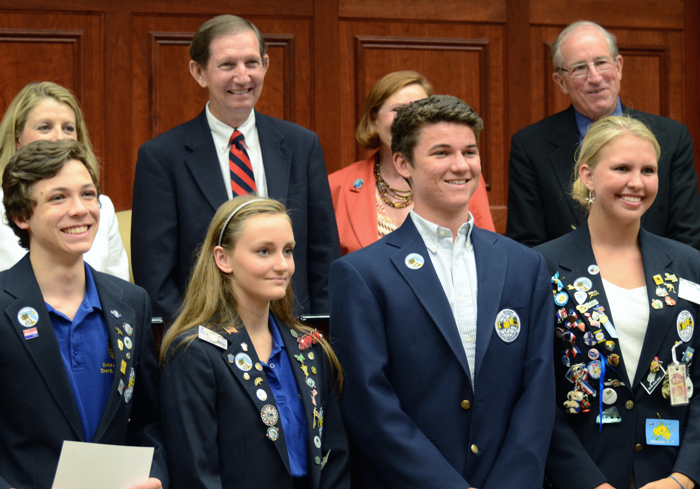
I was considering the value of cross-cultural experiences recently, as I wrote a cutline for a photograph of four local youth who will leave next month, quite literally, for the four corners of the world.
As Rotary Youth Exchange Students, they will spend their senior year of high school abroad, living with and learning from persons who’s cultural, philosophical, political, and perhaps even religious traditions are quite different from their own. When these youth exchange students return home next summer, their lives, and the lives of those they touch over the next 10 months, will be forever changed.
One of several books I’ve been juggling lately is by Thomas Merton, a trappist monk of some renown for his writings and reflections on the value of interfaith dialogue. Merton, who died in 1968, was one of Western Christianity’s more effective translators and ambassadors.
I imagine Merton in conversation with Vietnamese Buddhist monk Thich Nhat Hanh, who wrote, Living Buddha, Living Christ. Each having journeyed some distance from their respective base camps, they have pitched pup tents together and are warming themselves by a campfire. Taking turns tossing twigs into the flame, Merton and Thich Nhat Hanh share from the depth of their own experience of the peace that passes all understanding.
Be clear about this: Neither Thomas Merton, nor Thich Nhat Hanh, nor any centered, grounded, purposeful ambassador of politics or religion surrenders his citizenship for the sake of diplomacy and dialogue, but they do ultimately perceive themselves as citizens of the world, as well as of their home country, or their religious tradition.
My journey, or wanderings if you will – has taken me, not to ashrams in India, but to a Presbyterian seminary, and from that three-year respite of study, to the rough and tumble of real life in the parish, where the dogmas, ideologies and philosophies offered in the academy were, at least for me, often of very little practical use in addressing the every-day struggles of congregants, many of whom seemed to be as gerbils caught on the treadmill of their daily lives – and aren’t we all.
While I cherish and remain grateful for the opportunity I was given to study for three years at the feet of professors with brilliant minds and radiant hearts, people like Walter Bruggeman, Benton Klien, and Wade Huey, I confess that I have since wandered from the base camp they established that is Columbia Seminary. This path has been one not plainly marked by patches of brightly colored paint on tree trunks, or clear road signs, or even breadcrumbs.
Over the years since I left parish ministry I’ve found myself in monasteries, yoga centers, and places like Omega Institute. Every time I’ve been willing to set up camp in that open field out beyond right-doing and wrong-doing and religious dogma, I’ve met fellow seekers who have drifted, or strayed, or purposefully distanced themselves from their religious, or spiritual, or philosophical homes.
While attending an event at the Kripalu Yoga Center, titled “Awaking the Buddhist Heart,” and fellow participant asked me if I didn’t, as a Christian, feel somewhat out of place at Kripalu. “Hardly,” I replied.
And then I explained to her how the Hindu salutation “Namaste,” meaning, “I honor the light of the divine in you, just as I honor it is me,” sounds to me quite similar to a verse from the New Testament. “Do you not know that you are God’s temple, and that God’s spirit dwells in you?”
One of the books that has been most helpful to me is, The World’s Religions, by Houston Smith, first published in 1958. “If you take the world’s enduring wisdom traditions at their best, you get the distilled wisdom of the human race,” Smith writes.
Smith, who remained centered in his Methodist Christian faith throughout his life, offered several suggestions about how we might engage in constructive discourse about religion and philosophy.
First, Smith said, we can choose to see one religion as superior to the others, but he doesn’t advise it. Anyone who follows politics in Vero Beach knows what that looks like.
Second, we can see all religions as being on an equal footing. The danger of this approach is that we tend to distill and homogenize the essential beliefs of each religious tradition. In doing so, we drain each tradition of the distinctive and unique contributions they can make to interfaith dialogue.
Third, we can appreciate what is unique about each religious tradition, trusting that God’s spirit blows where it will, and that deep truth just might be found where we least expect it.
We can see each tradition, like stained glass, turning the same sunlight into a rainbow of colors.
From my own experience, which is all I can really share, I would offer three principal insights gained from inter-faith dialogue.
In one way or another, every religion and wisdom tradition teaches the values of humility and charity, and establishes a baseline for ethical conduct. In his book, Ethics For a New Millennium, the Dalai Lama wrote, “My religion is kindness.”
Many years ago, while participating in a seminar on ministry to people in business, I was sharing some of what I had recently read in the Dalai Lama’s book, “The Art of Happiness At Work.” Apparently I contributed more than my share, because the professor, in a somewhat testy tone, suggested that much of what the Dalai Lama teaches is “kindergarten level” wisdom. Immediately, I thought of Robert Fulgham, who wrote, “All I Really Needed To Know I Learned In Kindergarten.”
Taken in whole, as well as in part, the world’s wisdom traditions encourage us to see ourselves as belonging to a larger, interdependent whole. Things are more integrated than they may seem. Fortunately for humanity and for our planet, there may be a growing awareness of this truth. This teaching, of course, is not new. Diogenes wrote, “I am not an Athenian or a Greek but a citizen of the world.”
Rub elbows with, or even go so far as to make camp with those of other faith traditions, and you may well be reaffirmed in the fundamental goodness of creation. Things are, quite possibly, better than they may seem. Byron Katie reminds of this in her book, Loving What Is. There is a deep and profound harmony in creation that resonates at a frequency to which we may not be attuned.
There is perfection in decay we may not appreciate. There is creativity in destruction we may be incapable of discerning just as dust clouds are rising and the walls of our own little worlds are tumbling down around us.
Finally, by appreciating more fully what other religious traditions have to offer, we might very well be led to a deeper awareness of the profound mystery of God.
Some Christian theologians speak and write and teach as if they are so certain of their knowledge of God that they can tell you the exact altitude of heaven and the temperature of hell. I prefer them to struggle with the ambiguity in this definition of God: “Thou before whom all words recoil.”
The world is, after all, more mysterious than it may seem. The comedian Red Skelton knew this to be true when he said, “How little do they know how little they do know.”
Deepak Chopora said, “The world is not only stranger than we know. It is stranger than we can know.”
When we set aside certainty long enough to participate in interfaith dialogue, with our priority not on persuasion but on discover, we are gifted with a deeper appreciation and experience of Oneness, Goodness and Mystery.
 Indian River Guardian
“Finally, by appreciating more fully what other religious traditions have to offer, we might very well be led to a deeper awareness of the profound mystery of God.”
Mark, that is so beautifully and truthfully said.
In politics we tend to label one another with words like Liberalism or Conservatism, Progressive, Hard Line Leftist, or Right Wing Wacko, Democrat, Republican, or Libertarian, a Greenie or a Red, meaning Communism and the list goes on.
I guess too many folks are doing the same with Religion as they seem to be doing with politics. Seems like a lot of folks are trying to label us with religiosity according to the way they see it and that is not possible, nor is it right to do so.
I agree that we should be appreciating all religious traditions as we journey towards the mystery of the Almighty.