
MILT THOMAS
Rolf Bibow has had more than one lifetime worth of experiences. At age 83 He is now retired and living a well-earned life of leisure here in Vero Beach. Rolf has never been one to sit around and think about all those great memories or sit around at all. So why bring those experiences back to life?
“On the 50th anniversary of the Korean War, I was interviewed on public radio about my experiences in the war. I had to make notes, which led to my thoughts on the war itself. I didn’t realize it then, but I had begun writing my autobiography.”
Bibow’s life story is certainly worth retelling here. He was born in the U.S. of Norwegian immigrant parents, Carl Franz Bibow moved here as an adult and Elsa Lee came to the U.S. as a young child. It was during the Great Depression and Rolf’s parents were struggling, so the family moved back to Norway. Rolf was one year old.
“When I was nine, the Nazis came. Life was brutal then. They would starve and frighten us to keep control. But a resistance developed and at the age of 13, I was approached by the Norwegian underground to deliver messages. I was small for my age and could slip through places where adults couldn’t. One time I received an urgent message warning of an ambush. I was sent with two other boys to deliver it. I got through and the other two were never heard from again.”
For his wartime efforts, at age 15 Bibow earned an audience with King Haakon VII. “He patted me on the head.”
In a country where summer is defined as bad skiing weather, Bibow was invited to join the Norwegian ski team in 1947. But then he was unexpectedly called up for military service – in the U.S. “I probably could have avoided it, but I wanted to come back to America.”
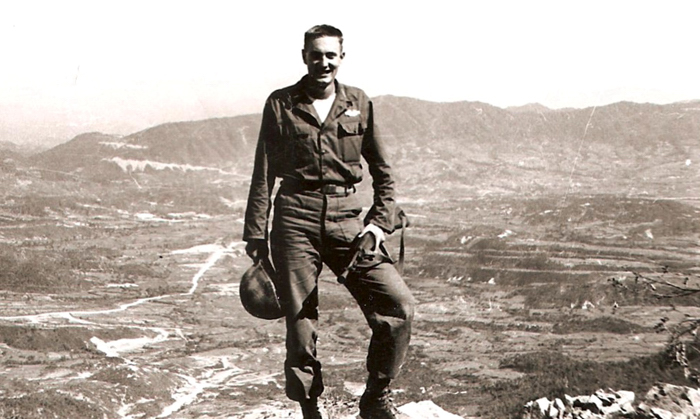
After joining the service, Bibow went to Oregon State College for two and a half years majoring in engineering and ROTC, then was called up to active duty in late 1951. “I had airborne and ranger training and was sent immediately to the Korean front.”
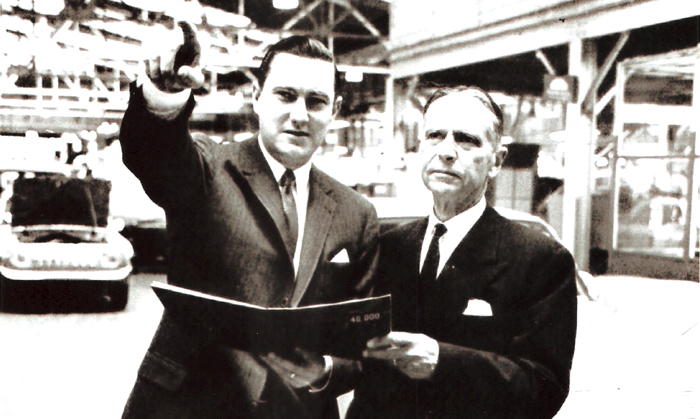
Over the next 14 months Bibow was wounded three times and returned to the States in April 1953. “I enjoyed my military experience and American friendliness, which I found unusual because Scandinavian people are more stand-offish. So I finished college at Oregon State on the G.I. Bill and went to Columbia University Graduate School in business administration, finishing in early 1956, then went to work for Ford Motor Company.”
Bibow met his future wife, Frances Adele Lowe at Columbia and they married in early 1957. “I went to Ford in Detroit as a trainee, but soon told my superiors I wanted a better job. So they sent me to Sweden. Fran and I spent two years there and had our first child. Then Ford asked me to go to Norway, where we had our second child. After that I went to Denmark, back to Norway and then Sweden, where we had our third child.”
After 12 years at Ford moving up the ranks, he was hired by farm equipment giant Massey-Ferguson as head of European operations in the U.K., then promoted to head of worldwide operations. In 1974 Bibow went to United Technologies. After several other positions, he decided to retire in the late 1980s. “Fran had multiple sclerosis, which had advanced and she needed to move to a warmer climate. We ended up in Vero Beach.
“I had been interested in children’s issues for some time and the new minister in our church wanted to reach out in the community, so I proposed mentoring kids. We put together a program that won some awards and I was contacted by Judge Paul Kanarek to start a children’s services council.”
As Fran’s condition worsened and required more of his attention, Bibow withdrew from his activities. They moved from the barrier island to Indian River Estates where they live now. “About a year ago, I was asked to give presentations on world affairs at Indian River State College and that led to a course I now teach called “Great Decisions.”
But let’s go back to bringing all his life’s experiences back to life. “After writing about the Korean War, I then wrote about my business career and raising a family, then about my community service and Fran’s worsening condition. It was all done over a ten-year period.”
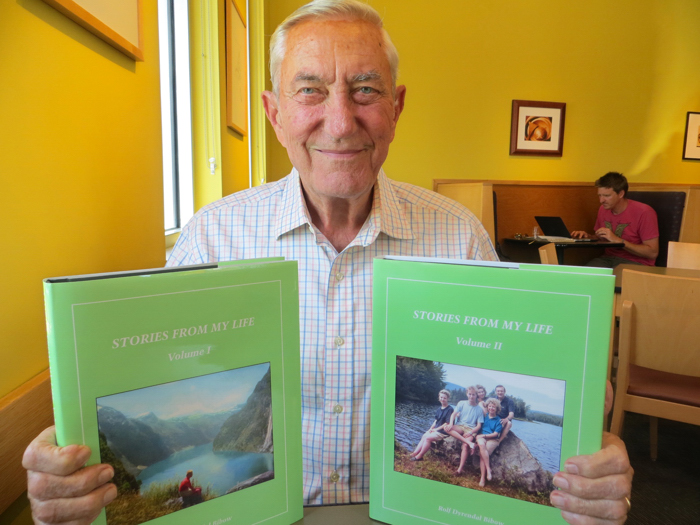
The result was Stories From My Life, Rolf Bibow’s autobiography. First of all, people often confuse biography and autobiography. An autobiography is written by the subject, a biography is written by others about the subject.
Many people talk about writing their life story, but few actually do it. So how did Bibow develop his interest in writing?
He credits a professor in college as his first inspiration, Bernard Malamud, Pulitzer Prize-winning author who wrote The Natural (made into a movie starring Robert Redford). “When I first came back to America I did not speak English very well,” says Bibow, “so I was told to take ‘bonehead’ English. Malamud taught the course and inspired me, creating in me a sense of using language in a way that becomes personal.”
Bibow’s fascination with language, his love of reading and love for the process of writing all conspired to influence his desire to chronicle his life. Of course, some would say living a life like his might be inspiration enough to write, but those are probably the same people who talk about writing their own life story and never get around to it.
In the not-to-distant past, you had two avenues for publishing a book. If you were good enough to be discovered by a traditional publisher, you might wait two years before your book appeared on bookstore shelves. The other option was self-publishing through a “vanity” publisher who would print up your book, collect a fee, then hand it over to you for the marketing. Your chance of success would be minimal.
Today, it is more difficult than ever to land a big time publishing contract, but easier than ever to get published. Many novices as well as experienced authors today take advantage of technology to create bookstore-quality books in quantities from 12-200. The process is called print-on-demand (POD) publishing. You write the book, then pay to have it printed, but in small quantities, not in thousands. You can give it away to family and friends or try to sell it on Amazon.com or through your local bookstore.
Rolf Bibow’s book is only for family and friends and was printed in two handsome volumes. He used publishing technology now available to anyone to print a quality book for a reasonable price.
Of course, you do have to write the book first.
 Indian River Guardian
I am so very proud of my father! He passed away in 2019, and I am so grateful that I can still read this article and think of him. He was an amazing man!