
GUEST COMMENTARY
PETER GORRY

In some years past to raise funds for charity a vehicle was parked on a frozen lake and wagers were made on when the thaw would sink the machine. Times have changed.
Lakes and waterways in the northern climes have a major problem, opposite to ours, with runoff from salt and other road materials spread during the winter. Clearly there is a hiatus of fertilizer use in the winter months and many municipalities and urban areas filter effluents being discharged; and some invasive plants do not survive the temperature.
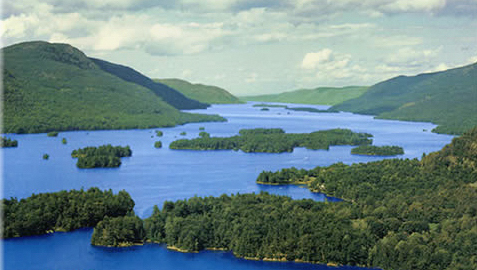
New York was successful in cleaning up the Hudson River and the harbor. Cleveland removed pollution from its Lake Erie waterfront. A major project is focusing on Lake George to ” …create a new model for predictive preservation and remediation of critical natural systems on Lake George … and ultimately around the world”.
This is a collaborative effort of IBM, RPI and the FUND for Lake George. The partners plan to use a combination of advanced data analysis, computing and data visualization techniques, new scientific and experimental methods, 3-D computing modeling and simulation, and historical data, expecting to gain an unprecedented scientific understanding of the Lake. The combination of these predictive capabilities will enable scientists and the community to prioritize and act before permanent degradation can take place.”
“The Jefferson Project”, an homage to his declaration of Lake George as “without comparison, the most beautiful water I ever saw” aims to establish one of the world’s most sophisticated lake environment monitoring and prediction systems, giving scientists and the community a real time picture of the health of the lake”. The project is privately funded and does not rely on the Corps of Engineers.
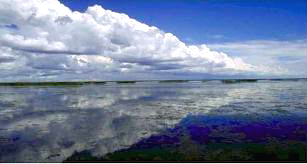
Lake Okeechobee is 15 times greater in area than Lake George, but has less than 2 times the volume of water. The latter flushes in 8 years unimpeded by human intervention. In contrast, Lake Okeechobee is constrained by a dike, dam, and locks and connected to manmade canals; its out flow is manipulated by man. The elegant “River of Grass” – the Everglades – its ecosystem, endangered species, wildlife, elegant tropical forested canopies, and grasslands is being impeded by thousands of acres of sugarcane.
In Florida the concentration was on sustaining growth of agriculture and development, as well as flood control. In New York the focus has been on preservation and nature; Much of George is surrounded by park land, and upstream and downstream flows are carefully monitored. In South Florida, the Everglades – unique in the world – are endangered as humans have engineered flowing contaminants east, west and south from the lake in addition to accelerating the toxic effluents from the northern watershed.
Both east and west coasts of the state, the Everglades and the longest Lagoon on earth are being degraded, polluted and slowly spiraling to a swirling demise.
Acclaim for New York, shame for Florida.
Quotes are from the Rensselaer Fall Alumni Magazine; Mr. Gorry is a graduate.
 Indian River Guardian
In every election we need to support and elect candidates who care enough about our lagoon to refuse campaign contributions from the big sugarcane growers. Before you vote, ask if they have accepted money from the sugarcane growers. We need to start there.