
PRESS RELEASE
The Environmental Learning Center hosted an education event called UpClose & Ecological that was specifically geared towards locally elected and appointed officials, as well as candidates. The program was held on Nov. 1, 2013 on the ELC’s 64-acre island campus in Wabasso.
The purpose of the event was to emphasize the natural functions of the Indian River Lagoon ecosystems, demonstrate the interconnections between the lagoon and land, and encourage political decisions that preserve these natural resources while inspiring personal stewardship in our citizens. This year’s theme focused on the fact that public officials have more opportunities to influence change than most of us.

Columnist for Scripps Treasure Coast Newspapers, Eve Samples, opened the event by telling participants how to be effective environmental leaders. She ended with a video clip of her son looking directly in to the camera saying that he was going to tell everyone about the harm to the lagoon where he lives.
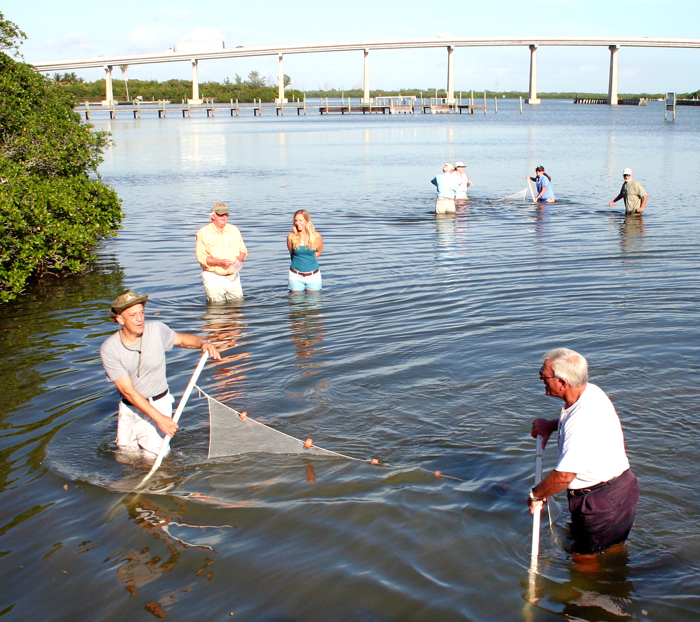
Participants rotated through three different stations: the greenhouse where they potted up mangrove propagules and signed a pledge to change one behavior for the benefit of the lagoon; the ELC’s “floating classroom” pontoon boat excursion; and, the teaching platform, where participants waded in the water and used seine nets to examine the biodiversity of the lagoon.
The beauty of the day, complete with sightings of dolphin, manatees, pipefish and birds, allowed participants to forget momentarily about the devastation. Most citizens in the lagoon region, however, are familiar with all of the problems facing the lagoon. These problems did not just arise. They have been long in the making stemming from the mistreatment of the lagoon. Scientists call that our “legacy load.” This is the cumulative effects of everything that humans have done over time to the Indian River Lagoon starting back with our earliest widespread draining efforts in the 1920s.
Public officials have more opportunities to affect environmental change than most. They can influence change through their public capacity with legislation, ordinances, land acquisition, and allocating funds for education. At the same time, they can influence change by being role models in their private lives. In UpClose & Ecological, ELC Education Director Heather Stapleton challenged participants to lead by example. She said, “Whether at home or at work, lead with every decision you make. Your decisions are surrounded with much more transparency these days thanks to social media and technology.” To illustrate that point, she noted that several participants had already been posting to social media sites throughout the morning. She then asked, “What are you doing to help the lagoon?”
 Indian River Guardian