
MILT THOMAS
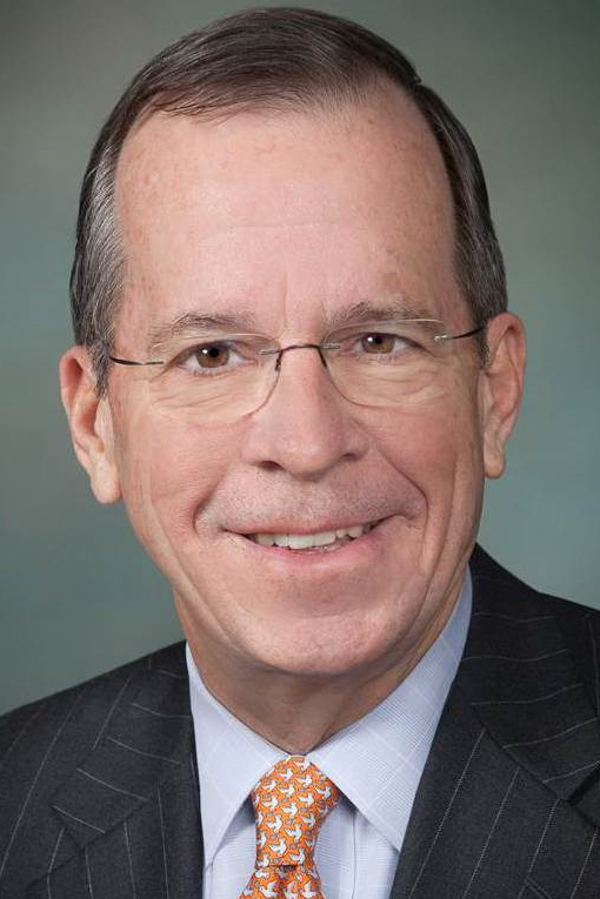
Admiral Mike Mullen, former chairman of the Joint Chiefs of Staff, spoke with InsideVero on December 12. He will present the first program in the 2014 Emerson Center Celebrated Speaker Series, appearing January 18.
Admiral Mullen’s Naval career spanned 43 years, including three warship commands, as well as commanding a Battle Group and the U.S. Second Fleet. He served in four different four star assignments (only the third in U.S. history to do that) as Vice Chief of Naval Operations and Allied Joint Force Command Naples from August 2003 to August 2004, Commander, U.S. Naval Forces Europe from October 2004 to May 2005 and then two terms as the 17th Chairman of the Joint Chiefs of Staff, the highest ranking officer in the U.S. Armed Forces and the president’s principal military advisor.
Since 2011, when he stepped down from the Joint Chiefs, he has gone through the advanced management program at Harvard Business School. Admiral Mullen currently serves on the General Motors and Sprint boards of directors. His combination of military and business experience gives him a unique perspective on national security from an economic standpoint and he leaves no doubt where he stands on the issue and sees economics as the key to all our relationships in the world.
“We have tried to foster relationships around the world where economies, especially big ones, are going to drive outcomes. In 1969, my first tour of duty in the Navy years ago took me to Hong Kong, where I saw a family of 14 living in a tin hut by the pier. It was my first exposure to the haves and the have nots of the world. That family, like most in the world, simply wanted to raise their kids to a higher standard and in a peaceful environment. I’ve kept that in mind throughout my career. Economic engines are critical to achieve those goals, especially in the U.S., the largest economy in the world. We need to be linked to economic outcomes in other parts of the world and if our economy isn’t strong, our national security can’t be strong. Right now, the greatest threat to our future is our huge debt.”
Admiral Mullen adds, “I am delighted to see that the deficit is better this year, but we haven’t done anything about reducing our overall debt. We have to start turning that around or we’re not going to have choices and we’re not going to be competitive as a country. I worry about that for my kids and grandkids.”
We discussed Vietnam, where Mullen served in 1969-70 and I just visited last month, encountering Typhoon Haiyan while there. According to Mullen, “I was on a destroyer at the DMZ (Demilitarized Zone) supporting the army and marines on shore,” says Mullen. “I went back to Hanoi in 2007 to help support their navy for things like typhoons. It was an incredibly emotional visit for me, especially since we were right in the middle of the Iraq war at that time. Vietnam still has huge challenges, but they are taking care of their people. That assured me things could become better in Iraq even though it may take another 20-30 years, and I am hopeful that will be the case.”
The philosopher-writer, George Santayana wrote one of the oft-quoted truths, frequently attributed to others, “Those who cannot remember the past are condemned to repeat it.”
Admiral Mullen illustrates that point. “When we went into Iraq and Afghanistan, we did not pay attention to the lessons of Vietnam, nor did we integrate them into the future. Our military thinking as well as the rest of the world was still dominated by the Cold War, which required a different kind of capability. However, once we figured it out, we adapted very quickly. I credit our Special Forces, who figured it out more quickly than anyone else. Still, we need to know more about the culture and languages of other countries so we can meet future challenges understanding other peoples’ perspective, not just our own.”
As to Iraq, Mullen says he is often asked about our role there and whether it helped or hurt. “It is too soon for a final judgment. That will be written by history.”
He feels with the increasing sectarian violence in that part of the world, no one can know where it will end up. As far as the future of Afghanistan, Mullen says, “It is hard to predict what will happen because there are many complexities, elections in April and Karzai has been a difficult interlocutor. I worry that without a presence there, we will really be challenged on the counter-terrorism front and on the training of Afghan forces. I think their forces are better than most people give them credit for, but it is hard to see what will happen if we are not involved. Without our $4 billion a year financial commitment in Afghanistan, their future is really in question, maybe insurmountable.
“Pakistan is another major challenge. It is the most dangerous country in the world. I’ve spent a lot of time on that and believe in engagement and having a relationship. But with 180 million-or so people, a difficult economy, an internal and external terrorist problem, there are many hurdles. The key to that whole region is for Pakistan and India to unlock disputed Kashmir. It is a complex alignment, complex individuals and a rich history that we don’t understand as we should.”
Admiral Mullen was with President Obama during the operation last year to kill Osama bin Laden. “That operation was the highlight of my career as chairman of the Joint Chiefs. For me it was a culmination of the changes and efforts made since that tragic failure to rescue hostages from Iran in 1980.
“What most people don’t know, is that the same night everyone was focused on bin Laden, there were 14 other similar operations going on simultaneously in Afghanistan. None were more risky strategically, but some were riskier in terms of terrain and the enemy at the point of attack. I had great confidence in the Navy Seals though and they were all successful.”
As to 9-11 itself, few people experienced the attacks closer than Admiral Mullen. “I was in the Pentagon that day and remember when the plane hit the building like it was yesterday. I still think the world changed at the moment of those attacks and at the time, had no idea where it was going to lead. But we started making investments immediately to respond.”
Admiral Mullen does not think killing bin Laden provided him with a sense of closure. “It wasn’t foremost in my mind. But my wife and I spent a lot of time with families who lost loved ones in the wars that followed 9-11, so I know his death was an important moment of closure for them.”
As to our future as a nation, what keeps Admiral Mullen awake at night? “Three things. First and foremost is our debt. I believe we’re going to keep digging this hole until the American people get fed up. Second is our k-12 education system. If we don’t fix that we won’t be competitive. Third is the political paralysis we are in. I believe the American people will eventually get the right people in office to make the right political decisions so we can move forward. I am optimistic about that. I just hope we don’t come to a real dramatic, tragic point that gets everyone’s attention. I do worry about that.”
On another subject, Admiral Mullen comes from a show business family, far from the military career path he chose. “Dad was a journalism major in college and his first job was as a publicist, traveling on the road with Gene Autry. He met my mother when they both worked at Republic Studios. When I was growing up, Dad was always careful to bring home only the positive things about his job and industry. As we all know, there’s plenty of negative things. What I learned from him was how to communicate. I watched him do things that would create messages to change perceptions. Throughout my career I always engaged the press, wanted to answer my mail and send the right messages to the American people. Most of all, I learned from my father responsibility, integrity and taking care of people.”
Admiral Mullen is affable, approachable, and sure to be a fascinating speaker when he comes to Vero on January 18.
 Indian River Guardian
I find it rather ironic for a military man to be considered about the national debt when Pentagon spending is a large portion of that debt. According to the non-partisan Project on Government Oversight it is military spending that is the greatest source of waste, fraud and abuse in the entire Federal budget. This is due to a large extent with the government contracts that are awarded to major corporations in this country who heavily invest in the lobbyist firms that surround the Pentagon.
There have been several independent studies conducted about Pentagon contracts and there is general consensus that a Pentagon contract results in costs to the taxpayers that can be as high a five time more than necessary.
Our national debt will never be addressed until people acknowledge that corporate welfare in the form of such things as Pentagon contracts is the reason for the size of the debt.