
ED TAYLOR
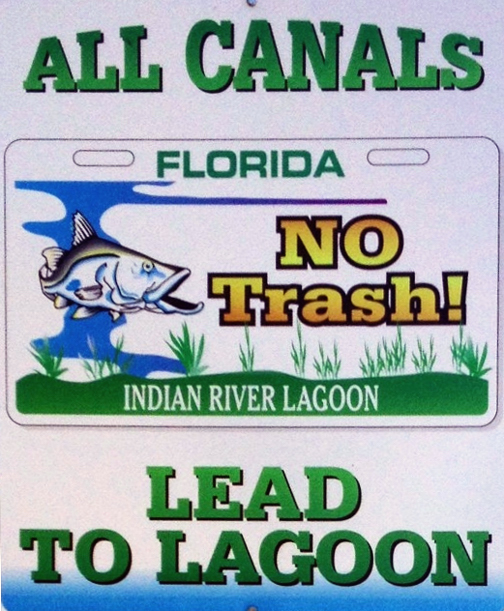 To what extent, if any, are septic tanks in Vero Beach creating nitrogen and phosphorus intrusions into the Indian River Lagoon which in turn feed a flowering algae that is killing sea grass vital to the survival of marine life in our river? Septic tanks are ”the elephant in the room”, according to Mayor Dick Winger, who indicated the answer is still unknown. However, the cause of pollution in the lagoon is of great concern to the city and answers are being sought.
Depending on the level of pollution created by septic tanks in Vero Beach, Rob Bolton, Director of Water and Sewer for the city, has prepared a plan to deal with the potential problem. Since the lagoon stretches across 40% of Florida’s East Coast, Vero Beach is not alone amongst municipalities dealing with attempts to determine the cause or causes of this pollution.
Bolton has been working with Edith “Edie” Widder, of the Ocean Research and Conservation Association (ORCA) in Fort Pierce., The Indian River Lagoon Counties Collaborative has been established so that representatives of all affected counties can work together to find answers. According to the St. John’s Water Management District, the total estimated annual economic value of the lagoon is $3.7 billion, supporting 15,000 full and part-time jobs and providing recreational opportunities for 11 million people per year.
The University of Florida’s Institute of Food and Agricultural Sciences (IFAS) estimates that a single family residence, with four occupants and reliance on a septic tank, on a 1/3 acre parcel of land contributes 36 pounds of nitrogen annually into the ecosystem. Septic tank effluent is also a source of phosphorus and other bacteria potentially causing lagoon pollution.
Based upon Bolton’s studies there are 2,962 septic tanks in the Vero Beach city service area creating the equivalent of .74 million gallons daily (MGD) of wastewater. That compares to 27,505 septic tanks in the county creating approximately 6.88 MGD of wastewater. Bolton lists other factors that could be the source of the pollution including fertilizer concentration in storm waters, plant decomposition and animal decomposition or wastes. Bolton’s study stated that“septic systems work fine for properties that are 1 to 5 acres in size. It is not the septic system that is that the problem. It is the density and proximity to surface water.”
The study suggests four potential remedies for merging the septic tanks into the city sewer system. The system of focus for the Vero Beach study calls for a septic tank effluent pump (STEP) which is currently being used successfully in nearby Palm Bay, in Brevard County and Port St. Lucie, in St. Lucie County. Based upon the report, this system has been utilized successfully in Florida for approximately 40 years. Other types of sewer/septic resolutions include what is called a “gravity”sewer system, which is typically installed at the time of building construction. Bolton also mentions two other systems known as “vacuum” and “grinder” which are effective but also require higher installation and maintenance costs compared to the STEP system.
The major benefits of the STEP system, based upon Bolton’s report, include its successful implementation in nearby communities, a similar maintenance cost to gravity sewers as well as providing the lowest upfront cost of sewer availability. For the homeowner, the installation cost would be comparable to replacing a faulty septic tank.
Bolton estimates the cost to merge a single septic tank to the sewer using the STEP system to be approximately $9,950, which would be paid by the property owner. That estimated cost includes the purchase of the STEP equipment necessary to make the transition, installation of the necessary electrical and plumbing connections as well as necessary building permits. The consumer cost, based upon the study, also includes $2,290 as an impact fee. Bolton also states that additional costs could be incurred depending upon the structural integrity of the individual septic tank.
Mayor Dick Winger has stated that the restoration of the Indian River Lagoon to a healthy state is his number one priority for this year. Should ongoing studies show that Vero Beach septic tanks are a contributing factor to lagoon pollution, Winger stated that in order to couple existing septic tanks to an existing sewer system, the city would have to pass a resolution that would require the approval of the state legislature since current state law does not allow such a merger of wastewater systems.” The work is not finished yet to understand the problems,” the mayor said.
Bolton’s study, however, does provide potential solutions should it be determined that septic tanks in Vero Beach are a contributing source of lagoon pollution. All parties tend to agree that lagoon pollution is of primary concern to the community and efforts to identify and resolve the problems should be pursued with all due diligence. They also tend to agree that it appears to be a time consuming, ongoing process without expectation of immediate solution.
 Indian River Guardian
Another alternative is the use of proven nitrogen reduction septic systems. For a few thousand dollars, nitrogen levels from septic systems can be reduced from 50% to 75% while improving the overall performance of the system at the same time. Sewers are not always the best or most cost effect answer.