
ED TAYLOR
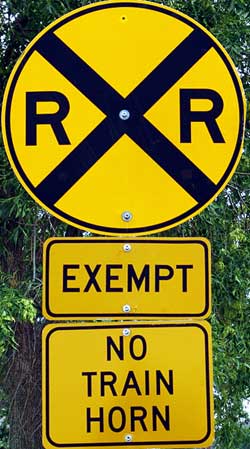 With the All Aboard Florida high speed railroad planning up to 32 daily non-stop high speed trips through Vero Beach beginning as early as next year; the city is seeking state assistance in funding seven requested “quiet zones” at an estimated cost of $3 million. As such, the Vero Beach City Council has approved a resolution making a formal request seeking state funds to help the city with the project.
The privately owned railroad has planned hourly departures beginning at 6:00 AM and ending at 9:00 PM departing from Miami and Orlando with each train passing through Vero Beach at speeds estimated at between 105 and 110 miles per hour. The trains will not be stopping in Vero Beach but has planned stops in Fort Lauderdale and West Palm Beach. Rusty Roberts, a vice president of Florida East Coast Industries which owns All Aboard Florida, has stated that the estimated travel time from Miami to Orlando is approximately three hours.
According the Federal Railroad Administration rules train horns must be sounded in a standardized pattern of 2 long, 1 short and 1 long blast at a minimum of 96 decibels and a maximum level of 110. The federal rules require that the pattern must be repeated until the lead locomotive or lead cab car enters the traffic crossing. The rule does not stipulate the durations of long and short blasts.
The city is seeking to establish seven quiet zones within an estimated distance of approximately 2.3 miles. Based upon the federal rules “in a quiet zone, railroads have been directed to cease the routine sounding their horns when approaching public highway-rail grade crossings. Train horns may still be used in emergency situations or to comply with other federal regulations or railroad operating rules. Localities desiring to establish a quiet zone are first required to mitigate the increased risk caused by the absence of a horn.”
Although the high speed railroad is privately owned, the municipality or party requesting the quiet zone is responsible for extensive modifications to each rail crossing where the absence of the train horn noise is requested. One such safety alteration would require all railroad crossings within the zone to have four warning arms. Crossings that currently have two warning arms would be required to upgrade to four.
City Attorney Wayne Coment told the council that the proposed resolution is similar to a resolution recently adopted by the City of West Palm Beach requesting state assistance in funding their quiet zones. West Palm Beach is seeking state assistance for the approximate $22 million it will cost to create quiet zones for their 39 rail crossings. There is no indication that the state will contribute to any municipality for the creation of quiet zones.
Roberts, while addressing the Vero Beach High Speed Rail Commission, said that his company will provide the necessary modifications to the railway system within the city in order to accommodate the yet to be built high speed trains. The All Aboard Florida executive told the advisory council to the city council that his company could do the work to make the crossings quiet zone compatible but it would be at the city’s expense. He added that his company could also make recommendations of other qualified contractors who could create the necessary modifications at the requested railroad crossings.
The Vero Beach resolution states that due to the closeness of the rail crossings in the city, the required train horn soundings before each crossing would result in “essentially a constant unrelenting blowing of their horns throughout the entire length of the City of Vero Beach”.
Roberts estimated that there would be two trains passing through Vero Beach hourly during the times of transit and it would take between “60 and 75 seconds” for each train to pass through the city. He also stated that each rail crossing would be closed to traffic for at least 45 seconds by the safety measures prior to the arrival of the high speed train. He said the trains are expected to reach their peak speed of 125 miles per hour while traveling west between Cocoa and Orlando.
Monte Falls, the director of public works for the city, told the advisory panel that the county and state have been providing maintenance for the city crossings but added “if we ask for improvements to the crossings, we are responsible for the costs”.
All Aboard Florida expects their rail service through Vero Beach to commence in late 2015 or early 2016.
 Indian River Guardian
Vero Beach requested the railroad intersections. The city is responsible for the repairs and maintenance done to those intersections and is billed and pays maintenance fees based on repairs made by the railroad company.
The city has long standing (agreements) with the railroad company. A question remains – will the contracts change with the new upgrades the railroad is doing?
The revenue source for these maintenance and repairs is the city general fund budget.
Why in the world are taxpayers required to pay for the costs of remedying something a private company is making money off of? I am sick of corporate welfare!