
COMMENTARY
MARK SCHUMANN
By publishing a one-sided and deeply opinionated “news analysis” story titled, “New electric deal needed in time for August referendum,” the editors of Vero Beach 32963 again this week failed to report the fuller story of why the current deal may be headed for the paper shredder.
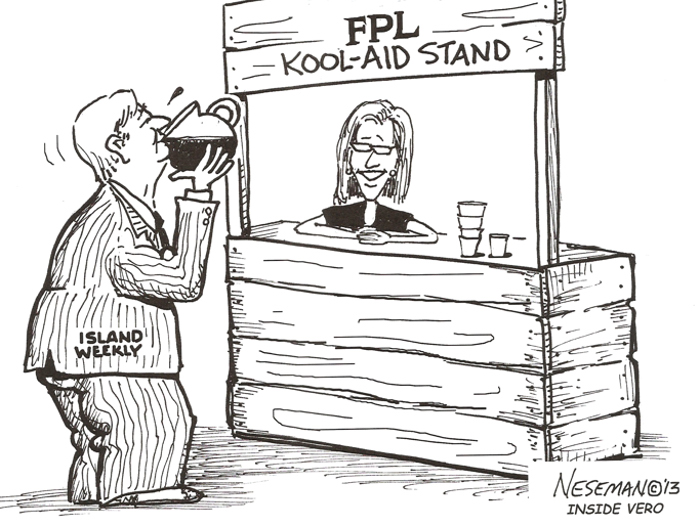
Reporter Liza Zahner and her editors continue to focus on the fact that Florida Power & Light is unable or unwilling to pay the price the Florida Municipal Power Agency has placed on absorbing excess power it does not want or need. The island weekly editors do not seem to want their readers to know that the Orlando Utilities Commission’s offer for taking on the power is also unacceptable to FPL.
Broader public awareness of that “inconvenient truth” would make it difficult for FPL and their local surrogates, including 32963, to continue placing blame on the FMPA for a deal that was fatally flawed from the beginning.
By joining FPL and local utility activists in peddling the notion that Vero Electric’s 34,000 current customers should have to “pay for past mistakes” through a surcharge, the island weekly is essentially siding with FPL’s public relations team. What they are passing off as “news analysis” is nothing but propaganda.
Given the apparent cooperative relationship between the island weekly and its FPL sources, Zahner’s “news analysis” does provide, at least, a window into what FPL’s strategists are thinking. What they appear to be leaning toward is a proposal to amend the sales contract to provide for a surcharge on the city’s 34,000 electric customers. If FPL sources were behind the island weekly’s story, they are clearly signaling that the deal is dead as structured.
What FPL does not seem to be open to is looking for ways of holding the deal together while enabling the city to do what can be done now to lower rates. Why? If the city were free to renegotiate with the OUC for lower wholesale power rates, and at the same time moved to decommission the power plant, there would always be the possibility Vero Electric’s rates would fall to within range of FPL’s, especially given FPL recent rate increases. The last thing FPL wants is to see public pressure for the sale to dissipate.
Nowhere in the Zahner’s “news analysis” does she mention that Vero Beach 32963, along with the Press Journal, urged voters last spring to approve a sales contract that some argued was grounded in little more than wishful thinking and could never be executed as written. Further, some who opposed the contract placed before voters last March, (Richard Winger and Jay Kramer would not sign the agreement.) were concerned that the City has never done a serious study of the potential of a partial sale.
With a contract allowing for a closing as late as Dec. 31, 2016, the 22,000 customers of Vero Electric located outside the city limits are stuck paying higher rates much longer than they would if the City and FPL could negotiate a partial sale.
In her signature one-sided style, the island weekly reporter Zahner wrote, “Councilwoman Pilar Turner has called Vice Mayor Jay Kramer’s dream of a partial sale ‘absolutely destructive’ for the City of Vero Beach. No analysis has been put forth to prove her wrong.”
Zahner did not also tell her readers that Turner has yet to present thorough analysis disproving Kramer’s claims that the City could operate a smaller electric utility more efficiently.
All along, the fundamental flaw in the island weekly’s editorial position has been its persistent urging that the City negotiate with both feet set in hardened concrete. Is Vero Beach 32963’s biased reporting and “editorial wisdom” to be trusted now?
By fixating on getting out of the power business, rather than pressing for lower rates, the City has and may continue to pass up opportunities to lower rates sooner rather than later.
For example, a change in territory agreements would enable the City to sell its Indian River Shores Customers to FPL. A broader partial sale may also an option. Forming a utility authority is another possibility that should at least be on the table. Enabling FPL to avoid the high cost of offloading Vero Beach’s Stantion I and Stantion II power between now and January 2018 by delaying the closing may also enable to deal to go forward.
Sticking it to ratepayers in the form of a surcharge, when there are others options, is no way to run a utility.
 Indian River Guardian
I am sorry to correct your heading but it should read “Vero Beach electric’s customers WILL have to pay and pay and pay and pay to keep power deal on track with the multi billion dollar FPL.
I think we should stop focusing on the corporate power plants and look into solar energy. The prices have come down so much in the past few years that we can completely get off the backs of electric companies and get free power for our houses and cars that will pay for itself in 10 years.why do we want to continue to be slaves to the power companies?
No sir! NO SURCHARGE! Don’t even think about it, COVB. If FPL wants it, let them pay the price – not us!