
MILT THOMAS
With the recent Vero Man excavation and annual Thunder on the Beach Pow Wow, attention has focused lately on the first Americans. After all, when Columbus “discovered” America in 1492, it had been long inhabited by millions of people organized into 500 or more nations, whose ancestors discovered America many thousands of years earlier.
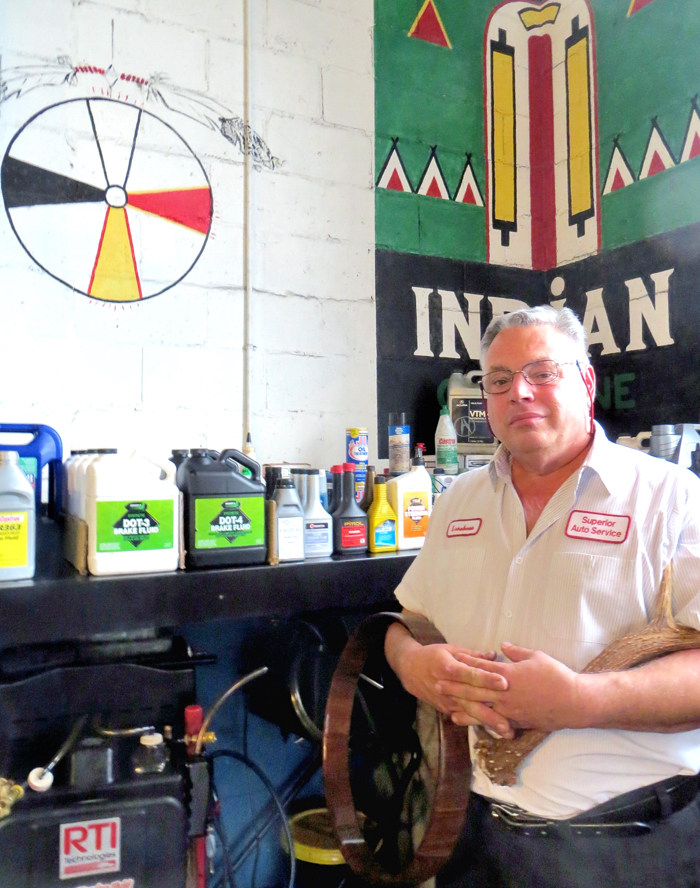
Today, most of these Native American people can be found on reservations around the country, but the rest of them live among us, even here in Vero Beach. Bill Marion, owner-operator of Superior Auto Service on 23rd Avenue, is “more than 90 percent” Cherokee Indian. His successful business has operated at that location since 1987 and most of his customers had no idea of his heritage despite graphics displayed around the shop that advertise it. Only a year ago, Marion started stitching his tribal name – Lonebear – on the front of his company shirt. There is a reason it took so long.
“Long-standing prejudice against Indians forced many generations of us to keep our true identity hidden,” he says, “but before the prejudice was fear.”
He is referring to a time in history when “Indians,” a name given to them in error when Columbus thought he had discovered a route to India, were driven nearly to extinction. “My grandparents in the late 1800s were forced as children into a boarding school in Carlisle, Pennsylvania.”
Carlisle was one of many such schools that were established to forcibly assimilate Indians into the predominate culture. “My grandparents’ experience there was enough to suppress their true heritage, even to their own children.”
Marion was born in Washington D.C. and he recalls a trip to Florida as a youth. “Our car broke down in South Carolina and a farmer came over to help us. My mother turned to me in the back seat and said, “Don’t you dare tell him you’re an Indian.”
His parents’ mixed blood was enough for them to hide in plain sight. “Mixed blood” is a term that describes the large majority of Native Americans, even those on the reservations. According to Marion, an ancestor 200 years ago is the only known white man in his family lineage. It was enough to give him features that surprise most people when they hear of his true identity, but less surprising once they know it.
Marion’s father did not know the fear his parents felt, but nevertheless, “I never learned anything about my racial and cultural heritage until I became curious as an adult and began investigating.”
That investigation was both external and internal. “I always had great marksmanship ability from the time I first fired a rifle and my father would tell me it was because I was Indian. But he never explain further. I loved to be next to nature in the woods and seemed to know how to move silently, to track animals.”
Marion says it is in his DNA, “like a housecat knows how to catch a mouse when he is two months old. Hunting was survival for my ancestors.”
As to his tribal name of Lonebear, Marion says, “You don’t pick your name, it is given to you by a tribal elder. I was from the bear clan, brother to the bear.”
Animal clans are part of traditional Native American culture and the Algonquin name for clan has been Anglicized as “totem.”
The day I visited Marion at his shop, there were at least a dozen cars lined up, waiting to be serviced. Whatever his ancestry, his business thrives because he is an excellent mechanic.
Speaking of Algonquin, another Vero area resident is Sister Judy Charles. “I was born on a reservation in the Kinsua Valley of Pennsylvania in 1935. It was a gorgeous place, almost untouched. But the government built a dam and we were moved to a reservation in Salamanca, New York.”
Charles (her maiden name though she is married), moved to Vero in 1955 and bought a lot in what was then rural south county, “for $10 down and $10 a month. My husband and I built our home, just the two of us. I lived off the land and only ventured into downtown Vero once in a while for some groceries.”
She says the only meat she ate in those days was what she caught. She also describes vegetarians humorously as “lousy hunters.”
Her family history is very similar to Bill Marion’s, except growing up in her traditional tribal culture equipped her with skills and lessons that still play an important part in her life. She wears her heritage as a badge of honor and regales anyone who listens with stories about every aspect of tribal life. “I was raised by my grandmother and then from the time I was 17 and for the next 37 years, I took care of her.”
Charles says she had five grandmothers alive at one time when she was a little girl. “Our people married young, so I learned from four generations of grandmothers.”
That strong bonding sheltered her from many of society’s injustices, so those experiences are simply woven into the fabric of her fondly remembered life story.
Both Marion and Charles have stories to tell for those willing to listen, and these days, as we await the revelations sure to come from the Vero Man excavation, many more people are willing to listen.
 Indian River Guardian
So glad there are surviving natives of this continent. Even if their ancestors migrated from somewhere else, it is likely they were here before the Europeans. If I’m not mistaken, this coming Thursday (2/13) Willie Johns, Seminole Indian historian, will speak at Emerson Center, 27th Ave & 16th St, at 7pm – subject: “Unconquered Seminole People & Traditions”.