
MILT THOMAS
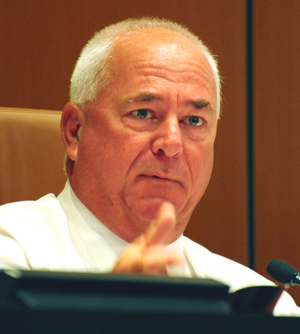

That would seem to be the direction at their February 4 meeting. Although not on the agenda, Susan Mehiel, representing the American Coalition for Property Rights (AC4PR), made a presentation to commissioners that asked why they continue to remain in the Treasure Coast Regional Planning Council (TCRPC) after dropping out of the Seven50 plan.
As to definitions of these organizations, the Treasure Coast Regional Planning Council is a not-for-profit organization created by local governments to provide planning and technical assistance services and assist in carrying out Florida’s growth management programs. It was established in 1976 through an interlocal agreement between Indian River, St. Lucie, Martin, and Palm Beach counties. Membership includes all four counties and 50 municipalities.
The AC4PR that Mehiel represents, on its website indicates it supports more than property rights. The organization is also opposed to Seven50, Common Core, Agenda 21 and more . The AC4PR motto is “Your key to unlocking the chains of tyranny.”
In her presentation, Mehiel cited Obama (“redistributing our wealth”), liberals (“running city’s coffers dry”), and regional planning groups (“regional governments bypass local governments using multi-county tax budgets”). She urged commissioners to convince Sebastian officials and citizens to follow their lead in dropping out of the Seven50 (originally seven southeast Florida counties and 50 municipalities getting together to map out a strategy for the future regarding quality of life issues).
Commissioner Solari, who is known to support many of the AC4PR principles, immediately commented that Mehiel made “very, very good points,” and found a number of things very troublesome, a word he used repeatedly.
High on his list of concerns was the Treasure Coast Regional Planning Council’s formation of a new Gubernatorial Committee to lobby the governor, thus, according to Solari, “reinventing” itself into a lobbying group. He added that it was the state’s responsibility to reinvent them, not theirs. “We should consider the propriety of our remaining in the Regional Planning Council when a stated objective is to bypass us.”
Solari and Commission chairman, Peter O’Bryan, are both members of the Treasure Coast Regional Planning Council.
Commissioner Davis then added his dissatisfaction with the Regional Planning Council because, “During the economic downturn every government body had to cut back but they didn’t.”
Commissioner O’Bryan, who is also Chairman of the Regional Planning Council, then addressed Solari’s comments regarding the gubernatorial committee. O’Bryan stated that the Gubernatorial Committee members are governor’s appointees and for the most part, businesspeople.
He explained that at the last legislative session, both houses approved two million dollars to research lagoon pollution, which this county commission supported. The governor then vetoed the funds. He said part of the reason the Gubernatorial Committee was formed was “to go to Tallahassee and convince the governor that the research money is critical to the overall health of the Indian River Lagoon, a mandate supported by all county commissioners.”
He added that, “If Commissioner Solari is opposed, that’s fine, but I am not opposed to trying and convince the governor of the importance of that research to this county and the region.”
O’Bryan went on to defend the Regional Planning Council on this issue and also working together regarding the impact of All Aboard Florida coming through the Treasure Coast with financial impact but no benefit to residents. “If four counties can get together, that’s a good thing,” he said, adding that on common issues, “two million people have a better chance of success in Tallahassee than 15,000 (the number of Vero Beach city residents who would bear the cost of railroad crossing upgrades). Addressing Ms. Mehiel, O’Bryan said he understood some of her concerns, but a lot of them are “a little bit overdone.” He added that we can agree on some things as a region but that doesn’t mean we have to agree on all things.
Solari then addressed Chairman O’Bryan and said, “You misunderstood something I said. I am absolutely not against research on the lagoon. I’m against the Treasure Coast Regional Planning Council changing into a lobbying group.”
He also said that we didn’t need a Regional Planning Council on any of these issues because it is the job of this county commission. Then added, “I don’t appreciate it when you continually turn something I said into something I did not say. I am not against research and I don’t like the way you twist my words.”
O’Bryan had disagreed with Solari’s criticism of the Gubernatorial Committee going to the governor, not questioning his support of research funds.
Commissioner Joe Flescher then commented that Commissioner Solari made valid points and went on to enumerate them. Commissioner Zorc also agreed with Solari on issues with the Treasure Coast Regional Planning Council.
Then a local resident, Althea McKenzie, spoke to the Commission about the importance of maintaining our relationship with the Planning Council, saying, “Four commissioners have participated in it, (former) Commissioner Wheeler was chairman, Commissioner Flescher was co-chair. There was a relationship and participation at some point, so we need to find out what is so horrible, is it real or a fear we are creating. That’s not what leaders do.”
Flescher then pointed out how they came up to do a presentation on the Seven50 program and that some information on the screen did not accurately portray what was being said.
Solari added that we are still members, but pointed out how he was removed from the budget and planning committee because of his stand on Seven50. After a year, he asked to be reappointed and was told he didn’t have the leadership qualities.
O’Bryan countered with, “It was your leadership of the association I had issue with. I don’t believe a member of an organization actively trying to kill or withdraw from that organization should be in a leadership position.”
Solari then said he had only objected to the Seven50 plan at this point.
The meeting ended soon after, but the controversy will likely continue.
 Indian River Guardian
I am not quite up to speed on all this, but what I can tell you is that all the top ranked state in education use common core. The state of Mass. where my kids went has been using it for years and is ranked #1 in math, and science and a state like Mississippi that does not use it is ranked 50th.
John, the beauty and blessing of our federalist system of government is that people who want the experience of living in a Third World county can move to a state that is heading in that direction.
Milt is right that the “controversy will likely continue.” It should because a small minority wants this community to reverse course and return to the 19th century while the majority want to be a part of the 21st century. The AC4PR should provide the citizens some explanation as to what are the “chains of tryanny” that they see that are not visible to the community as a whole.
Has anyone actually seen this thing that some call a “multi-county budget” or know what percent of the Indian River County budget has been allocated to such a proposition?
I am also curious about this alleged “liberal” who has run the “city coffers dry.” Who, what, where and how was this alleged to have been done?
Perhaps it would be useful to put on the ballot the issue of participation in the Seven 50 planning group since this is the only accurate way to determine what the true will of the people is in regard to this issue.
I’ll be the first to admit understanding what is going on in any of our governments (City, County, Florida) usually has me befuddled and confused……since it doesn’t take much. I am curious to know – is this the same County Board of Commissioners who voted money to hire a LOBBYIST to go to Tallahassee and shoot holes in the FMPA? I guess “United we Stand–Divided we Fall” is a sometime saying used when it suits somebody in this Country. Treasure Coast counties have some of the same problems – seems to me working TOGETHER would be a big plus. Or, we can just let paranoia overtake us, draw our heads into our shells and go our own way……
planning is what well built much of vero as we know it. one can go to city hall and see what they planned and look at exactly where the alma lee loy bridge is today was planned back in the 50’s.i do prefer local control over issues as much as possible.
I agree, Jason, the ideal way to plan a community is locally. What I can’t figure out is how is this done when, for example, the county wishes to take over the municipalities and even is paying a lobbyist to work against one of its cities. Then we have the high-speed train possibly running right up through the Treasure Coast counties without stopping but making big noise a couple of times an hour and closing railroad crossings for those brief but numerous runs. Then we read that Tallahassee folks might allow Dade & Broward Counties to have Las Vegas-style casinos (those high-speed trains would come in handy for transporting gamblers from Orlando to those casinos). And we read that a big Las Vegas casino owner has contributed money to Gov. Scott’s reelection campaign – as has the Seminole Tribe–who have gambling interests in FL. While local government worked pretty well in the past with careful planning, it doesn’t seem like it has much control over outsiders. It has to react to what is beyond its own control. With Treasure Coast Counties working together, maybe there’d be more political muscle to prevent those outsiders from taking over. The lagoon runs along the Treasure Coast and is a problem to be resolved by all of us. It just seems that some of our locals are working against us. Maybe they are being backed by big money from somewhere else. I don’t know.