
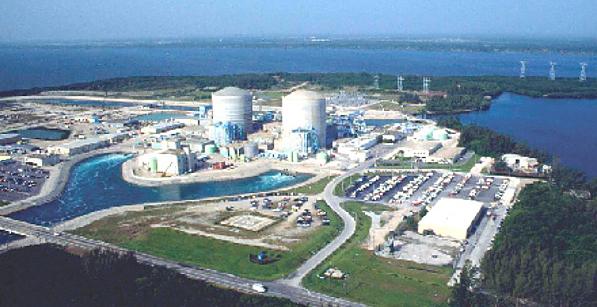
Editor’s Note: A report published in the Tampa Bay Times Saturday raises serious and troubling questions about maintenance issues at Florida Power & Light’s St. Lucie nuclear plant. Times reporter Ivan Penn’s wrote of problems with cooling tubes at the plant, problems which could result in catastrophic financial losses.
After struggling to resolve problems with its Crystal River nuclear plant, Duke Energy finally closed the facility and, with Florida Public Service Commission approval, passed much of the multi-billion dollar cost on to its customers. Duke Energy is now one of the highest cost energy providers in the state.
A number of critics of the proposed sale of Vero Electric to FPL have suggested that the company, which no longer has the lowest bills in the state, is equally vulnerable to the kinds of problems that have driven up costs for Duke Energy customers. The following are two story by Times reporter, Ivan Penn, revealing FPL’s problems with its St. Lucie facility and a second story on calls from Florida legislators for an investigation.
Cooling tubes at FPL St. Lucie nuke plant show significant wear
IVAN PENN/TAMPA BAY TIMES
Yet another Florida nuclear plant may be in trouble.
More than 3,700 tubes that help cool a nuclear reactor at Florida Power & Light’s St. Lucie facility exhibit wear. Most other similar plants have between zero and a few hundred.
Worst case: A tube bursts and spews radioactive fluid. That’s what happened at the San Onofre plant in California two years ago. The plant shut down forever because it would have cost too much to fix.
FPL says its plant is safe, the rate of wear is slowing and its customers’ multibillion-dollar investment in the plant is not in jeopardy.
“The bottom line is, these components are functioning within their requirements, and if they weren’t they would be removed from service,” said Michael Waldron, an FPL spokesman.
FPL is so confident in St. Lucie’s condition that it boosted the plant’s power. The utility acknowledged that will aggravate wear on the tubes, located inside steam generators.
Critics say that’s like pressing hard on the accelerator, even when you know the car has worn brakes.
“The damn thing is grinding down,” said Daniel Hirsch, a University of California at Santa Cruz nuclear policy lecturer. “They must be terrified internally. They’ve got steam generators that are now just falling apart.” MORE…
Related story:
St. Lucie nuke plant tube wear problem prompts calls for investigations
IVAN PENN/TAMPA BAY TIMES
Lawmakers and consumer advocates on Monday called for investigations into whether the St. Lucie nuclear plant in South Florida is safe and whether ratepayer money was used appropriately to boost the reactor’s power.
The questions came a day after a Tampa Bay Times story detailed how tubes inside the steam generators that help cool the reactor had abnormal amounts of wear.
The Times report also prompted a former U.S. Nuclear Regulatory Commission engineer to say that federal regulators aren’t using the right criteria to measure the damage. Until they do, the plant cannot be declared safe, he said. MORE…
 Indian River Guardian
Thank you for posting this relevant information.
WOW, lots of misnformation and conjecture in that those articles. The NRC is the toughest federal agency out there, accusations that they are being lazy or inattentive don’t add up in my mind.
Additionally, the engineers at Nuclear plants who are directly involved in the safety of the plant’s operation are tough to deal with. You cannot push them around and if they feel pressured to allow anything that they feel uncomfortable with, they only need complain to the NRC inspector on site and he has the authority to step in and bring the full force of the NRC to bear on the plant.
These articles read like typical “jouralist” tripe, and are full of the essential ingredients: scare tactics, misinformation, conjecture and innuendo.
Think about this: virtually every engineer employed at the plant lives and makes his families’ home in the vicinity of the plant. A dangerous plant threatens his family as much as it does anyone else. Most of us dont realize, until we work in the industry (as I have been since August of last year), the layers of inspections, approvals, reviews and regulation that go into a nuclear plant’s daily operation. It is an industry like no other.
And FPL fires engineers and managers who try to run a safe plant, [see stories on fired employee who refused to power up the reactor when a safety issue was present] so I guess it’s live there and keep quiet or do your job and get fired. That is not a comfort.