
COMMENTARY
“Squared against the truth, Zahner’s number of $205 million is off by at least $30 million. If the island weekly’s reporter had done some basic fact checking before misinforming her readers, she would have realized the $30 million FPL was to pay the OUC has always been a component of FPL’s $179 million offer. At least on paper, FPL’s latest offer is now down to $175 million, and just as the company is asking the customers of Vero Electric to kick in another $26 million.”
MARK SCHUMANN
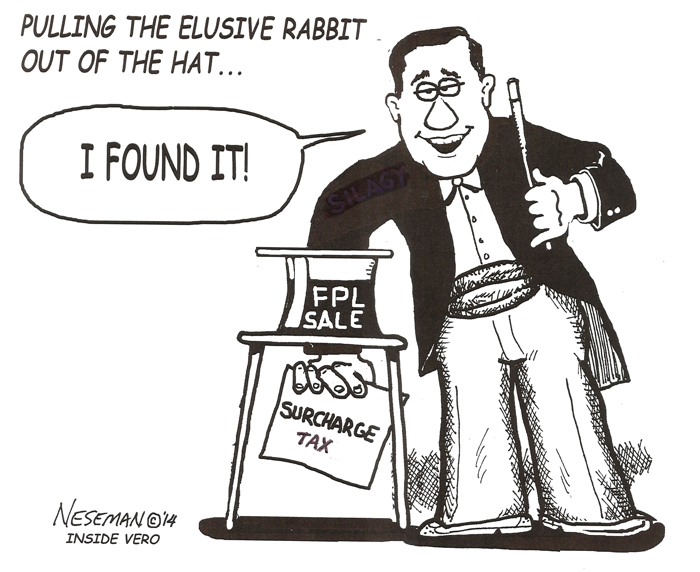 Referring to Florida Power & Light, the company with whom the City of Vero Beach is supposedly negotiating and arm’s length transaction to sell its electric system, City Councilman Craig Fletcher once said, “They’re like family.”
From the time Fletcher, along with Tracy Carroll and Pilar Turner, decided to forego an open, competitive bidding process, and instead made it the official policy of Vero Beach to sell its electric system to FPL, negotiators for the City have been at a disadvantage in seeking to strike a deal that is fair to the residents and taxpayers of Vero Beach.
As Vero Beach 32963 continues to try to justify and support a deal that has gone from bad to worse, the newspaper’s editors and reporters have resorted to tortured logic. They seem increasingly challenged to report the truth about the latest turn south in the negotiations.
In a “news analysis” story published this week, Vero Beach 32963 reporter Lisa Zahner greatly mischaracterized the impact of FPL’s latest offer on the company’s bottom line. FPL now says it will contribute half of the $52 million the company is proposing be paid to the FMPA to compensate the agency for absorbing Vero Beach’s power entitlements for three years, through Dec. 31, 2017.
Zahner wrote, “For FPL, it means $26 million out of its coffers to finally, hopefully, get the deal across the finish line. On top of the $179 million package FPL was already set to pay, that makes $205 million.”
In truth, FPL’s payment of $26 million to the FMPA will be in leu of the $30 million the company had said it would spend to buy power from the Orlando Utilities Commission under the earlier proposed power purchase agreements. Those agreements were shelved when FPL’s negotiators and the City’s transaction attorneys, after months of stubbornly insisting otherwise, finally accepted that the proposed sale of the power to FPL would likely never be approved by the Internal Revenue Service.
Squared against the truth, Zahner’s number of $205 million is off by at least $30 million. If the island weekly’s reporter had done some basic fact checking before misinforming her readers, she would have realized the $30 million FPL was to pay the OUC has always been a component of FPL’s $179 million offer. At least on paper, FPL’s latest offer is now down to $175 million, and just as the company is asking the customers of Vero Electric to kick in another $26 million.
Zahner, apparently with the blessing of her editors, also mischaracterized the proposed $52 million payment to the FMPA as a “ransom.”
“Weeks before the announcement of a plan to pay what amounts to a $52 million ransom to finally get Vero Beach out of the electric business, the old guard was organizing to trash the idea,” Zahner wrote.
The proposed payment to $52 million is a deal the FMPA seems just as willing to leave on the table as to accept. To FPL President Eric Silagy, FMPA General Manager Nicholas Guarriello wrote, “If FPL would prefer to pay OUC to take the capacity of energy from the Vero Beach Stanton and Stanton II Projects power entitlement shares immediately after the closing between FPL and Vero Beach, FMPA has no objection to FPL and OUC striking that deal.”
Zahner did not inform her readers that for a reported $44 million the OUC has also offered to absorb Vero Beach’s FMPA power entitlements through 2017. Why FPL is proposing to pay the FMPA $52 million, when the OUC has reportedly offered to take the power for less is a mystery to everyone but half a dozen or so exceedingly bright minds that go to work every day at FPL headquarters in Juno Beach.
What seems likely is that FPL sees the difference between the FMPA offer and the OUC offer as a way to entice the FMPA to set aside a long list of other requirements which the agency has for several years held out as necessary steps to be taken before any member city could conclude a deal such as the one Vero Beach is proposing to transact with FPL.
Based on Guarriello’s encouragement to Silagy to instead strike a deal with the OUC, the FMPA hardly seems to see the $52 million as a windfall. In fact, FMPA Assistant General Manager Mark McCain explained the money will go to cover expenses that would have been paid by Vero Beach, had the city continued to take the power. Despite these facts, Zahner and her editors continue to try to sow seeds of resentment toward the FMPA.
Several years ago, FMPA executives outlined for Vero Beach officials precisely the steps to be taken to exit the FMPA in a way that would resolve the city’s contractual obligations to its fellow members and to the agency’s creditors. FMPA officials explained that if Vero Beach was to sell its utility, the city would need to find someone to assume its contractual obligations to purchase power from three FMPA power projects: Saint Lucie, Stanton I and Stanton II.
Had Vero Beach been able to find a fellow FMPA member to buy its utility, the deal would almost surely have been concluded by now. Why? Because there would have been no issues relating to Internal Revenue Service regulations and contingent liabilities.
After much searching for a “path forward,” late last summer FPL announced with great enthusiasm and hopefulness that the Orlando Utilities Commission, and FMPA members, had agreed to assume Vero Beach’s position in the Saint Lucie, Stanton I and Stanton II power projects as of Jan. 1, 2018. The one wrinkle, which has turned out to be an Achilles heel, has been the need to find a buyer for the power through Dec. 31, 2017.
Despite clear, precise and definitive warnings that their scheme would not be approved by the IRS, Vero Beach’s transactional attorneys and FPL negotiators pressed ahead with a deal in which FPL would buy the power from the OUC. When it finally began to sink in that their plan would put in jeopardy the tax-exempt status of FMPA bonds, the transactional attorneys and FPL negotiators went to work on “Plan C.” (At that point, “Plan A” had long been shelved. That plan called for FMPA officials to willingly suspend disbelieve and accept Vero Beach’s claim that it was not really selling its electric system, but was simply shrinking it 34,000 customer utility to a logo.)
FPL and Vero Beach then approached the FMPA, asking the agency what it would need to simply keep that power Vero Beach is obligated to buy through the end of 2017. This request was made in the form of a written offer which included a blank line where FMPA was to name its price.
In accordance with Silagy’s request that the negotiations not be carried out in the press, the FMPA verbally communicated the $52 million number to FPL on Dec. 6. It took FPL officials, who are now expressing a great sense of urgency, more than two months to meditate over the $52 million number before officially accepting in last Thursday.
Now, joined by FPL’s public relations team, and a number of local utility activists, the island weekly seems to have turned up the fire in its long campaign to cast an evil character in the story of Vero Beach’s effort to sell its electric system.
 Indian River Guardian
This entire sales process has been handled so amateurishly by The City of Vero Beach Council that it is no wonder that we are being walked over by FLP. If you told our actions in this sales to a Merges and Acquisition specialist at any major brokerage firm they would never believe what we have done. For the City of Vero Beach residents who own the Vero Electric it is time to say STOP,
let’s get a professional to help us with a new contract.
What has the COVB gotten for its huge expenditures on lawyers over the years of “negotiating” a contract where FP&L gets a deal with a blank line on the costs?
The transaction to sell VBE may be on life support. The public is frustrated with continuous promises of a swift clear path to a resolution, continually extended.A signed contract which cannot be executed, botched strategy with all the involved stakeholders, dealing with the salient issues last, and relying upon other entities and currently excluded from negotiations. And critically the key elements of a solution stalemated between a decades partner of the City and an arrogant prospective buyer
FPL serves its shareholders, FMPA protects its members, COVB must balance the demands and expectations of ratepayers, taxpayers and its financial viability. Thus, two of the principal entities engaged focus on and seek to optimize value for their stakeholders, the City is striving to provide an accommodation among three.
Sell at any price is irresponsible, satisfying each of its constituencies is impossible, extending these negotiations perpetually is impracticable. The City must rivet on a date certain for closure, and if not reachable, prepare for alternatives
We must not be a pawn in a Corporate acquisition and expansion strategy, checkmated by an Associations priorities, or benumbed by paralyzed inaction awaiting others to manipulate and dictate our future.