
ED TAYLOR
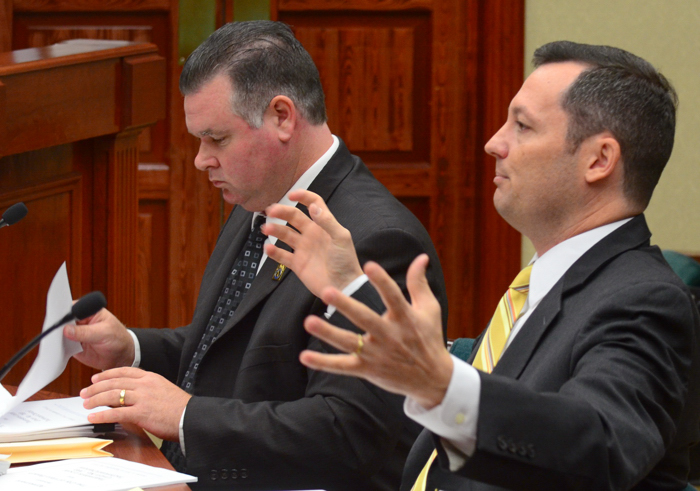
For the first time in approximately five years, numerous city workers will see a wage increase in their paycheck effective the beginning of this month. The city council acted as negotiators in a quasi-judicial hearing to break an impasse in potential wage issues which was the sticking point in collective bargaining efforts between the Teamsters Local Union #769, representing 263 employees of the city, and the city negotiating team. Steve Myers was the agent representing the union with Jason Odom negotiating on behalf of the city.
The council conducted two separate hearings, the first involving 200 blue-collar city workers and the second pertaining to 63 employees who are classified as technical or clerical. Odom told the council that there was no question the workers deserved of a pay increase since wages have remained constant since 2009. Odom proposed a pay increase of 2.5 percent or 3 percent depending on whether or not the raise would become effective retroactively to the beginning of the fiscal year in October, 2013. Odom recommended that if the council chose a 3 percent increase that it become effective as of the beginning of this month.
The collective bargaining began in June of last year and the two sides have reached an impasse on the wage issue necessitating the hearing before the elected city council. Myers said that the city’s initial position was to provide no wage increases for the union workers. He reminded the council that some of the worker’s wages have been frozen since 2008. The union’s position was to request an increase of 5 percent. He also recommended re-establishing a “longevity plan” to provide additional pay incentives based upon length of employment.
Vice Mayor Jay Kramer said that he would like to defer discussion on the longevity plan issue so that the assessed value of the City’s tax base could be considered during the upcoming summer city budget hearings. City Manager Jim O’Connor recommended the council go forward with the 3% pay raise proposed by Odom and agreed with Kramer that the longevity plan needed more study.
Councilmember Craig Fletcher made a motion to approve the 3 percent pay increase, effective the beginning of March, and to leave terms of the second fiscal year of the two-year agreement open until after the summer budget hearings. The last day of the current fiscal year is September 30.
The council voted 4-1 to approve the pay increase, with Councilmember Pilar Turner opposing the raises. O’Connor said the cost for the pay increases would be approximately $178,000, which will include the $64,000 approved year for police officer pay increases.
Another issue relating to the contract for the City’s blue collar employees represented by the Teamsters involved workers in the water and sewer system who have become dual certified to handle both water and wastewater issues.
“When positions were eliminated, many of the workers were cross-trained and are now, in effect, working in both jobs without any increase in pay,” Myers said. “Our initial position was for a $2 per hour increase but the city countered with an offer of zero. We are at an impasse because it reached a point where we realized we were negotiating with ourselves.”
City Manager O’Connor told the council that in his view a $2 per hour would be excessive. O’Connor pointed out that the city paid for all of the expenses that were necessary for the employees to be certified in both areas. O’Connor said he considered the training an employment benefit for the workers. He indicated that the 3 percent pay increase was not out of line, but he did not agree with the additional $2 per hour increase proposed by the union.
Both Mayor Richard Winger and Kramer agreed that some additional compensation was reasonable since the city has received a benefit by having fewer employees who are doing more work. Winger suggested a $1 hourly raise. Councilmember Pilar Turner recommended that the money be paid as a monthly premium rather than a salary increase to avoid additional costs to the city when the increase is applied to vacation and overtime pay, but she received no support from fellow council members.
A motion was made by Winger to increase the salary of the cross-trained workers with the water and sewer utility $1 per hour. The motion passed by a vote of 3 -2 with Councilmembers Turner and Fletcher casting negative votes.
The second hearing regarding the technical and clerical union workers resulted in the same 3 percent pay increase as approved for the blue-collar workers. Union representative Myers asked the council to consider a “step plan” to compensate workers who had assumed what should have been higher paying positions but were at their previous pay grade. Odom, on behalf of the city negotiating team, told the council explained the suggestion applied mostly to city dispatch and customer service workers.
Councilmember Craig Fletcher asked that the council be provided more information on this issue and proposed that the matter remain at the status quo until budget negotiations begin in June. Fletcher’s motion was approved by a unanimous council vote.
The council also voted unanimously to equalize the pay for shift differentials between the two divisions represented by the union. The blue-collar workers are receiving an extra $1 per hour for the second shift, $1.25 per hour for the third and $.85 addition per weekend hour worked. The technical and clerical workers are paid less for shift differentials, receiving $.50 additional per hour for the second shift, $1 per hour for the third along and $1 for weekends. The council voted to make the technical and clerical workers pay for differing shifts the same as those workers classified as blue collar.
“I have trouble that there is no parity with this issue,” Winger said prior to the 5-0 vote, which eliminated the disparities.
Last December, city police officers with two or more years experience received a 2 percent pay increase, which totaled $64,000 for the current budget cycle. The city’s police department was not a part of the recent hearings involving the city and the Teamsters.
 Indian River Guardian