
In explaining why FPL is asking the customers of Vero Electric to pay a $26 million surcharge, spokespersons for the company are now confidently asserting that a ruling from the Internal Revenue Service on the power purchase agreements would not have been necessary, that the FMPA would have controlled and slanted the wording of any letter to the IRS and that the FMPA would have arbitrarily rejected IRS approval. Meeting notes and email correspondence raise serious questions about all three claims.
MARK SCHUMANN


When Florida Power & Light President Eric Silagy met with Florida Municipal Power Agency General Manager Nicholas Guarriello in Orlando, Aug. 19, the head of the state’s largest investor owned utility put forward yet another proposal for structuring the sale of Vero Electric. During his dinner meeting with Guarriello, Silagy reportedly acknowledged that two earlier proposals, (Plan A and Plan B), stood little chance of being approved by the Internal Revenue Service.
Now, as FPL turns up the pressure in a public relations campaign to build support for a $26 million surcharge to be assessed on the customers of Vero Electric, the company’s spokespersons are making statements that essentially contradict Silagy’s Aug. 19 explanation to Guarriello.

Addressing the Vero Beach City Council March 3, FPL attorney Patrick Bryan said FPL never accepted the FMPA’s position that a plan for selling Vero Beach’s power to FPL by channeling it through the Orlando Utilities Commission would need to be cleared by the IRS. To ensure the deal did not violate restrictions on the sale of public power to investor-owned utilities, FMPA officials insisted on seeking a private use ruling. Their interest, FMPA officials say, is to protect the tax-exempt status of their bonds.
There were, in fact, two earlier plans for the sale, both of which raised concerns from FMPA’s bond and tax attorneys. FMPA counsel, Jeff Piemont, for example, characterized Plan B as “just an artifice,” according to notes from a May 28 meeting taken by FMPA Assistant General Counsel, Jody Finklea.
FPL’s first proposal for structuring the power purchase agreements that are key to the sale was for the Orlando Utilities Commission to take on Vero Beach’s 38 megawatts of power allotments from the Stanton I and Stanton II. This so-called Plan A called for FPL to then to purchase that 38 megawatts of power from the OUC through the end of 2017.
Concerned the power purchase agreement would require a lengthy process of seeking IRS approval, and doubtful of what the IRS’s response would be, FPL then proposed what became known as Plan B. FPL’s second solution for offloading Vero Beach’s power supply contracts called for FPL to purchase from the OUC, not Vero Beach’s 38 megawatt allotment from Stanton I and Stanton II, but some other 38 megawatts of power from OUC’s 1,600 megawatts of generating capacity. From discussion in the May 28 meeting where Plan B first surfaced, Finklea noted, “OUC and FPL acknowledged that this alternative deal is being put together to avoid private use restrictions. So, any private use ruling request, if any, will have to include that fact and the fact that there was a previous deal that was different.”
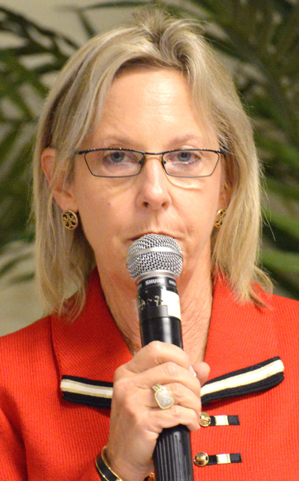
Speaking before the County Commission March 10, FPL External Affairs Manager Amy Brunjes said FPL is not confident of closing the deal under the terms of the contract approved by voters last March, ”because of the FMPA’s insistence on that opinion from the IRS.”
Brunjes continued, “We’ve had opinions from our tax counsel, the City’s tax counsel and others that says that those bonds would not be in jeopardy. But as you know, FMPA controls the message, and so we are sort of at their mercy here.”
In response to an inquiry from Inside Vero, transactional attorney, John Igoe, confirmed his expectation that the drafting of a request for a ruling from the IRS would be a collaborative effort of attorneys for the City, the OUC, the FMPA and FPL.
Finklea’s meeting notes contradict Brunjes’ claim that attorneys for FPL, Vero Beach and the OUC were willing to render unqualified opinions regarding the potential tax consequences on FMPA’s bonds. Email correspondence between the FMPA and Vero Beach’s transactional attorneys describing the collaborative effort that would be needed to to draft any letter to the IRS further contradicts FPL’s claim that the FMPA would “control” the message.
From a May 28 meeting, which included representatives from FPL, Vero Beach, the OUC and the FMPA, Finklea noted, “Scott (Scott Lilly, a tax attorney working with the city’s transactional attorneys) will not give an unqualified representation as to the impact on FMPA’s bonds. He will give an unqualified opinion to OUC as to its bonds only (without any representation as to the impact on FMPA).”
Finklea’s notes from a June 12 meeting are even more revealing. After hearing FMPA’s tax counsel explain why “Plan A” could not achieve IRS approval, negotiators for Vero Beach, FPL and OUC, in order to consider their options, met without FMPA representatives present. “After a separate caucus, Wade Litchfield (attorney for FPL) said Plan A is off the table…Now, FPL’s sole focus is on making Plan B work.”
The June 12 meeting continued with a “substantive discussion of the process to get the tax lawyers working on a private letter ruling request(s).”
Finklea’s notes continue: “As to Plan B, John Igoe said: ‘I had nothing to do with this. This was the business guys at FPL and OUC.”
The FMPA Assistant General Counsel’s notes from the June 12 meeting conclude: “Jeff Piemont (FMPA tax and bond counsel) said, ‘This (Plan B) is nothing more than a device to avoid an IRS private letter ruling, which makes me all the more convinced that there needs to be an IRS letter ruling to protect FMPA.’”
Negotiations continued on June 26 with a follow-up conference call including representative from FMPA, Vero Beach and FPL. Finklea’s notes from that meeting open: “John Igoe says OUC and FPL are still discussing Plan B. Once that discussion is done, we will kick off the tax attorneys to begin work on the private letter ruling request.”
Finklea concluded his notes on the June 26 conference call observing, “Lack of discussion or additional information on Plan B probably means it is not going well between OUC and FPL.”
Finklea’s next set of meeting notes is dated Aug. 23, just four days after Silagy and Guarriello met over dinner in Orlando. Present to discuss the entirely new offer were representatives from FPL, Vero Beach, OUC and FMPA. “Gone is Plan B,” Finkleia wrote, adding, “Silagy made it clear (to Guarriello) that FPL had become convinced the private letter route would not be successful…”
FPL’s public relations team is now busy claiming Silagy meant to say that seeking a private use ruling from the IRS would not help move the sale along because FPMA would never take “yes” for an answer.
FPL’s assertion that the FMPA would so blatantly obstruct the sale of Vero Electric is, arguably, an insult to the very negotiating partner from whom Vero Beach most needs cooperating and support.
FPL currently claims that a private use letter would not have been necessary, that the content of the letter would have been controlled by the FMPA, and that the FMPA would have arbitrarily interpreted any IRS ruling in a way that would kill the sale. At least according to detailed meeting notes taken by FMPA’s Assistant General Counsel, Jody Finklea, FPL’s latest public relations spin seems to be just that – spin.
Finally, at no time during their presentations to the City Council and the County Commission did FPL officials acknowledge that the $30 million premium the company had planned to spend to buy 38 megawatts of power from the OUC is to be replaced by the $26 million FPL now proposes to pay the FMPA. The $26 million from FPL is over and above the $26 million to be paid by the customers of Vero Electric.
Brunjes at one point claimed the $30 million to be spent on FMPA power channeled through the OUC would have brought value. If FPL’s earlier statements are to be believed, though, the $30 million was a premium over and above what it would cost FPL to generate 38 megawatts of power at one of its own plants. Clearly, then, the total value of FPL’s offer is now $4 million less that it was before the surcharge proposal replaced Plan B, which replaced Plan A.
 Indian River Guardian
NEWS ALERT!! FPL, FPMA, OUC,IRS and the City of Vero Beach has come up with an agreed upon arbiter to settle the electric sale. This person is writer Russ Lemmon of the TC Palm. Having recently written two pro sales articles and with vast knowledge of electrical sales, he will take his other well known knowledge and settle the matter. By the end of next week if there are more Alabama license plates spotted than Georgia plates the city will have to pay the total $52 million. But if there are more Arkansas plates than Wyoming plates in the city FPL will have to pay the $52 million. And lastly if there are more Florida plates spotted than Hawaii plates the the city has to take any deal it gets even if if means doubling every resident’s property tax and the city has to declare banruptcy and be taken over by the county so they can build 13 story buildings on Ocean Drive so all their backers can make millions.
It does not look like Russ Lemmon can indeed be the arbiter, Jon Huntsman is going to want him to be his press agent in his next bid for the Presidential nomination.
We should all put our faith in Mr Lemmon’s decisions. After all he is one of Vero’s most objective people along with Glenn Heran and Milton of 32963 fame .They could hold a townhall meeting run by Charlie Wilson , and in this way we can all be educated on the finer points of how to buy an electric company, raise taxes and erect very tall building’s on Ocean Drive. I hope Mr Lemmon can lead us out of the wilderness in this and other matters; he is so insight..
In Ms. Rushworth’s reticently published book “Images of America, Vero Beach” she writes that the founders selected Vero representing the Latin word veritas (truth). A recommended read.
The City should well acknowledge and hold fast to its origins, traditions and heritage. Clearly, challenges, changes and uncertainties abound as the future looms opaquely.
Consider Alexander Pope’s observation “Be not the first on whom the new is tried, nor yet the last to set the old aside”
A veritable Gordian Knot has been entangled regarding the sale of VBE. Who will become the latter day Alexander the Great to unsheathe the sword and sever it? Who will provide the leadership to equitably serve the utility customers, taxpayers, residents of VB and preserve our City? How can civility, reason and decency be reignited in our community?
Why are obvious impediments to the Electric sale dismissed, denigrated and demonized? Why has this transaction swerved from a professional to be personal confrontation?
The shards of shattered glass, which is breaking windows of opportunity, wounding all involved, would be more productive were the windows simply opened.