
ED TAYLOR

The Vero Beach City Council did not directly address a request by Ken Daige, the chairman of the city’s advisory high speed railroad commission, to consider obtaining legal counsel that is familiar with federal railway regulations to assist in the city’s ongoing attempts to deal with and understand the consequences of the oncoming rail project of the private railroad company, All Aboard Florida. They did, however, agree to draft a letter to State Senator Joe Negron who is leading a legislative effort to provide funding to municipalities who will be negatively affected by the railroad without achieving any recognizable benefit. They also agreed to provide any suggested documents to the federal regulatory agency that will be releasing an environmental impact study on the railroad to be released this spring to which the city will have 45 days to respond.
Councilmember Pilar Turner asked that the information go directly to the federal regulatory agency since the initial draft is being prepared by a consulting firm hired by All Aboard Florida. “We need to get our concerns known to the agency that will be making the decisions,” Turner said. She also expressed hope that the city’s concerns would be expressed in the final report.
This was met with approval by the council with Mayor Richard Winger stating that he had “no hesitation” in sending any pertinent documents to any federal agency working on the environmental impact study of the railroad that is scheduled to commence operation by late next year.
All Aboard Florida has scheduled 32 trains coming through Vero Beach daily between Miami and Orlando (16 trains from each point of origin) at speeds of approximately 105 miles per hour. The Federal Railway Administration requires a “quiet zone” to be created at the expense of the city to avoid a mandatory four whistle blast at each railway crossing. There are 7 such crossings within a 2.3 mile area in the Vero Beach city limits and the creation of the quiet zones will cost the city an estimated $3 million. The council has already passed a resolution asking the State of Florida to assist with the creation of the quiet zones to which there has been no response as yet.
Daige asked the council to consider specialized legal advice so that as the chairman of the rail commission he would be able to answer questions that are frequently posed. “People want to know what rights they have on this issue,” Daige said. “They want to know their rights and what they can do about dealing with these trains.” Although the city council did not address the issue of retaining counsel directly, Indian River County Commissioner Tim Zorc was on hand to say that the county has someone on retainer that can be brought on board to assist in defining any rights the city may have.
Fellow railroad commission member Brian Heady expressed disagreement with Daige over the need to obtain additional legal counsel saying that exaggerating the potential problems would do more harm than good. Heady pointed out that while Daige was speaking to the council a freight train passed and that it did not affect Daige’s ability to speak or be heard. He also pointed out that there were no noticeable vibrations. Vero Beach City Hall is approximately one-quarter of a mile east of the railroad tracks. It was Heady who first suggested that the council provide direct input to the federal agency who will ultimately prepare the environmental impact study.
“We need to give input to the agency while the study is being done,” Heady said.
City Manager Jim O’Connor told Heady that he could work with the Treasure Coast Regional Planning Council who would get the first draft and he believed that the 45 day response time could be expanded. This prompted Councilmember Turner’s suggestion to begin assertive action while the draft was being prepared.
Don Crocteau, the vice chairman of the high speed rail commission, asserted that it would be essential for the various communities on the east coast of Florida to work together in evaluating what appears to be the inevitable encroachment of each city, without benefit, to form a consistent plan on how to deal with common issues and problems associated with the oncoming railroad.
“We represent only 9% of the crossings in the three county area (Indian River, St. Lucie and Martin) and we each have both common and unique problems,” Croteau said. “There is strength in numbers,” he added. “We need to all work together because it is apparent that they are not going to change their route.”
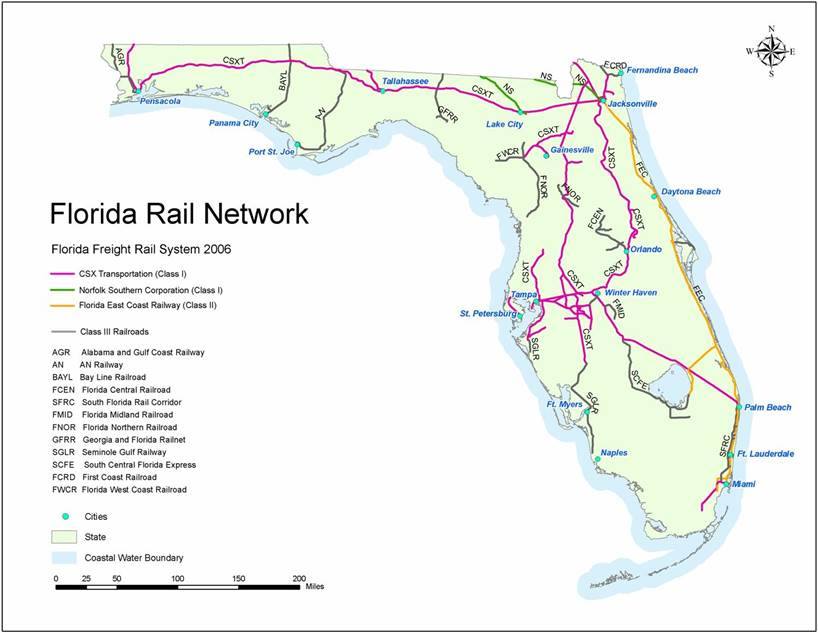
At least one city on the Treasure Coast has already started a grass roots effort in an attempt to persuade All Aboard Florida to use an alternate set of railroad tracks that would not impact cities on the east coast north of West Palm Beach, which is one of the scheduled stops. K. C. Traylor, of Stuart has helped create “Florida NOT All Aboard” which is using Facebook and a website to garner support for the railroad to use an alternative route. The website petition has garnered over 2,500 signatures.
“We are not opposed to the railroad but believe they should use the existing CSX tracks that go through Central Florida to Orlando rather than the FEC tracks that will create havoc in the City of Stuart,” Traylor said. “The addition of 32 trains coming through our city will severely impact both vehicular and marine traffic since we have three drawbridges over the river that cannot be raised while a train is passing.”
When contacted, Rusty Roberts, Vice President of Corporate Expansion for Florida East Coast Industries (the parent company of All Aboard Florida) stated that his company has made no effort to pursue the use of the alternate site.
“We have ownership rights in the FEC tracks,” Roberts said. “We have no rights to use the CSX tracks,” he added.
 Indian River Guardian
No real concern is an exaggeration. The proper handling of those concerns in proper procedure is crucial to being heard by the necessary officials.
While attending a Main Street meeting I was invited to, a train rode by. We were on the outside patio of a local bistro close to the train tracks. Those in attendance noticed the vibrations of the train and the sound of the train whistle. Comments such as it’s hard to hear over the train sounds and we feel the vibrations or shaking. This concern was placed on a list by those in attendance. I did not presume to tell those in attendance what their concerns were – they told me. Both Mr. Heady and Mr. Taylor were at this meeting. The long list of concerns recorded at that meeting are very real to those who were in attendance and want to be taken seriously.
Our High Speed Rail Commission, which is an advisory board, has been collecting data, information and trends. This is all on file at city hall. We have been told we need to hire a consultant that works in the rail industry to evaluate the city’s rail crossings. We have been told in part that most rights lean in favor of the railroad authorities.
There is no point to drafting complaints to any regulatory body without proper back-up. We need to know our rights before we can draft our concerns. We need proper procedure or we risk setting the wrong precedence when we file our concerns, thereby risking being taken seriously when the time to respond to the final draft is available.
Ken, you are correct. There were vibrations and noise that caused a disruption during the meeting at Osceola Bistro and I should have included that in the story rather than just quote Mr. Heady. I will make the addition and submit it for the print publication.
Thanks, Ed. I appreciate your interest.