
COMMENTARY
MARK SCHUMANN

In a memorable scene from the movie The Last King of Scotland, Ugandan dictator Edi Amin complains to his personal physician and confidant, “You told me, but you didn’t convince me.”
Despite advice to the contrary, Amin had ordered the arrest and execution of his interior minister on charges of disloyalty. Later, it was discovered the interior minister had been secretly planning a celebration in Amin’s honor.
“You told me, but you didn’t convince me,” could just as well be the excuse of those who have ignored the City’s contractual obligations to the Florida Municipal Power Agency, as they have pushed forward with the proposed sale of Vero Electric to Florida Power & Light.
It is not as if City leaders and the transactional attorneys were unaware of several steep hurdles to be cleared before Vero Beach could sell its electric system to FPL.
As early as 2007, when the City was seeking a buyer for its FMPA power, FMPA attorneys laid out in full detail the very issues which remained unaddressed in the purchase and sale agreement signed last February. Whether the sale can go forward without significant delay and additional expense to the customers of Vero Electric remains the pressing question.
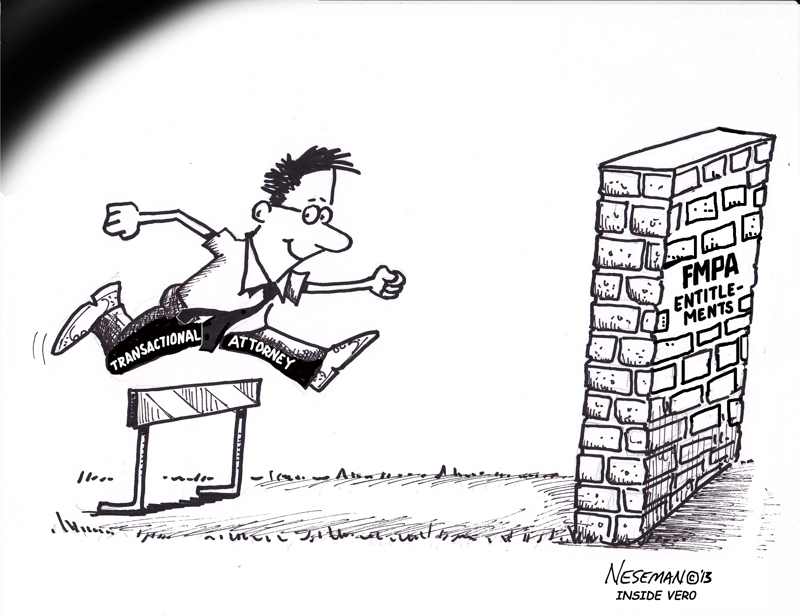
In response to a 100-page memo from the FMPA outlining Vero Beach’s contracts, attorneys representing Vero Beach acknowledged a number of central issues, all of which have seemingly been ignored, or at least unresolved by the City’s current transactional attorneys.
Key excerpts of the June 28, 2007 letter from Scott J. Miller, counsel for Vero Beach, to FMPA General Counsel Fred Bryant are presented below.
Taken together, these acknowledgements of the City’s responsibilities as a participant in three FMPA power projects and the All Requirements Project are a damning indictment of those who now claim the FMPA is throwing up new hurdles to thwart the sale.
The following are excerpts of Vero Beach counsel Scott J. Miller’s June 28, 2007 letter to FMPA General Counsel Fred Bryant.
• Vero Beach is not disputing “the critical role” which the Power Sales Contracts play in the finance and operation of the St. Lucie and Stanton I and II Projects.
• Vero Beach agrees that no “purported assignments” to a winning bidder would “relieve Vero Beach of its obligations under the contracts.”
• Vero Beach understands that FMPA’s fundamental concerns with Vero Beach’s RFP are: (a) the maintenance of the security provided by the various contracts to bondholders and interested other third parties as well as to other FMPA members participating in the Projects; and (b) preservation of the Federal tax exemption on existing bonds and avoiding contractually prohibited restraints of FMPA’s ability to issue tax exempt bonds in the future.
• Vero Beach does not dispute the statement in the Memorandum that the Power Sales Contracts are regarded as important to the bondholders, and to FMPA and the other Project Participants, and that the contracts play a crucial role in the financing and operation of the St. Lucie and Stantion I and II projects.
• Section 14 of the Power Sale Contract prohibits Vero Beach from making “any sales of its Power Entitlement Share,” or taking any other action that would “adversely affect the exemption from federal income taxation of interests paid on Bonds. Vero Beach expressly acknowledged this restriction in Section 3.2.2 of the Offering Memorandum which provides: The energy and capacity from St. Lucie Unit 2 must be used by municipal customers who meet the requirements of federal tax exemption of interest paid on bonds.
• “…Section 29(d) which prohibits any amendment that would “provide terms and conditions different from those contained” in the Power Sale Contract, without prior notice to and written consent of each of the Project Participants, is inapplicable because no contract amendment is contemplated.
• As in the case of the St. Lucie and Stantion I and II Projects, Vero Beach acknowledges the crucial role the ARP Contract plays in the operation and financing of the ARP.
• “…the Memorandum notes that Section 19 of the ARP is virtually identical to Section 29 of the St. Lucie and Stantion I and II Contracts, and contains the same “triple reference: to the prohibition against termination, amendment, modification or alteration “in any manner” of the ARP Contract.
 Indian River Guardian
Thank you, InsideVero, for this detailed article which gives the public a better understanding of the electric issue.
Looks like Kenny Rogers’ song “The Gambler” may have some truths we should have considered;
” If you’re gonna play the game, boy, ya gotta learn to play it right.
You got to know when to hold ’em, know when to fold ’em,
Know when to walk away and know when to run..”
I had assumed that the phrase “Scot Free” referred to the infamous Dred Scott case where a slave who lived several years in free States but was returned to bondage by the Supreme Court.
The origin actually is from Scotland, regarding obligations from which one has no consequences if not honored, or can otherwise evade.
One should well take pause with modern day Dread Scotts, certain pro-sale advocates who have sought to assure the public Vero Beach can sell its electric utility “Scot Free” of its long-standing contractual obligations.