
COMMENTARY
MARK SCHUMANN
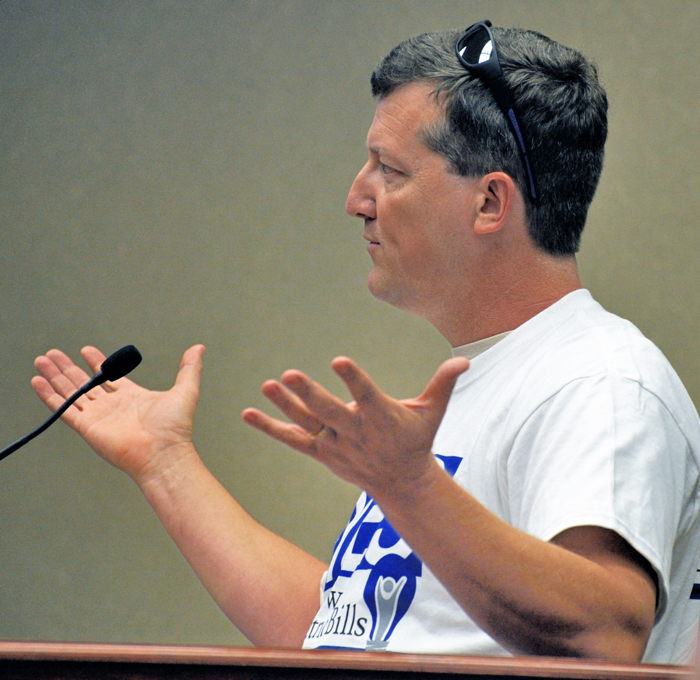
Less than an hour before pro-sale utility activist and Florida Power & Light apologist Glenn Heran gave the latest version of his road show to a local service club, detailed notes from last week’s meeting between City of Vero Beach officials and representatives of the Florida Municipal Power Agency were released to the public.
Had Heran reviewed the meeting notes before making his pro-FPL pitch, one might assume he would have amended his comments in the interest of accuracy. Given the numerous contortions of truth in Heran’s performance, it seems unlikely, though, that he would have used the information released today to better inform his listeners. Heran is not interested in informing. His objective is to convince the public to sell Vero Electric to FPL, no matter the cost.
Listening to Heran today, I was struck by how much his justification for the sale has morphed over the years. Back in 2009, Heran was projecting the City would net $156.5 million from the sale, not including electric system reserve funds that would become unencumbered. Today, Heran said the City will net just $1.4 million of the $111.5 million FPL is offering. The City will also have, he said, $38.3 million in reserve funds it can use to restructure its pension funds.
Heran several times described as “myth” claims the city will net $3 million or less from the sale, yet there in his own calculations was the confirmation that no more than $1.4 million of the cash FPL proposes to bring to the table will be left after all debts, contracts obligations and closing costs are paid.
Heran’s presentation could not have been more carefully scripted had the fine folks in FPL’s public relations department assisted him. In fact, FPL has is the past worked closely with Heran. For example, a political action committee and an electioneering communications organization controlled by Heran received more than $125,000 in contributions from FPL.
Clearly attempting to inflame his listeners, Heran continually referred to a “penalty” the FMPA is assessing Vero Beach for selling its electric system. What Heran wants people to consider a “penalty” is actually the price at which the FMPA offered to take on the City’s power entitlements for three years. At the same time, the FMPA encouraged FPL to instead make arrangements with the Orlando Utilities Commission to buy the power. The FMPA’s offer was anything but a “penalty.” Heran seems convinced, though, that a lie repeated often enough will become the truth.
No longer able to promote the sale on the claim the City will net enough in proceeds to avoid service cuts and tax increases, Heran has switched his tack and is now trying to build public support for a legal battle with the FMPA. Any such litigation will be long, drawn-out, immensely expensive, and will almost surely be doomed to failure.
A central piece of Heran’s current road show is his libertarian, ultra-right argument that providing electric power is not an “essential” government service. Heran also contends that none of the 32 municipally owned utilities in the state are competitive with FPL. This claim is simply not true, but more to the point, Heran fails to mention that many of the cities that own and operate their own electric utilities are not located within FPL’s service territory. In truth, many of them are doing better on rates that the state’s other investor-owned utilities.
Another of Heran’s false assertions is the claim that the FMPA is “stripping Vero Beach of its assets.” At this point, one has to wonder if Heran has ever taken the time to read the City’s FMPA contracts. Nowhere in those documents is there any suggestion that withdrawing members have a claim to the joint action agency’s assets. In a similar way, when one withdraws from a country club, or resigns from a service club, there is no proportionate claim on the club’s cash and other assets.
Just as City Councilwoman Pilar Turner — who serves, ironically, as the City’s representative on the FMPA board — has set the negotiations back by continually attacking the agency, Heran’s latest public relations campaign to demonize the FMPA can is no way lead to lower electric rates. Heran’s bull-in-the-China-shop style of diplomacy is only making the negotiations more difficult.
Absent from Heran’s bashing of the FMPA today was any constructive suggestions for how the City might lower rates, such a decommissioning the power plant. Another step the City could take to reduce rates would be to re-negotiate its 20-year wholesale power agreement with the OUC. These negotiations cannot take place, though, so long as the City and FPL continue in their failed effort to push forward with a deal.
Heran may have found it cathartic to spend his lunch hour attacking the FMPA, but if he continues to do so, he will never be a part of the solution – only a part of the problem.
 Indian River Guardian
Mark
What is your position on the sale of the power plant and your reasons why you choose that position?
Bill
Did he hand any Vero Beach City resident a check for $625.00 that he promised with his $156,500,000 profit claim in 2009? I think not.
My “position” is that the public should be told the truth about what can and cannot be accomplished, given the City’s contractual obligations; and my belief is that wishful thinking is not a strategy. To build public support for the sale by greatly exaggerating the likely net proceeds to the City, as Glenn Heran and Stephen Faherty have done, and to ask voters to approve a purchase and sale contract that had no chance of begin executed, as was done last March by Tracy Carroll, Craig Fletcher and Pilar Turner, was irresponsible.
If, without being bombarded by a misinformation campaign funded almost exclusively by FPL, voters approve the sale of the electric system, then the City Council should make every effort to conclude the sale. Having said that, the expressed will of some 65 percent of just 22 percent of registered voters does not eclipse or dispense with the City’s contractual obligations. Only children believe they deserve what they want simply because they want it.
Is Mr Heran a paid lobbyist? If so why doesn’t he simply say so?
If Mr. Heran admits to being a paid lobbyist, would he have to claim that income on his taxes? Just asking.