
MARK SCHUMANN
Six pages of detailed notes from a key meeting held last week between City of Vero Beach officials and representatives of the Florida Municipal Power Agency were made public today. The four-and-a-half-hour discussion covered all the key hurdles to be cleared, if Vero Beach is to sell its electric system to Florida Power & Light.
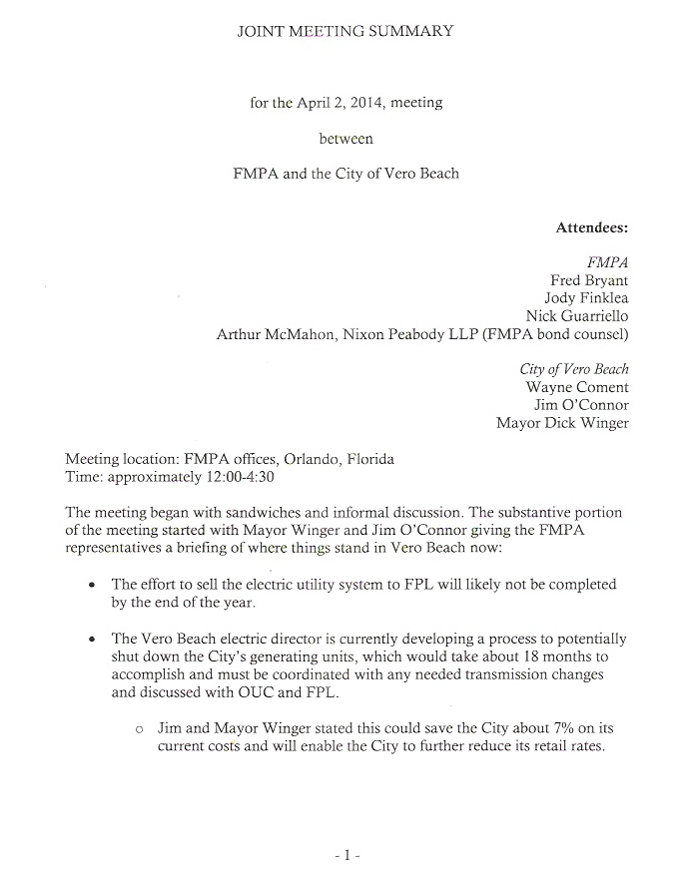
Hoping to restart negotiation, Mayor Richard Winger, City Manager Jim O’Connor and City Attorney Wayne Coment met last Wednesday with FMPA General Manager Nicholas Guarriello, FMPA attorneys Fred Bryant and Jody Finklea and bond counsel Arthur McMahon.
Both parties concurred the sale of Vero Beach’s electric system to FPL will likely not be completed this year.
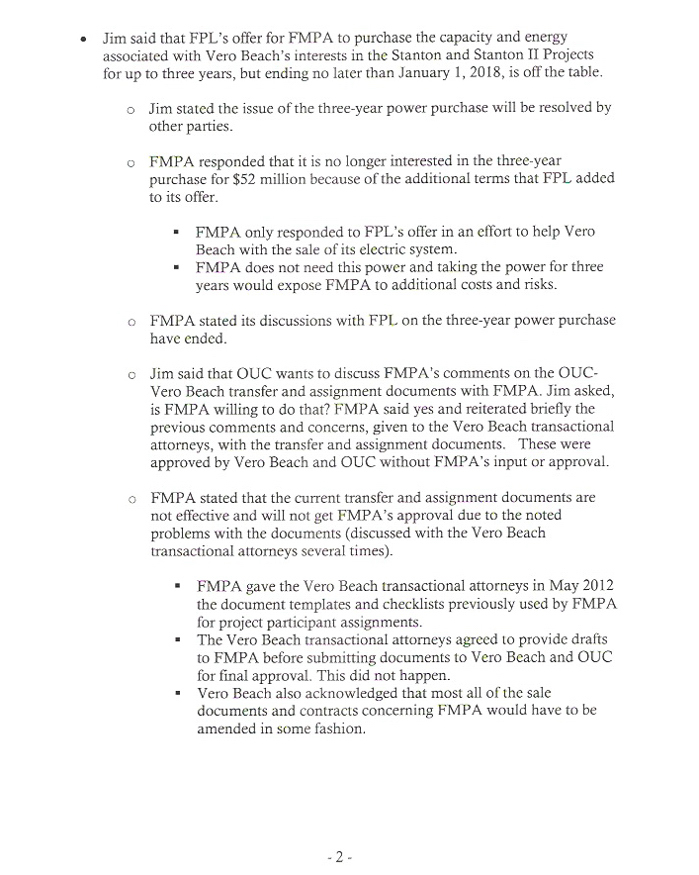
Both parties also agreed that FPL’s offer to pay the FMPA $52 million to absorb Vero Beach’s Stanton I and II power entitlements for up to three years is off the table. The FMPA rejected FPL’s counter offer when it came with a number of conditions and contingencies the agency said were “unworkable and unacceptable.”
As has since been reported, O’Connor said FPL representatives are now talking with officials of the Orlando Utilities Commission about buying Vero Beach’s power short term.
The OUC has already agreed to assume Vero Beach’s position in the Stanton I and II coal plants and the St. Lucie Two nuclear project as of Jan 1, 2018. The transfer and assignment documents, however, will have to be amended before they are submitted to FMPA members for approval. According to FMPA representatives, Vero Beach’s transactional attorneys agreed to submit drafts of the documents before they were signed by Vero Beach and the OUC, but that never happened.
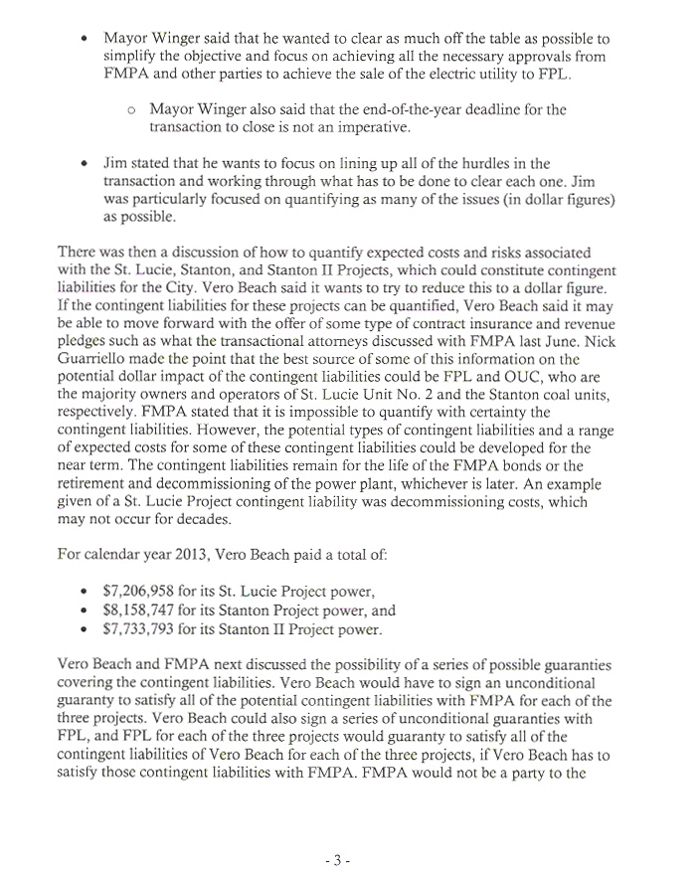
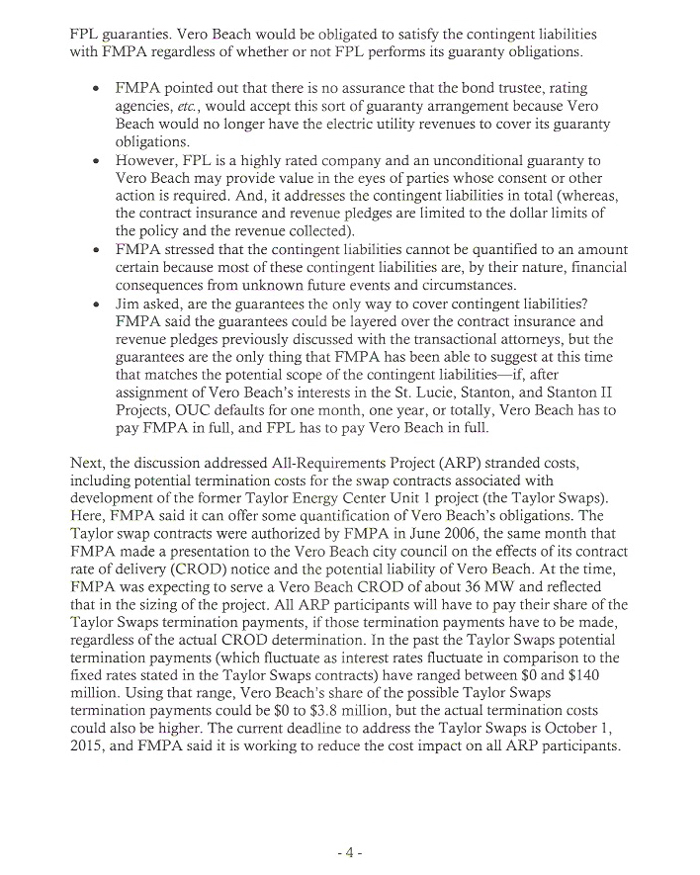
What followed was a lengthy discussion about what Vero Beach will need to do to cover contingent liabilities on the three power projects in which it has a position, as well as from its membership in the All Requirements Project. These contingent liabilities remain for the life of the bonds or until the plants are decommissioned, whichever comes later. The lack of a definitive end date to the obligations makes it difficult for the City to buy contract insurance. Another approach may be for FPL to assume the liabilities, since it will be acquiring Vero Beach’s customers. Such a concession on the part of FPL will almost surely come at some cost to the City.
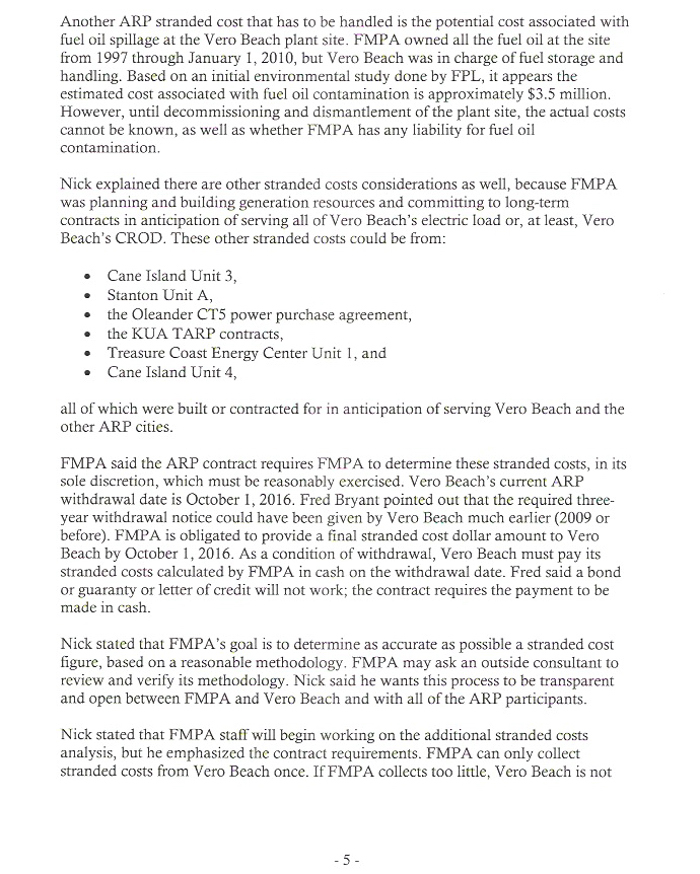
The discussion then turned to stranded costs the City will have to pay as it withdraws from the All Requirements Project. Vero Beach’s share of an interest-rate swap that went bad could be as much as $3.8 million. The City is also facing a potential liability of as much as $3.5 million for fuel oil contamination at its power plant on the Indian River Lagoon. The liability is attached to the time when the FMPA was responsible for operating Vero Beach’s power plant, while the City was a participant in the All Requirements Project.
According to Guarriello, during the time when Vero Beach was still receiving power from the All Requirements Project, half a dozen other power plants were being planned and built. Vero Beach could also face stranded cost assessments for these power projects. All of these estimated stranded costs will have to be paid up front. If the actual costs are less, the City will be reimbursed up to 90 percent.
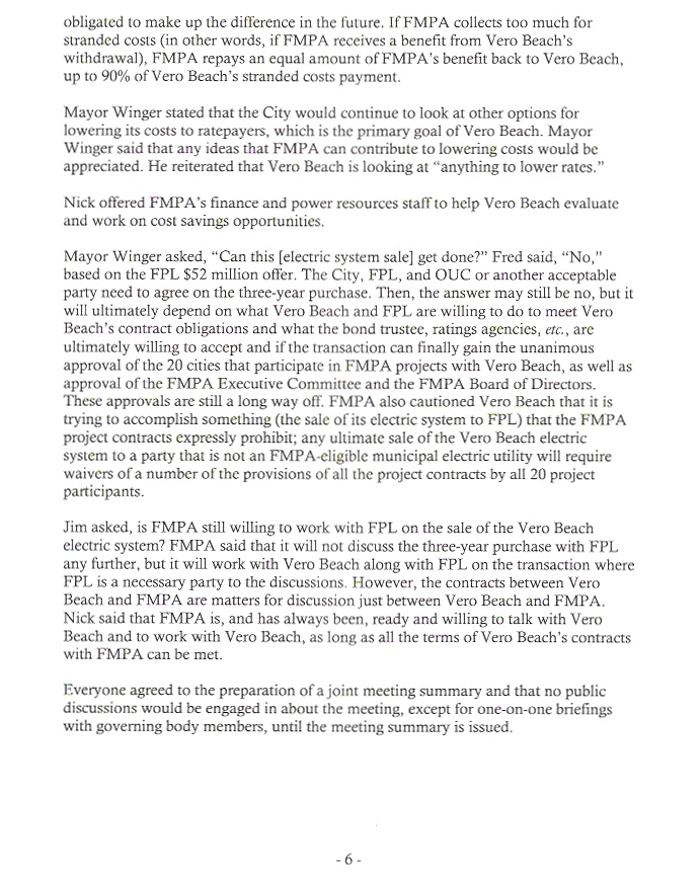
At one telling point in the discussions, Winger asked, “Can this (electric system sale) get done?”
FMPA counsel Fred Bryant said the answer will ultimately depend on what Vero Beach and FPL are willing to do to meet Vero Beach’s contract obligations. Bryant reiterated that the transaction must be approved by all 20 cities that participate with Vero Beach in FMPA projects. The deal, Bryant said, must also be approved by the FMPA’s executive committee and its board of directors, as well as by the bond trustee and rating agencies.
Vero Beach officials were cautioned that the City is trying to sell its electric system to a party (FPL) that is not an FMPA-eligable municipal electric utility, something that is expressly prohibited in FMPA’s project contracts.
The meeting concluded with a discussion of what the FMPA is willing to do to help the Vero Beach conclude the sale. Further negotiations between the FMPA and FPL concerning Vero Beach’s FMPA contracts are off the table. Guarriello, though, reiterated the FMPA’s willingness to work with Vero Beach, “as long as all the terms of Vero Beach’s contracts with FMPA can be met.”
Below are the six pages of meeting notes jointly released today by the City of Vero Beach and the FMPA.
 Indian River Guardian
I think it is time for “Solar Energy”. I would go this route just to make a point, and that is I can do something about it! Look at all of the gallons of gas we are saving because our vehicles have become more efficient, it is making a big difference to OPEC! Perhaps it is now time to get a collective rate on solar equipment, I am sure that the solar industry would love to get in on the “spoils” and resolve our energy problems due to the actions inexperienced Vero City Council members who blindly sold us down the river!