
COMMENTARY
MARK SCHUMANN
 Because the Promised Land held such high strategic value as a key crossroads in the ancient Middle East, the region along the western Mediterranean Sea that is now the modern state of Israel was promising, not only to the descendants of Abraham and Sarah, but also to the Egyptians, Persians, Assyrians, Babylonians, and later the Greeks and Romans.
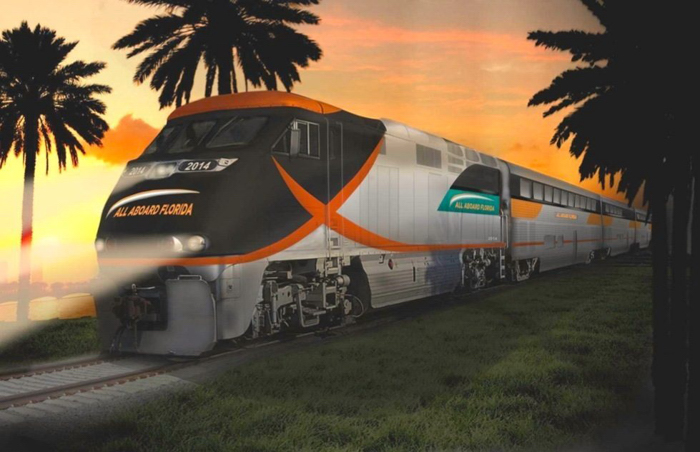
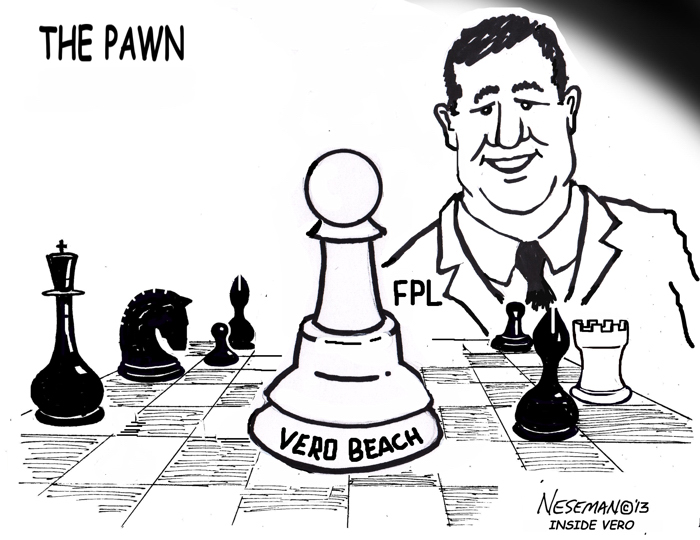
In a similar way, Vero Beach finds itself in the crosshairs, as large corporations like 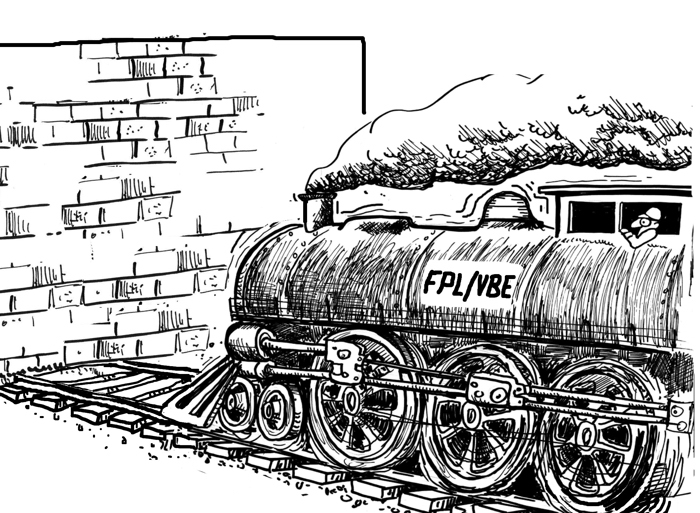 Florida Power & Light and the parent company of All Aboard Florida, Florida East Coast Industries, seek to exert their political influence and enormous economic muscle to extract as much wealth as they possibly can from Florida. In All Aboard Florida’s attempt to run 36 high speed trains a day between Miami and Orlando, and in Florida Power & Light’s effort to march across the state acquiring municipal utilities, little Vero Beach, the gem of the Treasure Coast, stands in the way.
Recently, All Aboard Florida sent out an appeal, urging people to ask Florida Gov. Rick Scott to continue to support the high speed rail project. “Some residents of Vero Beach have struck a more conspiratorial tone, sending a letter to Republican Governor Rick Scott, who publically supports the project, asserting that All Aboard Florida is putting profit over lives,” the All Aboard Florida’s email reads.
 Increasingly, it is clear what was to be a privately funded project will depend heavily on public support. In truth, All Aboard Florida will be a tremendous disruption to the quality of life in Vero Beach and along the Treasure Coast, and a drain on the public treasury.
Like many of FPL’s carefully scripted communications, All Aboard Florida’s appeal for “help” is a masterful contortion of the truth. There is absolutely no evidence the rail service, which will not make any stops between West Palm Beach and Orlando, will, as All Aboard Florida claims, “remove as many as three million cars from regional highways each year.”
This wild assertion by All Aboard Florida sound much like FPL’s greatly exaggerated estimate of some $25 million a year in projected saving for the 34,000 customers of Vero Electric. Pure fantasy!
“The service will promote substantial economic development along the length of the line,” All Aboard Florida claims. This is certainly not true for Vero Beach and the other communities of the three Treasure Coast counties.
Below is the full text of All Aboard Florida’s latest distortion about the truth of the costs and benefits of its planned high speed rail service between Orlando and Miami.
Exciting Project Under Attack From Anti-Rail Forces
When Florida East Coast announced it was privately funding a fast and frequent train service between Orlando and Miami, there was widespread support for the project from all corners. In recent weeks, we’ve seen a small-but-vocal minority initiate a campaign to kill the train.
Tell Governor Scott you support All Aboard Florida!
Two Floridian Representatives recently wrote a letter to U.S. Department of Transportation Secretary Anthony Foxx urging him to “appropriately assess” All Aboard Florida’s promised profits with the safety and livability of the communities along the route. [Find out more on the NARP Blog.] Some residents of Vero Beach have struck a more conspiratorial tone, sending a letter to Republican Governor Rick Scott, who publically supports the project, asserting that All Aboard Florida is putting profit over lives. They go on to say they’ve “connected even more dots” about the parent company, casting the train as doomed to fail, and merely a pretext to gain access to federal loans to pay for expanded freight capacity.
However, we don’t need to spin off wild hypothetical scenarios to outline the case for building the rail line. The fact is: All Aboard Florida represents the best chance Floridians have at having convenient and reliable alternative to the massively congested Interstate 95:
Regular train service along the corridor would remove as many as three million cars from regional highways each year, reducing both commuter stress and road fatalities.
With 300 drivers killed in road accidents between 2004 and 2008, I-95 has been ranked as the deadliest highway in the United States—a passenger rail alternative will save lives.
The service will prompt substantial economic development along the length of the line. Nearly one million Floridians live fewer than five miles from the route’s four proposed stations, and travelers take more than 50 million trips a year in the Miami-Orlando corridor.
And this doesn’t even include the tens of thousands of construction jobs created by the line or the 500 permanent positions needed to operate the service.
So join NARP in telling Governor Scott you support All Aboard Florida! Whether you’re a local or a visitor, let him know if you plan on riding the train. America’s passengers need to counter entrenched interests standing in the way of progress!
Railroads have always provided the foundation for Florida’s development. More than a century ago, Florida East Coast opened Florida’s Atlantic coast to travelers, tourists, and investors, and laid the foundation for the state’s present economic strength. Today, Florida East Coast will once again harness the power of the railroad to bolster Florida’s economic growth—but only if advocates make a stand for balanced transportation and counter short-sighted local opposition.
 Indian River Guardian
The press release supporting All Aboard Florida failed to mention the sad history of all the lives that were lost in order that a few rich people could ride trains to escape the winter storms in the Northeast. Those who do not learn from history are doomed to repeat the same mistakes. For this reason, voters need to read: (1) Last Train to Paradise by Lee Staniford, or (2) A Land Remembered” by Patrick Smith.
The Seven50 plan is the scheme that All Aboard Florida seeks align itself with and profit from.
Both have the same source of funding provided by the Sustainable Communities Partnership of HUD, DOT and EPA.
Rhett Lloyd is unfortunately wrong about the Seven50 agenda. It is nothing more than a common sense approach to 21st century planning. In this current environment we as a community are dependent on the actions of other communities.
Since we also have to live with budget constraints, it is imperative that we learn from one another. It makes absolutely no sense to burden the taxpayers in all communities when the sharing of ideas could and would substantially reduce the cost to all citizens.
There is no evidence that All Aboard Florida has obtained any funding from the Federal government.
I agree with Pat Lavins about Seven50. However, I have a question for her: Are you saying that with the building of a high speed rail, people are going to repeat the same mistakes (such as losing their lives) as when it was built? And why do voters need to read those excellent books? What are they going to vote on? I obviously don’t understand your first set of comments.
I am indeed saying that the potential exists for the loss of life because of high speed trains. I am also considered with the length of the trains because no one should have to wait at a railroad crossing when they need to get immediate access to a hospital.
There is nothing associated with the Seven50 common sense approach to conducting government business that has a profit motive.
The books that I recommended wiill reinforce the logic that as a community we need to learn from one another and not keep making the same mistakes.
There is no issue to vote on now. However, an informed public can and should provide their input before any legislation is written. Also, as the information is provided such as the environmental impact report, the voters need to be aware of the pros and cons.