
COMMENTARY
“Though FPL is to gain the 34,000 customers that secure this liability, and though the chances of the OUC’s defaulting are remote, FPL is balking at being asked to backstop Vero Beach. Given FPL’s firm refusal to cover Vero Beach’s contingent liability, the power sale seems closer to dead than done.”
MARK SCHUMANN
Last fall, Florida Power & Light spokespersons consistently offered assurances all was well with the power sale negotiations. In public statements and in at least one letter mailed to registered voters in mid September, FPL’s message was one of supreme confidence the power sale would be concluded in 2014. Any needed changes to the purchase and sale agreement and the power purchase contracts, “will not change the city’s position financially at all,” FPL spokesperson Amy Brunjes said.
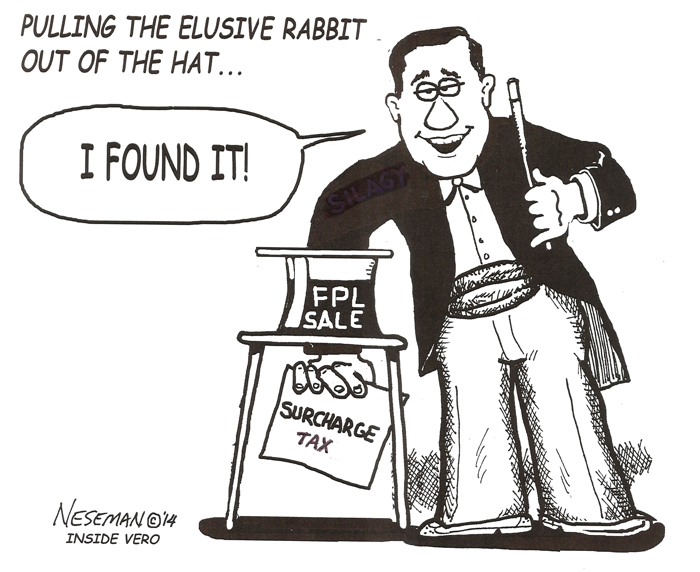 Taking FPL at its word, the only logical conclusion to be reached at the time was that the sale was essentially a “done deal,” at least as far as any role for the Vero Beach City Council. Any remaining details, none of which were to affect the City’s financial position, were being worked out between negotiators for FPL and the Florida Municipal Power Agency. At least that is what we were told.
At the time, City Manager Jim O’Connor explained that if the City Council were to refuse to approve contract amendments that do not “change the city’s position financially,” the City would be in breach of contract.
Confirming O’Connor’s position, transactional attorney John Igoe made clear the City does not have the option of simply breaching its agreement with FPL. “There is no ‘opt out’ for $5 million on either side of the Agreement between the City of Vero Beach and FP&L,” wrote Igoe in response to an inquiry from InsideVero. “The City cannot vote to pay FP&L $5 million to terminate the Agreement. Each side has the remedy of specific performance, meaning either party could get a court to require the other party to perform its obligations under the Agreement,” Igoe added.
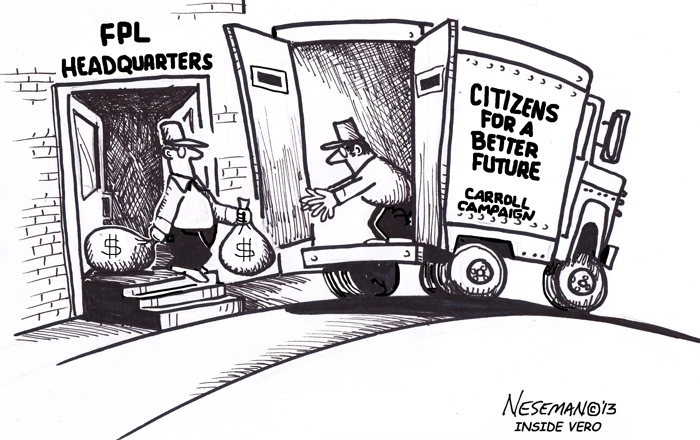
On the one hand, FPL seemed to want the public to believe any changes to the purchase and sale agreement would not materially alter the deal, yet the company was also sending a not-so-subtle message that Tracy Carroll’s reelection would be crucial in holding the deal together. In hopes of retaining Carroll’s “yes” vote for all things FPL, the company funded an electioneering communications organization, Citizens for a Better Future, headed by Glenn Heran, which ran in independent campaign on Carroll’s behalf.
In retrospect, it now seems obvious something did not ring true in FPL’s assurances that all was well with the negotiations. Now that FPL has asked the City Council to approve a $26 million surcharge to be assessed the 34,000 customers of Vero Electric, the company’s incongruous positions of last fall have become more comprehensible.
Pro-sale fundamentalists like Craig Fletcher, Pilar Turner, Glenn Heran and Charlie Wilson want the public to believe Mayor Richard Winger and Councilwoman Amelia Graves were less than honest when they said they were committed to approving any contract changes that did not materially alter the deal as it was approved by voters in March 2013. Neither Graves nor Winger have said anything that suggests they have changed their position. What has changed is that FPL is now proposing amendments to the purchase and sale agreement that fundamentally change the terms of the deal.
Some argue that the sale has gone from a “done” deal to a “dead” deal, and they seek to blame anyone and everyone but the former City Council, the City’s transactional attorneys and FPL.
Supposedly, FPL is now in conversation with the Orlando Utilities Commission about taking on Vero Beach’s power supply entitlements through Dec. 31, 2017. Even if FPL and the OUC reach an agreement on the short-term power supply issue, the deal will almost surely be one FPL will ask Vero Beach’s ratepayers to partially fund. The customers of Vero Electric will also have to share in the cost of covering Vero Beach’s contingent liabilities, as well as the stranded costs the City will leave behind when it exits the FMPA.
At this point, perhaps the biggest stumbling block is FPL’s unwillingness to assume Vero Beach’s contingent liabilities. Though FPL is gaining the 34,000 customers that secure this liability, and though the chances of the OUC’s defaulting are remote, FPL is balking at being asked to backstop Vero Beach. Given FPL’s firm refusal to cover Vero Beach’s contingent liability, the power sale seems closer to dead than done.
 Indian River Guardian