
GUEST COMMENTARY
PAUL ROSKE

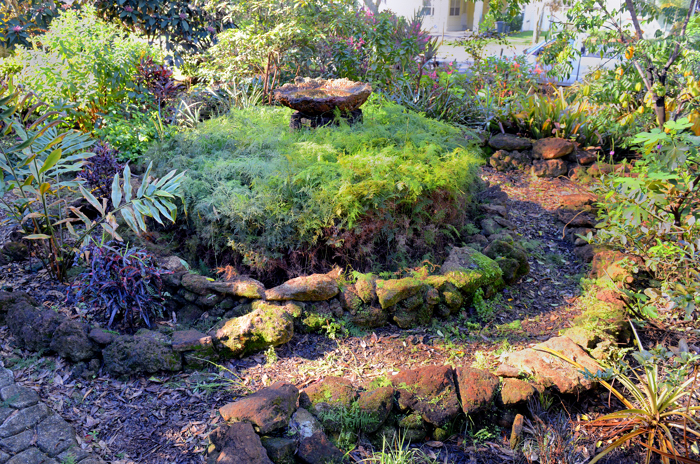
Much ado has been made recently about Bob Solari’s statement that traditional lawns are detrimental to the lagoon and should be replaced with rocks and native material. However, for Vero Beach resident John Roske, this idea is in no way new. Over the past several years, he has gradually transformed his traditional Florida lawn into a staggering botanical masterpiece that artfully merges beauty and functionality. Intimate mulched pathways meander through multi-level rock gardens sporting a vibrant array of primarily native or well-adapted Florida plant life. Many of these are purely ornamental, such as the multi-colored fire spike, bromeliad, croton, porter weed, and shooting star clerodendrum, while others are edible or even fruit bearing, such as the centerpiece carambola, Florida grapefruit, elderberry, and wild coffee. Hummingbirds and butterflies flit from blossom to blossom and jays splash about in the stone bath, while anoles sunbathe on the fronds of the stately sable palm in this thriving micro-habitat.
A short stroll through this verdant labyrinth is a welcome respite from the bustle of city life, where the air is fresh and organic and senses awash with the sweet fragrance of jasmine and four o’clocks. Best of all, this “earthscaping” is entirely lagoon friendly. Native species are adapted to this environment and require significantly less maintenance than exotics, and fertilization needs can be easily met through natural composting and recycling of lawn debris. No mowing is necessary, so there are no grass clippings to deal with (or early-morning engine noise or exhaust fumes, for that matter) and the mulched paths and beds keep weeding to a minimum.
While initial establishment takes vision and a solid effort, maintenance of an earthscaped property becomes increasingly less demanding than a traditional lawn, and is far more rewarding both for the homeowner and the environment in general. Earthscaping increases soil percolation, decreases nitrogen runoff, produces more oxygen, and requires significantly less fertilizer and herbicide to maintain. Plus, it is simply more aesthetically pleasing, and always a hit with guests. The way I see it, when it comes to earthscaping, there is no downside, and it should be considered an upgrade rather than a sacrifice, as some critics have held.
As someone who makes a living on our waterways, it has been very heartening to see attention finally being brought to the environmental crisis we are facing. The media and people in power are now saying what we have been saying for years–pollution has reached critical mass, and action must be taken immediately. It is a common misconception that heavy use of fertilizer and herbicide is only an issue on waterfront properties–most land drains to the canals, which ultimately lead to the lagoon, so we all have a responsibility to make environmentally conscious decisions about our landscaping. Many types of fertilizers collect and concentrate in runoff in the canals with every rainfall and dump directly into the lagoon, contributing to algae blooms that blot the sun and stifle or kill sea grasses, while herbicides have a more direct impact.
Now, I am no scientist, just a self-studied nature enthusiast who leads informative kayak tours. I have no basis to say to what extent residential runoff contributes to our lagoon’s woes, and to think that it is a primary culprit or that we can save our lagoon by ripping up our lawns…well, that strikes as a bit naive. However after directly witnessing the decline of our waterways and the tragic loss of our wildlife, I think that anything that we can do both collectively and as individuals should be strongly considered. Deadly algael blooms caused by nitrogen and phosphorus contributed to the deaths of 120 of our lagoon manatee and 60 Atlantic bottlenose dolphin in 2013 alone. Massive “dead zones” have formed in areas where vital sea grasses once thrived, leaving acres of lagoon bottom barren and desolate, completely devoid of life. I see the damage every day, I’ve watched it progress, and it is heartbreaking. Sea grass seems such a small thing, but it forms the backbone for life as we know it in our lagoon, and if its destruction is not arrested immediately, we will almost certainly be the generation to witness the Indian River’s gradual degeneration into a stagnant bog.
Earthscaping is an amazing concept, and yet it is only one small piece of the puzzle, and certainly not a stand-alone solution. Implementation of a plan to immediately address septic systems in key areas, logical limitation or outright bans of harsh chemical herbicides and cheap, hazardous types of fertilizers used by the citrus industry as well as in commercial and municipal landscaping, public pressure to immediately end the draining of Okeechobee’s wastewater into our estuary, topographical studies, retention ponds, and research into mass cleansing and reseeding efforts are vital steps that should not be put off or politicked. The situation is bad, but nature is resilient. I have no doubt that our lagoon can recover if we can address the issue of pollution directly and without delay.
Green Pennsylvania-style lawns are a time-honored symbol of respectability, but perhaps the time has come for us to accept that there is a better way, or at least, that it is not the only way. Mr. Roske has shown us that it is not only possible, but feasible, and choosing to earthscape your property opens countless new avenues for creativity and expression on a vital, living canvas. Contrary to the nay-sayers and the immediately dismissive, the limestone used to create the decorative walls is readily available and can be delivered to your home by the truckload for a relatively fair price. The walls however remain just that–decorative.
What is important is not the rocks at all, but the flora they encompass. Birds of paradise, hibiscus, banana, star fruit, lemongrass, hamelia, plumeria, and orchid that require little or no maintenance…or grass that you have to constantly cut, fertilize, weed-kill, and cut again and again and again until the end of time? Florida plant life is so beautiful and diverse it seems almost a shame that we tore it out for lawns in the first place. It seems an easy, logical choice, but one we all have to make for ourselves. It certainly will not be a welcome idea to many who make their living off the endless manicure of lawns, but at the same time we must all look to the future and decide how we will shape it. For those who elect to keep their lawns as they are, do the research or talk to your lawn service provider. Demand and advocate the use of lagoon-friendly, slow-release fertilizers and herbicides that break down quickly, and use them consciously, because everything we put on our lawns ends up in the canals, and all canals lead to lagoon.
 Indian River Guardian
Mr. Roske has a beautiful Florida yard! Congratulations. I would suggest anyone wanting to change their yard, know in advance that though maintenance may not be as intensive–and does save water–weeds don’t pull themselves up and dead fronds, tree debris, etc. should be raked and picked up on a regular basis. Our lawn is mostly weeds; the plants were either already there or “cast-offs” from our lawn customers when we were working. No irrigation system – dependent on rainwater. No fertilizing of yard. Using native plant material is definitely a plus. Perhaps the next owner can turn this into a Florida Garden, welcoming birds and bees and other native wildlife.
This garden looks so beautiful. I would love to have something like this around my house. Any ideas about getting help creating such a lovely tranquil spot