

MILT THOMAS
Where in the world is a dry savannah, 60 miles from the Atlantic Ocean, 500 feet above sea level, bordered by a dune ridge buffering a meandering fresh water stream?
If you guessed Vero Beach you would be correct. And if you guessed 11,000 years ago you would also be correct.
That is the prehistoric world uncovered behind the County Administration Building as part of the now famous Vero Man dig site. It was a world discovered back in 1915 when developers began creating what would become Vero Beach. Back then, the area was a buggy, swampy wetland that extended as far as the eye could see. As workers began digging the main canal that would drain the land, they uncovered bones of prehistoric animals – mastodons, giant sloths, sabre tooth tigers – and humans.
The scientific community did not believe humans co-existed with these Ice Age animals and the mystery remained unsolved until this past January, when archeologists and paleontologists from Mercyhurst University began digging in the area where those early 20th century bones were discovered.
The project was the brainchild of the Old Vero Ice Age Sites Committee (OVIASC), a local volunteer group that helped raise money and interest from scientists to prove that modern humans settled in Florida between 13,000 and 20,000 years ago, rather than the 8,000-year benchmark that has been accepted until now.
The first task last January was for bulldozers to remove seven feet of fill that has been deposited over the years in the 60X100-foot targeted site. According to Dick Kerr, an OVIASC charter member and tour guide at the site, “Then the dig team from Mercyhurst dug with shovels to go deeper. Now they are using mason trowels to scrape a few centimeters of earth at a time. They are looking for tiny bits of stone, charcoal, plant material, anything that indicates what the land was like in Ice Age times.”
The work is all being done inside a canvas canopy over the 100-foot site, with steps down the seven foot edge and a boardwalk around the entire perimeter. Workers are confined to the easternmost edge of the dig. “This tedious effort can only be done on a small section of the site, not much more than a large sandbox. “But they are down to the 11,000 year level and it has already produced results,” according to Kerr.
What results, you ask? Well, they are keeping that under wraps for now. “We don’t want to announce anything until the lab has had an opportunity to authenticate our finds using carbon dating, geological and botanical analysis. Remember, ever since those first bones were discovered, there have been doubts and our job is to remove all doubt.”
We can say they have found pollen from flora that no longer exists in this area, or anywhere for that matter. Also, I understand bones have been uncovered and other evidence of habitation.
Getting back to the trowel-scraped dirt, it is carefully placed in buckets that are numbered. Then the buckets are taken to other tents where large sifters separate the soil from any possible objects. In one small pill-size container, one of the sifters shows a tiny bit of charcoal, the size of a pea gravel. It will be tested to determine if it came from a man-made fire or a brush fire, which would have been a common occurrence in this once dry environment.
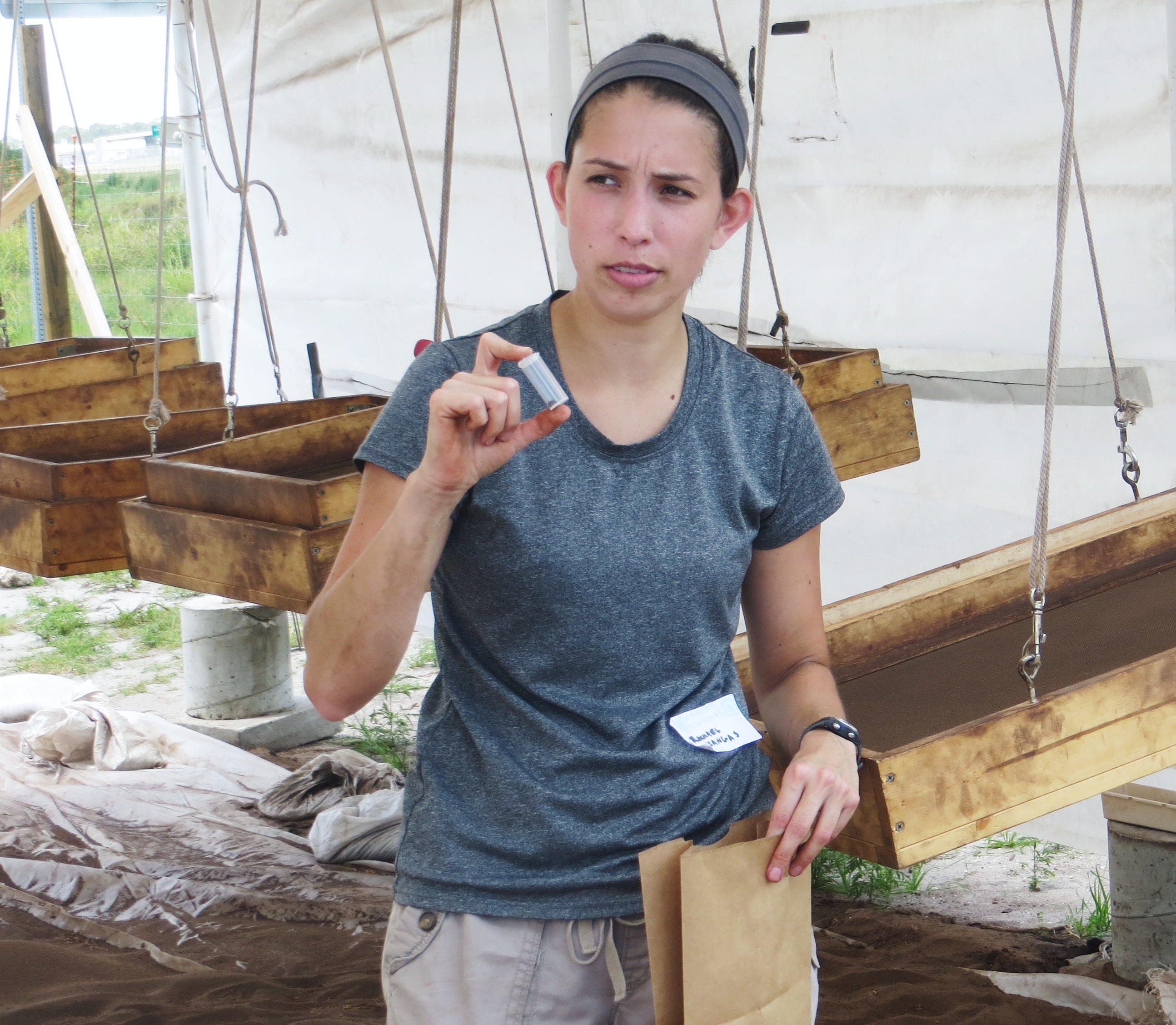
“The site itself was determined using GPS and ground penetrating radar technologies. Every inch is recorded horizontally and vertically.”
Such precise measurement is necessary because this month the entire site will be filled back in with the dirt that was originally removed. “We have to limit our work to the drier months, which means we are closing shop this month. The worst thing that could happen to our site is a heavy rain. Twenty inches of rain could not only destroy what we have accomplished, but it could also cause a breach in the nearby canal, and during the rainy season, a tropical storm could do that.”
Kerr feels that this could be the most significant Ice Age discovery in all of North America if the results are proven. But that may take years, he says.
If you are wondering why the ocean was 60 miles away and land that is currently 12 feet above sea level was once 4-500 feet above sea level, you should know that during the Ice Age, all that water has been locked in the ice. Current levels show how much has melted since the end of the Ice Age. At the rate Arctic and Antarctic ice is currently melting due to global warming, might give you some idea of how our great little community could become a future deep sea diver’s paradise.
 Indian River Guardian