
JANIE GOULD
When Jay Williams was growing up in Fort Myers, his parents expected him to take over the family’s Ford tractor dealership, where he worked until he was a college sophomore.
“I could never see myself as a tractor dealer, but I can still drive a tractor,” he said. “I know how to run a backhoe and a front-end loader, too.”
He used his hands-on knowledge of farm equipment to do the mowing of his mother’s citrus grove near Fort Myers. Ultimately, though, he decided to pursue his passion for art and now, four decades later, is curator of collections and exhibitions at the Vero Beach Museum of Art.
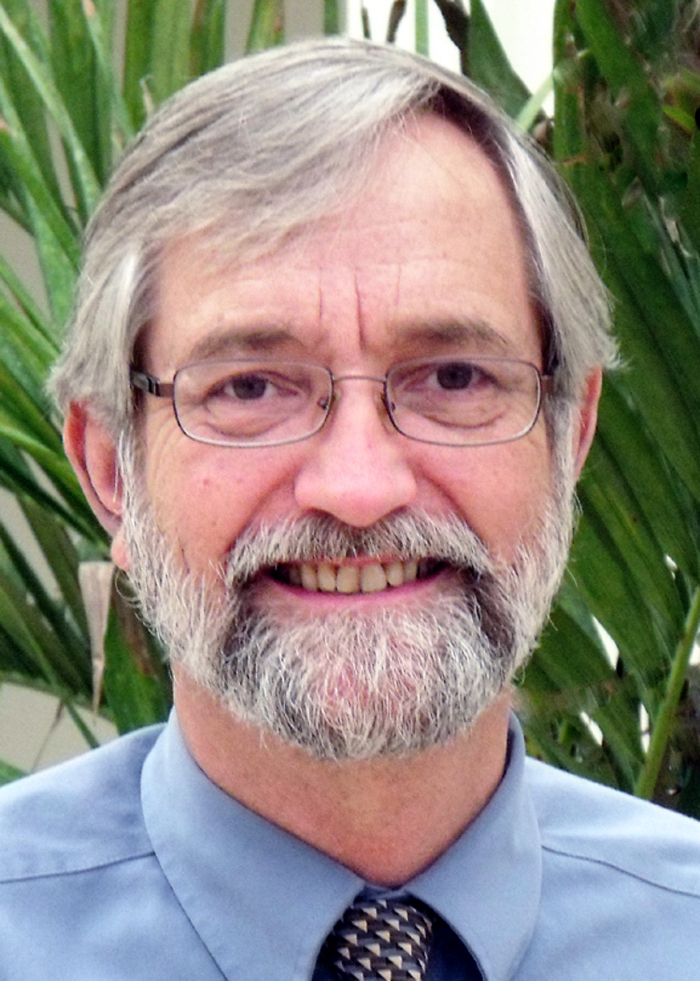
Williams, 64, earned three degrees in art, including a master’s in art history. Besides being an art historian, he has taught art and he paints and does printmaking. With a grey beard that gives him a professorial appearance, but without a trace of academic pomposity, he talks in depth about a host of topics, from the great 20th century artist Robert Rauschenberg, who he worked with in Fort Myers, to Renaissance art, Southern culture, regional art, and a current show at the museum, “Walter Wick: Games, Gizmos and Toys in the Attic.”
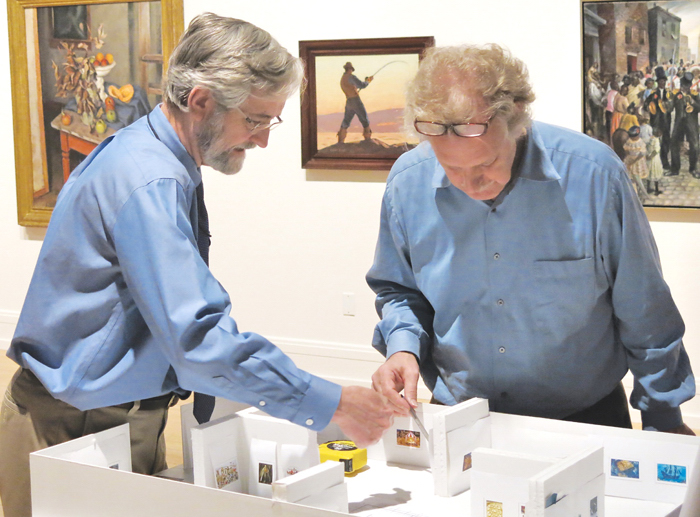
Wick is an award-winning author and photographic illustrator, and his show contains photographs of intricately designed puzzles and illusions that appear to have a lot of moving parts. As Williams guides a visitor thorugh the exhibit room, he points out details that casual observers never would notice, like a small building block at the bottom of a scene that appears to be the foundation supporting a jumble of toys and well, gizmos.
“I love Walter Wick’s work,” he says. “He’s one of the most creative people I’ve ever met. He has a fantastic mind that lets him think from a scientific point of view and a creative point of simultaneously. It’s an unusual combination. He’s very much in touch with how the mind of a child works. He has that unique ability to produce works of art, and I do consider his photographs to be works of art, that appeal to adults and children. ”
Williams says part of his job as curator is to help the general public understand the art they are seeing. Indeed, 40 years ago he became a missionary of sorts to help his practical, businesss-minded parents understand why art mattered so much to him. His mother was fairly supportive, he said, but his father was deeply disappointed that he didn’t want to follow his footsteps into the tractor business.
“Financially, I would have been much better off taking over the business and being a businessman,” Williams says with a laugh indicating he has no regrets.
People often ask Williams what a curator does. He said the term originally was applied to someone who cared for and studied a collection. Later , when museums began to host visiting shows, it took on the connotation of someone who organizes a show. Now, “curate,” a term for a member of the clergy, is often used incorrectly as a verb meaning to organize a show.
“As a curator, what you’re doing is drawing attention to someone else’s creativity and interpreting someone else’s art,” he said. “It’s my job to help interpret that art to the public and perhaps give that work the attention it deserves.”
Williams has worked at five museums, all in the South, and came to Vero Beach from St. Augustine, where he was director of the Dow Museum of Historic Houses. He says most of the South lacks a strong tradition in the visual arts, at least partly because of the type of churches that traditionally have dotted the landscape.
“The Southern churches were basically out of the iconoclastic tradition,” he said. “I grew up Presbyterian. I’m Episcopalian now, and when I was a kid a lot of the churches that drew from the Reform tradition tended to be plan in style.”
It was a reaction against Roman Catholic statuary and stained glass, “all the things I learned to love in art history,” he said.
“If we had been Spanish we would have had all of that,” he said. “In the South we were most comfortable with rich literary and music traditions. I think our predominantly Protestant culture in the South really was a detriment to the development of the visual arts.”
Regional art began to flourish in the South in the 1930s, and in the postwar era, when the National Endowment for the Arts came along, more and more museums were built in the South with some federal dollars.
Many consider Vero Beach to be an anomaly, though. Its art museum was established in 198xxx with much of the funding from Northern transplants who wanted high-quality art, music and theatre in the community.
Planning is under way at VBMA for an exhibit next season that Williams calls “contemporary art for people who don’t like contemporary art.”
“Some of it is textile-oriented, some is found-object oriented, some of it is machine-like,” he said. “I think it will surprise people and they will enjoy it a lot.”
He says it will include some pieces by Rauschenberg, who died in 2008. The artist, whose roots lay in abstract expressionism, used to have a house and studio on Captiva Island, and Williams worked with him when he was curator at the Gallery of Fine Arts at Edison Community College in Fort Myers.
“He was a wonderful person, and was extremely supportive of the arts scene, unlike a lot of people who came and went from Captiva,” Williams said. “He viewed himself as being a member of the local community, and I remember being so surprised when he looked at me and said, do you think people in Fort Myers are going to like my work? He was a small-town Southerner and he had not lost his connection to that culture.”
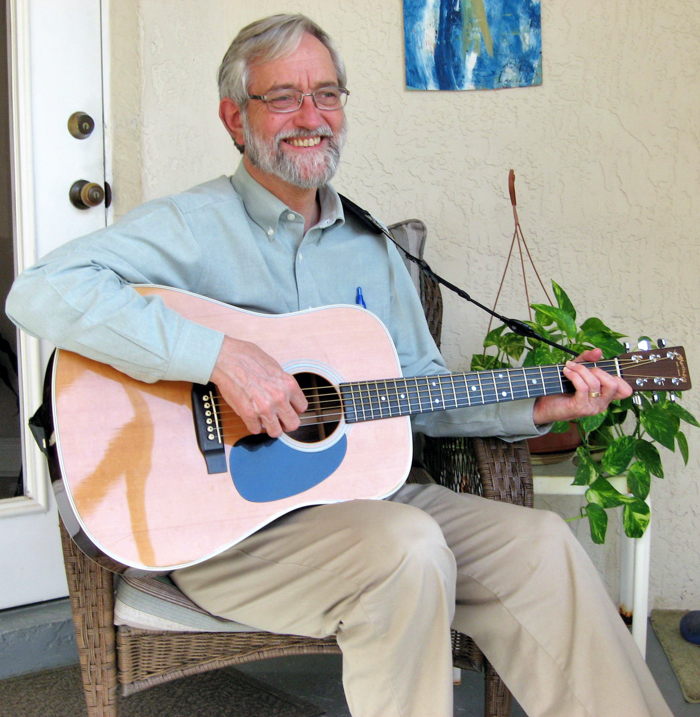
Williams’ own Southern roots play out in his passion for music. He’s a guitarist who often plays old-time spirituals such as “Do Lord” or anthems of the 1960s like “If I had a Hammer“ for friendly gatherings. He also sings, though he says he’s really just an accompanist for others who sing. A cousin taught him to play the ukulele when he was 9. Then, when he was 12, his father had a heart attack.
“The doctor said, Frank, you ought to take up a musical instrument,” he said.
His father bought a guitar but didn’t learn to play, so Williams started playing and has never stopped.
“I was always the kid who had a guitar handy on campus,” he said.
Williams’ painting style is a blend of abstract and realism, and he says the art in his home is not really a collection but rather mementoes of various projects that have accumulated “like barnacles on a boat.”
He calls himself an appreciator of art rather than a collector, and no, he doesn’t have a favorite artist. He’s a generalist who appreciates many styles and many artists.
Williams’ wife, Penney, is an accomplished potter. The couple have two daughters, Brooke Shaw, a hospital educator who lives in Tavares, and Emily Harper, a teacher in South Carolina. The daughters are married and each has a son and daughter.
“It sounds like Prairie Home Companion, that all my grandchildren are above average, but I think they are,” Williams said.
He give s credit for success at the museum to coworkers, including registrar Dana Twersky and chief preparator Matthew Mangold, along with executive director Dr. Lucinda Gedeon, and the exhibition nd collections committees.
“We have a museum family here,” he said. “I think the fact that we’re doing exhibits that the community responds to speaks well for the team we have.”
 Indian River Guardian