
Helping Rescued Dogs Overcome Stress and Why Our Children Should Become Involved
THOMAS HARDY
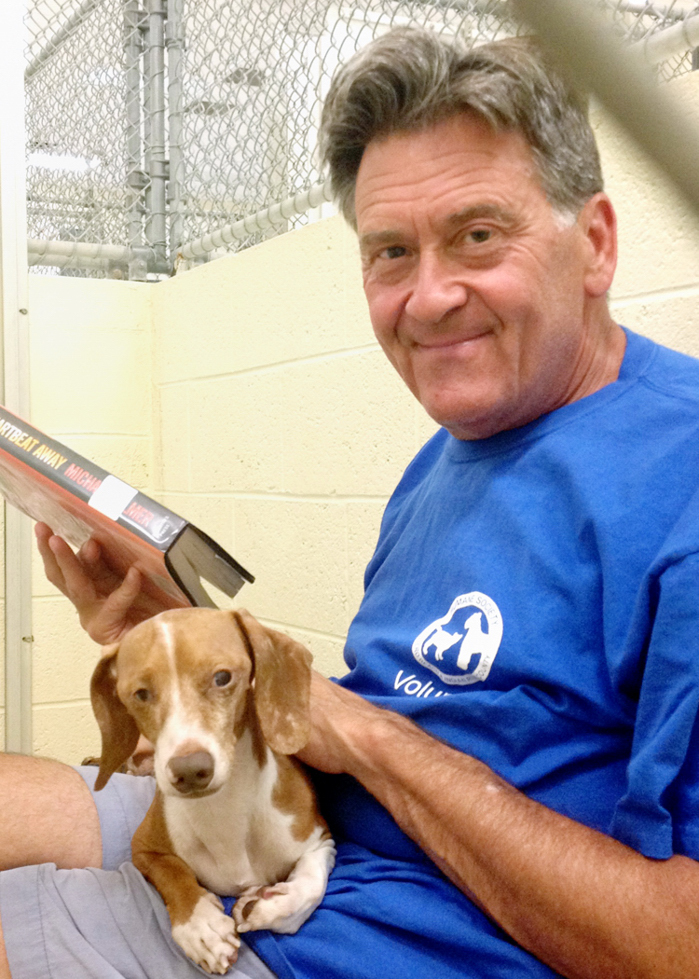
The way the “Read and Relax” Program works for volunteers at The Humane Society is that you enter the adoption center consisting of approximately 20 kennels. It ‘s disturbing to see most of the kennels are always full.
Ask a staff person to point you to a particularly stressed dog. Enter its kennel with a folding chair and begin to read out loud. You have to practice restraint in wanting to pet or play with the dog and ignore inappropriate behavior such as barking, jumping and whining. The purpose of the session is to sit quietly and read out loud. Bring a book or magazine you are currently reading.
Here is a specific example of my own. A beautiful Yellow Labrador was found running wild in Fellsmere early one morning, with no identification tags. The Humane Society was called to rescue the dog. A few hours later I arrived for a Read and Relax session. The lady at the reception desk said the Yellow Lab had just come in and was barking, pacing and jumping up and down in the pen. This fellow, in particular, needed help.
Entering the kennel with a folding chair, I read out loud. At first he was all over me, jumping up, barking, panting and pacing back and forth.
Remarkably, the dog behaved differently as time progressed. He stopped barking, jumping up and pacing, and after 20 minutes was leaning on me. After 40 minutes he was lying at my feet. No more barking, jumping up or pacing.
Why not enjoy reading your book with the satisfaction you have given a dog peace of mind. With smaller dogs they often want to get up in your lap!
This particular Yellow Lab had no tags and thus no name. Since I was early on the scene I was asked to name him. He needed to be registered into the system with a name. My first suggestion was “Wellington,” an ancestor, but no one liked that.
But since I knew this dog would eventually be happy, I said how about “Happy?”
Everyone liked the name Happy. So there you go, he had a name. Then they registered him, took him for a bath and a walk. Such kindness.
When I continued to visit the Society people were talking about Happy! He was a big shot. Eventually, a nice family adopted him. They now visit The Humane Society regularly for training classes. Everyone is talking about Happy!
“Stress” is a major factor in today’s society. It is a widespread condition. Financial pressures, parenting, unemployment, health, aging and personal relationships are some causes of stress. Oxford Dictionaries define stress as “a state of mental or emotional strain or tension resulting from adverse or demanding circumstances.”
Many of us are prone to stress. But have you ever given any thought to animals being prone to stress here in lovely Vero Beach?
We love our dogs here and take extra care to ensure their wellbeing. Surprisingly though, there are an alarming number of stray, stressed dogs running around in the area without identification tags, a home and food and water, rescued by The Humane Society.
Stress can have a detrimental effect on the behavior of dogs, resulting in illness and behavioral problems such as anxiety and aggression. Significant causes of stress in dogs can be grief due to scary events, uncertainty, hunger and thirst, lack of sleep, abuse and pain. There is no doubt many of the dogs rescued by The Humane Society suffer from these conditions.
The first and most comprehensive efforts to define an animal’s basic needs were addressed by Brambell Commission, established in Great Britain in 1965. The Commission defined five basic needs, known as “The Five Freedoms.” These are to 1) ensure your animal is free from hunger, thirst and malnutrition, 2) free from discomfort, 3) pain, injury and disease, 4) free to express normal behaviors and 5) free from fear and distress.
Without these “Five Freedoms,” dogs exhibit restlessness, jump up, are hyper-vigilant, irritable, have hyperactivity, bark, growl and whine. Chronic stress can lead to distress, which in its worst form can be actual pain.
Originally developed at the Animal Refuge League of Greater Portland in Westbrook, Maine, the Read and Relax program was designed to help decrease dog’s arousal and stress levels on the adoption floor as adopters pass through, and to help increase the dog’s success in their new home.
So the purpose of the Read and Relax program is two-fold. On one hand it is about helping a dog calm down and relax. Dogs hang out with you at home when you are watching TV, reading, cooking and reading. Reading out loud creates this same atmosphere. It calms them.
And by calming them, they become more appealing to people wanting to adopt them. No one wants an unpleasant dog. They want a happy dog! That’s essentially the mission of The Humane Society: to market rescued dogs to qualified people for adoption where they will provide the dog with a safe environment.
Why Children Should Be Involved
Research now suggests that dogs can actually help children learn to read. A study in 2010 by researchers at the University of California, Davis, concluded that children who read out loud to dogs improved their reading skills 12%, over the course of a 10-week program, compared to children in the same program who did not read to dogs, who showed no improvement.
Hannah Richardson, a BBC News Educational Reporter, reported on the ABC website, that “children can be nervous and stressed when reading aloud in class.” They struggle and are often laughed at by their classmates when stumbling while reading.
But by reading out loud with a dog, children read without the pressure of a classroom. Dogs are nonjudgmental, attentive, and perfect listeners. You can make mistakes. There is no pressure. It’s fun. It’s a private session between the child and the dog. Your child will begin to enjoy reading!
Specifically in regard to students in Indian River County, the School District has implemented an Accelerated Reading Program for students in grades K-12. The program is a computer based reading management and motivational system. Students must set aside 35 minutes for reading each school day. Mom’s and Dad’s have to sign off on the exercise. This is homework. But why not do it with a dog needing love and attention, in a non-pressure and enjoyable environment?
The only limitation for students reading to dogs at The Humane Society is that they have to be 10 years old and be accompanied by an adult until age 18. But as a parent with the Accelerated Reading Program you have to sign off on their reading anyway, so why not do it with them in a happy and motivational setting?
In the end, the most compelling factor of all this is that the program will build your child’s self-esteem. What can be more important than that? This is the key ingredient to meaningful life.
The Humane Society program is not only good for the dogs – it’s also good for you. Involve your children. Let them experience the feeling of contributing to the welfare of a dog, building their own self-confidence, purpose and establishing a meaningful new relationship. Think of the boost this can give your child? Go do it!
Editor’s Note: Thomas Hardy is a regular volunteer at the Humane Society of Vero Beach and Indian River County. The perspectives in this article are his own personal views, not those of The Humane Society itself. Professionally, Mr. Hardy lives in Vero Beach, specializing in business development. He can be reached at 781-635-2251 or hardythomast@gmail.com. If you are interested in the Humane Society’s Read and Relax Program, please contact Millissa Ferrer, Volunteer Coordinator at 772-388-3331 ext.12.
 Indian River Guardian