
COMMENTARY
“In a sense, though, there is some consistency in Gatewood’s and Brunjes’ statements. Rather than a partial sale, the company may be scheming with the Shores Town Council and with the Indian River County Commission to orchestrate a partial ‘steal.'”
MARK SCHUMANN
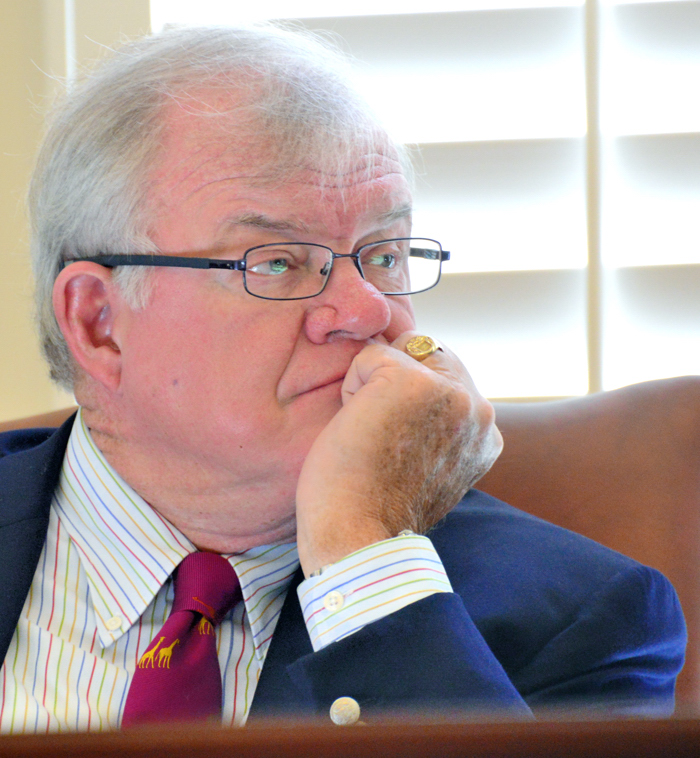
In a desperate act of what appears to be collective insanity, the Indian River Shores Town Council today voted unanimously to file a lawsuit against the City of Vero Beach. The lawsuit is an effort to force the City to remove its electric utility infrastructure from within Indian River Shores.
These five mature men have surely outgrown the use of recreational, mind-altering drugs. What, then, could they be thinking?
The Town Council’s willingness to spend $250,000, perhaps up to $1 million, to prosecute a lawsuit that is based on Charlie Wilson-style legal reasoning just goes to prove the town has money to burn – lots of it. One Shores Town Councilman acknowledged to me that the ultimate legal cost to the town could reach $1 million. Vero Beach will have its own legal costs, which will be borne by its electric customers, including the 3,500 within Indian River Shores. Essentially, all the Shores Town Council’s lawsuit will accomplish will be to further drive up electric rates for the citizens.
The third conclusion to be drawn from the news of the Shores lawsuit is that in accepting this case, the Holland & Knight law firm is proving the axiom that 98 percent of lawyers give the rest of them a bad name.

Like Debbie Mayfield’s four failed utility bills, none of which ever made it out of committee, and like all of Florida Power & Light’s crafty efforts to force the Florida Municipal Power Agency to abrogate its legal commitments to bondholders, and like every addle-brained idea the Heran-Faherty-Wilson crowd has put forward, this lawsuit is going nowhere.
Not only does the City of Vero Beach have a right to serve its 3,500 customers within Indian River Shores, it has a legal obligation to do so. The Shores Town Council’s decision not to renew the existing franchise agreement, which will expire on Nov. 6, 2016, in no way relieves the City of Vero Beach from its obligation to provide electric service to its customers.
FPL spokeswoman Sarah Gatewood indicated yesterday FPL is prepared to provide service to Indian River Shores, should the Town end its franchise agreement with Vero Beach. FPL and the Shores would first have to persuade the Florida Public Service Commission to alter Vero Beach’s designated service territory.
As has become typical for FPL, the company’s spokespersons are talking out of both sides of their mouths. FPL External Affairs Manager Amy Brunjes has publicly insisted the company is focused on completing an acquisition of Vero Electric’s full system and is not interested in a so-called partial sale.
In a sense, though, there is some consistency in Gatewood’s and Brunjes’ statements. Rather than a partial sale, the company may be scheming with the Shores Town Council and with the Indian River County Commission to orchestrate a partial “steal.”

The only merit I can see to the Shores lawsuit is the request that the courts require Vero Beach to hold a referendum of its electric customers to determine whether a separate utility authority should be formed that will be accountable to all customers. This authority should have been formed years ago, before Tracy Carroll, Craig Fletcher and Pilar Turner cozied up to FPL. See: Despite objections from Fletcher and Turner, Council so consider forming utility authority)
Ironically, if what the members of the Shores Town Council really want is FPL rates, they could achieve that result by persuading FPL to buy the Indian River Shores customer base from Vero Beach. What they really seem to want is a fight.
Before the Shores lawsuit goes to court, there will be a 100-day mediation period. By state law, disputes between local governments must first be mediated. Though at least one Shores council member indicated privately he is prepared to lay $1 million on the crap table, what the Shores Town Council is probably angling for is a mediated settlement in which the Vero Beach City Council capitulates. Had Tracy Carroll been re-elected, the Shores Town Council almost surely could have achieved a win-lose agreement benefiting the Shores at the cost of Vero Beach, which is may be why Cadden publicly supported Carroll and contributed to her campaign.
Perhaps the most puzzling statement made during today’s Shores Council meeting was Barefoot’s assertion that the rate differential between Vero Electric and FPL amounts to “a tax on our citizens.”
Currently, FPL’s rates are among the lowest in the state. Following Barefoot’s logic, every electric customers in Florida who is not a customer of FPL is paying what amounts to a “tax.” This kind of logic argues for a monopoly for FPL.
Further, Barefoot’s claim that Indian River Shores customers, collectively, are paying $2 million more with Vero Electric than they would with FPL is, at best, suspect. As of May, Vero Electric’s rate for 1000 kilowatt hours of residential use is $129.42. FPL’s is $99.17 – a rate differential of 23.4 percent. The Board of County Commissioners would, of course, assess a 6 percent franchise fee, reducing the rate differential to 18.8 percent for out-of-city customers. Presumably, the Shores Town Council would not assess a franchise fee.
Vero Electric’s annual billing for all residential customers is approximately $45 million. Indian River Shores represents approximately 8 percent of the city’s residential customer base. Assuming the residential rate differential between Vero Electric and FPL is approximately $10.5 million, then Indian River Shore’s proportionate share of that is closer to $800,000, not $2 million.
When they meet next on Aug. 19, the Board of County Commissioners may well follow the Shores Town Council’s lead. By doing so, they will be checking themselves into the same cuckoo’s nest where the Shores Town Council has chosen to reside.
 Indian River Guardian
fpl isn’t interested in any more customers but rather all customers of any city grid. their greed will be their undoing. more customers even if its a few thousand more is better then none.
While neither understanding nor approving of the Shores’ action Barefoot’s comment is not just on track it’s a valid assessment of the underlying issue of COVB’s electricity enterprise. COVB has been for decades using cash from its electric utility – funded in part by residents outside of the City – to underwrite a lower tax rate for COVB taxpayers. So Barefoot is correct. The higher COVB rates are in effect a tax on residents for the benefit of Vero taxpayers.
The higher COVB rates are in effect a tax on residents for the benefit of Vero taxpayers.” Should have said “…tax on NON residents . . .”
They want us to do something we legally cannot do? Remove our electric infrastructure from Indian River Shores? Well, since we are already going to be involved in a legal battle anyway, I’m all for just turning off the electricity to Indian River Shores immediately and remove what the City of Vero Beach put into place. I hope they enjoy eating by candlelight; meals prepared on grills; and walking up stairs instead of elevators in some condos……and using generators of all sizes. What an ungrateful bunch of folks. I find it hard to believe everyone in that town feels the need to destroy Vero Beach in order to help FPL achieve its ultimate goal of sovereignty on Florida’s Electric Power Grid.
Bob, one could argue the portion of the rate differential which goes to the city’s general fund is a form of a “tax,” but to argue that the full rate differential is a tax is at best a novel argument. FPL has not always been the lost cost power provider in the state. At the point in time when others were selling power for less than FPL, would you have argued that FPL customers were paying a “tax”? You are buying into Mayor Barefoot’s exceedingly simplistic messaging.
Further, Barefoot’s claim that Indian River Shores customers, collectively, are paying $2 million more with Vero Electric than they would with FPL is, at best, suspect. Currently, Vero Electric’s rate for 1000 kilowatt ours of residential use is $129.42. FPL’s is $99.17 – a rate differential of 23.4 percent. The Board of County Commissioners would, of course, assess a 6 percent franchise fee, reducing the rate differential to 18.8 percent for out-of-city customers. Presumably, the Shores Town Council would not assess a franchise fee.
Vero Electric’s annual billing for all residential customers is approximately $45 million. Indian River Shores represents approximately 8 percent of the city’s residential customer base. Assuming the residential rate differential between Vero Electric and FPL is approximately $10.5 million, then Indian River Shore’s proportionate share of that is closer to $800,000, not $2 million.
Mark,
I was simply responding to your extension of Barefoot’s comments to FPL ratepayers across their entire service area. I think that’s a specious argument. Barefoot was, in part, “right for the wrong reasons.” While I, as I said, disagree with the the Shores’ wrongheaded action, I think you begin to loose the argument by not acknowledging that non-COVB citizens are, in effect, paying a “tax” by their subsidization of COVB taxes. Moreover the stripping of operating cash to underwrite COVB’s tax budget while not setting aside adequate provisions for maintenance, upgrades and debt service is a large reason for the city’s current financial problems. (That and stupid acquisitions of overpriced land by former council, but that’s another story.) And the higher rates charged by the city to enable that subsidy are the reason non residents are pushing the sale. Don’t blame them.
Resorting to hyperbole or dismissing reasonable concerns on the other side won’t make your argument more effective.
Bob, if Vero Electric’s rates were within the statewide average, and the City were transferring six percent of its revenue to the general fund, would you still consider that six percent as a “tax” on non-residents? It would seem to me that if the city charge competitive rates, not necessarily with FPL, but with the statewide average, then the city has every right to earn a “profit” and to use that profit as it sees fit. No one is arguing the FPL’s profit amounts to a tax, or even that Duke Energy’s profit amounts to a “tax.” (With its recent rate cut, Vero Electric’s rate is close to that of Duke Energy.)
My criticism of Barefoot’s argument, is that he seems to be asserting that the only “reasonable” rate is the rate being charged by FPL. All of the rates below have been approved by the Florida Public Service Commission. By claiming damages of $2 million, the Shores suit seems to assert that only FPL’s rate is reasonable. Vero Beach’s current rate is $123, and FPL is up to $101.
1000 KWH (as of May, 2014)
Florida Power & Light – $99.17
Gulf Power – $128.70
Duke Energy – $122.16
Tampa Electric – $106.87
Florida Public Utilities NE – $121.33
Florida Public Utilities NW – 128.98
Mark,
Guess I did not make my point clear. As I said, I don’t agree with the Shores’ actions. I was merely pointing out that Barefoot’s comments summarized the main complaint of non COVB rate payers who are paying a premium that has, in the past, been used to underwrite city taxes. If the rates were competitive – a 23% margin while better is not “competitive” – no one could reasonably argue against the city’s making a reasonable profit for the benefit of the city. And while your list of other utility rates is informative, it’s not germaine. None of those listed is, as far as I know, in position to supply power to this area.
My point was not to support the Shore’s wrong headed action but to offer that by going down the same road of hyperbole and overstatement, you weaken your position, IMO.
COVB has mismanaged its utility system in the past. It has ignored the complaints of non-resident rate payers. That is the basis for much of the present argument. Ignoring that basis does not help the debate.
Bob, I think the rate comparisons statewide are, indeed, germane. Just because Vero Beach may happens to have a service territory contiguous to the state’s largest electric utility does not make a rate comparison between the two the only relevant measure. The Shores is arguing Vero Beach’s rates are unreasonably high, yet the city’s current rate is lower than the current rate for a number of utilities that are regulated by the Florida Public Service Commission. With all due respect, I do not consider it hyperbole to suggest that FPL would like, if it can, to get something for nothing.