
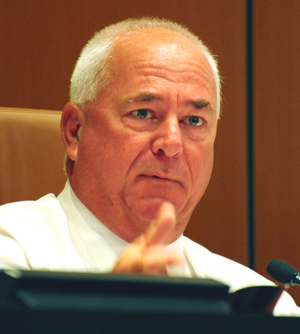
Editor’s Note: Soon after Inside Vero posted a story reporting on the Indian River County Commission’s 6 percent franchise fee that is added to utility bills for Vero Electric’s county customers, County Commission Chairman Peter O’Byan wrote pointing out information he believes would make our coverage more complete. The following is the complete correspondence between Commissioner O’Bryan and Inside Vero editor, Mark Schumann.
See: County Commission adding 6 percent to Vero Electric’s bills to county customers
July 25, 7:54 AM
Mark,
You may wish to include the fact that the county charges FP&L customers the same 6% franchise fee. So to help you make an apples to apples comparison, compare the City’s base rate of $123 (your figure) to FP&L base rate $101 (again your figure), difference of $22, City is 21.8% higher than FP&L. In addition, because the city rate is higher, city customers pay $1.32 more in the franchise fee than FP&L customers.
Peter
July 25, 10:08 AM
Peter,
I get it that accessing a franchise fees is a common practice of local government. Without making any investment, and without providing any added value, the County Commission, for example, extracts millions in franchise fees from the customers of Vero Electric and FPL.
Mark
July 25, 10:14 AM
Mark,
The electric franchise fee goes into the county’s municipal services fund. The municipal services fund covers the county aquatic centers, recreation, ocean rescue, parks, code enforcement, and planning, in addition to significant transfers out to transportation and law enforcement. Your statement that the franchise fee doesn’t add any value is pretty lame. Oh, by the way, the county residents get to VOTE on their representation for how those funds are expended. What a noble concept! Too bad the county rate payers don’t get a vote on the city transfers.
Peter
July 25, 10:22 AM
Peter,
You and I both know the franchise is assesses in place of a higher mileage rate, at least partly because many, if not most, electric customers never give a thought to the fact that the franchise fee is a County tax.
Mark
July 25, 10:41 AM
Peter, Mark
You and I both know the franchise exorbitant rate is assessesed in place of a higher mileage rate, at least partly because despite that many, if not most, electric customers never give a thought to realize the fact that the franchise fee exorbitant rate is a County City tax over which they have no vote.
So now you are trying to make the entire discussion over the county’s franchise fee (which again is assessed to all county electric customers regardless of service provider, provides substantial services to the community, and they get to vote on their representation) but you are conveniently forgetting the original point of discussion, the city’s base rate is 21.8% higher than FP&L at the 1000 kw level. The city could have begun some meaningful rate reduction with the upcoming budget by reducing the amount of transfer and then raising the millage rate to cover the shortfall. A three year planned phased approach to significantly reduce the base rate would have gone a long way towards resolving the current rate issue. Unfortunately the city did not have the political courage to do the right thing.
Peter
July 25, 11:16 AM
Peter,
What I find interesting is how sensitive you seem to be to having attention called to the County’s franchise fee. Further, you define Vero Electric’s rate as “exorbitant” by comparison to FPL. There are, in fact, many other electric utilities in Florida, including investor-owned utilities, charging as much as or more than Vero Electric. In the case of the investor-owned utilities, those rates have even been approved by the PSC.
Most discontentment is around comparison, and it seems to me there is a cottage industry is Vero Beach and Indian River County making its living fostering discontent.
If unshackled by the asset purchase and sale agreement with FPL, Vero Beach could likely get its rate down to within the statewide average. Unfortunately, that would not be good enough for those who have assumed discontentment as their default posture.
Mark
July 25, 2014 2:36 PM
Mark,
If you look at my original email you will see what I was sensitive to was your one-sided reporting, only showing the franchise fee on city customers and totally ignoring the fact that it is applied to FP&L customers as well. If you’re going to make a comparison, you should provide all the facts.
Peter
July 25, 2014 3:10 PM
Peter,
It might have looked better for the County Commission if the story had included the fact that FPL’s Indian River County customers also must pay the County a 6 percent franchise fee, but that fact is, at best, tangential to the story I wrote. The facts I presented were intended to put in context the rate comparison between Vero Electric’s out-of-city customers and FPL’s county customers
At $101 plus the County’s 6 percent franchise fee, FPL’s customers in the unincorporated areas of Indian River County are paying approximately $107. Vero Electric’s county customers are paying $130.38, including the county’s 6 percent franchise fee. That equates to a rate differential of 17.9 percent, which is exactly the number I reported.
The current base rate differential between Vero Electric and FPL is $22. If assessing a 6 percent franchise on out-of-city customers brings in $1.32 more per KWH, then why not just drop your franchise fee on those 17,000 customers so that you are collecting the same per KWH for all residents in the unincorporated areas of the county. Again, my point is that the County Commission is choosing to be a part of the problem, rather than a part of the solution.
Mark
July 27, 2014 1:32 PM
Peter,
Because I respect you and admire your political courage, I want to believe you are quoting the percentage highlighted below without realizing it is misleading. It has been the practice of the FPL propaganda team to cite the percentage Vero Electric’s rate is above FPL. That number, though, is not an indication of how much someone will save if and when they switch to FPL. Rather, the percentage you cite is how much more someone would pay switching from FPL to Vero Electric. Since no one is contemplating doing that, using FPL’s rate as the denominator yeilds a meaningless comparison, though it is effective propaganda.
1. FPL’s rate for 1000 KWH is 17.9 percent below Vero Electric.
2. Vero Electric’s rate is 21.8 percent above FPL.
You will continue to cite the number you want, but the comparison that is meaningful and relevant is the former.
Mark
 Indian River Guardian
I would suggest to Peter O’Bryan (whom I do like in spite of some disagreement with him), that when/if FPL is awarded the electrical system (which seems to be the goal of some), NONE of us will be able to vote on ANYTHING that company does. The (few) voters who took time to put Carroll and Turner on the City Council (and for a time, Mr. Heady and for a SHORTER time, Mr. Wilson), provided the votes (Mr. Fletcher joined in) to put us where we are today. Getting out of the mess is hindered by having one of Mr. Wilson’s closest buddies (Mr. Stradley) pushing when the rest are pulling. It is hoped we can get our utility rates down. In the meantime, we could all make an honest attempt to use less power where possible, just like many of us try to use less gasoline by making fewer trips to complete basic errands. Anyway, I do hope there will be a reasonable resolution.
Cathy, I, too, have much respect for Mr. O’Bryan. On this issue, though, I think he is misguided. Th belief that the Florida Public Service Commission will ultimately do anything other other than rubber stamp FPL’s frequent requests for rate increases is a notion laboring under dilution or naiveté. See: http://insidevero.com/2013/10/21/at-the-psc-a-confederacy-of-yes-men-and-women/
Someone suggests to me that they way the County Commission spends its 6 percent on Vero Electric’s billings is no different from the way Vero Beach spends its 6 percent. Both governments use the revenue to pay for basic, general fund services. The real difference, though, is that the City has taken the risk to run an electric utility and to provide a valuable, essential service. For its 6 percent revenue on Vero Electric’s billings, the County has done nothing, absolutely nothing – except, of course, complain.
So if these “ratepayer” get to go with FPL they get a say in what FPL does with their money.
Vero Beach does just about the same thing the county does with their franchise money, they just have to work harder and take more risks.
Vero Beach is a great place to live, our kids are thankful they grew up here. Why destroy it?