
COMMENTARY
MARK SCHUMANN

Speaking before and/or pandering to the crowd during a Tea Party candidate forum Wednesday evening, Indian River County School Board District 4 candidate Charles Searcy said, “We’d have a happy school district if teachers would just stop worrying about their evaluations and pay.”
Unlike Searcy, many believe better education outcomes will newer be achieved simply by bashing teachers.
In January 2013, Jamie Vollmer, author of “School’s Can’t Do It Alone,” addressed 300 educators and community leaders at Indian River State College’s Richardson Center. The following is an article I wrote at the time summarizing Vollmer’s message.
BY MARK SCHUMANN
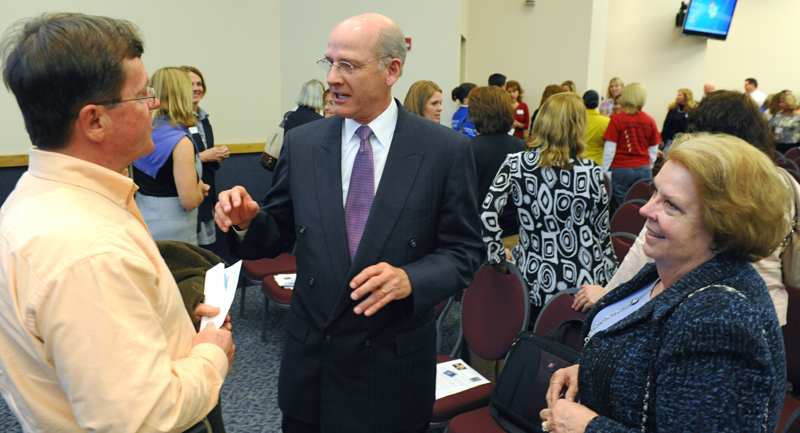
Once convinced teachers were the weak link in America’s schools, Jamie Vollmer, a successful executive turned education activist, now believes the fundamental problem with public schools is that they were never designed or intended to teach all children to their highest potential.
Speaking before a crowd of approximately 300 educators and community leaders at the Indian River State College’s Richardson Center, Vollmer said the time has come to begin “a great conversation” between educators, community leaders, and those who no longer have children in school. That conversation, he said, must be centered on better understanding why and how schools need to change.
Vollmer’s address capped off a two-week-long launch of the Learning Alliance’s public awareness campaign calling attention to a new initiative of achieving 90 percent literacy among Indian River County third graders by 2018.
Vollmer said that objective, which a coalition of educators and local leaders are calling their “moonshot moment,” will require a sustained effort to build greater understanding of the challenges schools now face, and a greater appreciation for the ways improvements in education can affect the quality of life in a community.
Having spent time working with teachers in their classrooms, Vollmer said he is convinced that as a group they are as hard working, competent and motivated as those in any other profession.
Vollmer, the author of Schools Cannot Do It Alone, said one challenge in building consensus for meaningful reform is to help the broader community understand how improving education can benefit everyone – by reducing crime rates, cutting indigent health care costs, bringing down unemployment and in other ways preserving and improving the quality of life.
“There is both a moral and practical motivation for improving schools,” Vollmer said, “and we need to help people understand why changing the system is the right thing to do.”
Vollmer explained that the global economy has changed since the 1950s, when the high school dropout rate in Florida, for example, was 50 percent. “There is no longer a place where dropouts can drop in,” he said, adding that the time has come to rethink many of the assumptions that underlie the current structures of education.
“We group students by their date of manufacture,” he said half-jokingly, adding that the practice doesn’t make any sense, because children do not all learn at the same speed, or in the same way.
Reflecting his own shift in thinking about how to improve schools, Vollmer said, “We don’t have a people problem (teachers), we have a system problem, because the system was never designed to teach all children to their highest level, only to teach some children to a high level.”
Seismic shifts in the world economy have led to the evaporation of many unskilled and semi-skilled jobs once filled by high school dropouts, and by those high school graduates who did not continue on to college.
In the mid-1960’s, Vollmer explained, 70 percent of unskilled and semi-skilled jobs paid a living wage. “Today only 16 percent of those jobs pay a decent, respectable wage, and in five years that number will be down to six percent.”
Vollmer said four major issues must be addressed before there can be significant improvements in education: the current practice of grouping students exclusively by age; the teaching of a curriculum “set in stone” in the late 1890s; the school calendar; and an eight-decade trend of placing ever-increasing responsibilities on schools.
After decades of society having placed more and more demands on schools to teach non-core curriculum courses, including drivers education, home economics and sex education, there is precious little time left to help students develop the key skills they will need to compete in the new economy.
Pointing to Scouting and higher education as two examples of where the pace of learning is variable, Vollmer makes a case for more flexibility. As if learning is a race, the school year starts on a certain date, ends some nine months later, and then its on to the next grade. For millions of children, this rigid schedule isn’t working.
“If time is held constant, then quality is the variable,” Vollmer said, adding that when public schools were first conceived in the 1790s their objective was to do what Thomas Jefferson characterized as “raking the genius from the rubbish.” To prepare America to compete in the 21st century global economy, Vollmer argues that the country can no longer afford to squander the talent of millions of children who just happen to not learn at the pace prescribed by the traditional school calendar.
Finally, Vollmer said, education policy making, which has become highly concentrated in state legislatures and state departments of education, should be decentralized. Vollmer said many of the mandates being placed on local boards of education, well-intentioned though they may be, are only serving to impede progress.
Following Vollmer, Ray Oglethorpe, former President of American Online, and a founder of the local Learning Alliance, said that, along with its 44 partners, the Alliance would continue to work to help teachers be effective. “We are bifurcating as a nation between haves and have-nots. We cannot let children fail,” he said.
 Indian River Guardian
It is long past time for the Tea Party to recognize that we are living in the 21st century. Our students today are going to have to compete in a global economy. Public education is the best investment that this nation has ever created.
It has my experience that teachers worry about more than their evaluations and pay. Teachers worry about how to meet the needs of the child where domestic violence is the norm. Teachers worry about the children who come to school sick because their parents are not able to afford a day off work. Teachers worry about how to meet the needs of the students who routinely make A’s and still have time to meet the needs of the underachievers.
Any candidate for the School District should first be required to read: “Disrupting class — How distruptive innovation will change the way that the world learns” by Michael B. Horn and Curtis W. Johnson
The underlying idea is that bad teachers and bad teaching exist and shouuld be weeded out, Give credit where creditis due – what about the administrators?
If that was Mr. Searcy’s underlying idea, then that is what he could have said, instead of saying something quite different.