
COMMENTARY
MARK SCHUMANN

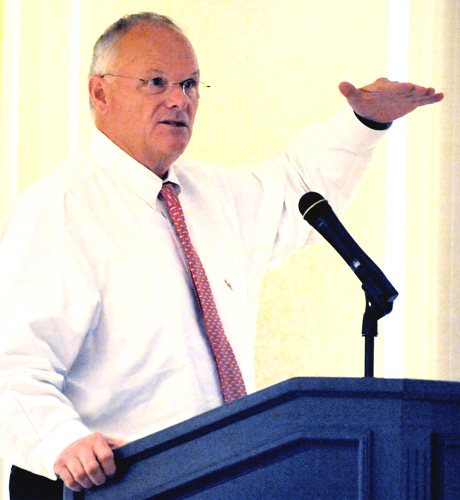
“From the beginning, to all but the most wishful thinkers among pro-sale fundamentalists, the County Commission’s petition seemed, at best, a novel idea, one that may well have been cooked up while County Commissioner Bob Solari and utility activist Glenn Heran were power walking together.”
Florida Power & Light weighed in today against the Indian River County Commission’s effort to break new ground in utility law. The County Commission is asking the Florida Public Service Commission to subordinate its jurisdiction over service territory assignments to a County Commission’s authority to enter into franchise agreements. FPL is joined by nearly every Florida electric utility,including the Orlando Utilities Commission and the Florida Municipal Electric Association, in advising the PSC to deny the County Commission’s petition.
OUC
Arguing an affirmative response to Indian River County’s petition would seriously impact all utilities, Christopher Browder, attorney for the Orlando Utilities Commission wrote, “A declaratory statement indicating that a local franchise dispute could mandate the transfer of transmission facilities, transmission service obligations and retail customers without any recourse or oversight by the Commission and without regard to an existing territorial agreement would…lead to uncertainty in resource planning for the affected utilities, and could lead to the degradation or interruption of service of the integrated grid system in the State of Florida.”
Browder added, “The Petition (Indian River County Commission) has requested declaratory statements that, if answered in the affirmative, would apply not only to the City and the County, but potentially to investor-owned utilities and other utilities that own and operate electric distribution and transmission infrastructure subject to local franchise agreements.”
The OUC’s lawyer explained that an affirmative response to the County’s petition would impact the OUC’s rights under its agreement with the City, “as well as impacting operational decisions by OUC and other municipal and investor-owned utilities.”
Browder urged the PSC to dismiss the County’s petition.
FMEA
Representing the 34 members cities of the Florida Municipal Electric Association, Arthur Lacerte Jr., Vice President and General Counsel for the Kissimmee Utility Authority also asked the PSC to dismiss the County’s petition or, essentially, to refute the County’s claims.
Lacerte wrote, “The Board (Indian River County Commission) essentially asserts that the franchise agreement between the County and the City, rather than and superlative to the Commission-approved territorial agreement, is the singular source of the City’s authority to operate that portion of its electric system located in unincorporated Indian River County…the County wrongfully supposes that the franchise agreement between the City and the County is the ‘sole legal authority’ for the City to use the County’s rights-of-way to provide electric service to unincorporated portions of the County.”
Lacerte continued, “It is the Commission (PSC), not a county or municipality, which possesses exclusive and superior jurisdiction over territorial matters and has the legislatively-mandated responsibility for the planning, development, and maintenance of a coordinated electric power grid throughout Florida.”
FPL
After weaving in a few jabs and low blows directed at the Florida Municipal Power Agency, FPL Senior Counsel Patric Bryan wrote, “It is FPL’s position that the Petitioner’s requested declaratory statements should be dismissed or denied to the extent the declarations it seeks run counter to the Florida Public Service Commission’s exclusive and superior jurisdiction over territory matters and the planning, development, and maintenance of a coordinated power supply grid throughout Florida.”
Bryan continued, “FPL asserts that the Florida Public Service Commission has exclusive jurisdiction to approve territorial agreements and regulate territorial boundaries, notwithstanding the expiration of any franchise agreements, and that such territorial agreements continue until modified by the Commission.”
The County Commission’s assertion is that with the termination of its franchise agreement between the County and City of Vero Beach the City will no longer have the right to provide electric service to its out-of-city customers. From the beginning, to all but the most wishful thinkers among pro-sale fundamentalists, the County Commission’s petition seemed, at best, a novel idea, one that may well have been cooked up one morning while County Commissioner Bob Solari and utility activist Glenn Heran were power walking together.
The crux of the Town of Indian River Shores’ lawsuit against the City rests on the same logic the County Commission employed in seeking the PSC permission to essentially seize Vero Electric utility infrastructure and customer base outside the city limits. If the PSC rejects the County Commission’s request to turn established utility law upside down, the Shore’s suit will almost surely crumble, though it may take the members of the Shores Town Council some time to accept the reality that their participation with the County Commission in a coordinated assault on the City of Vero Beach does not represent the high point in the history of the Town of Indian River Shores.
Both the Shores Town Council and the Indian River County commission claim their actions are motivated solely by a desire to seek rate relive for their constituents. Unlike the Shores, the County Commission levies a 6 percent franchise fee which costs County customers of Vero electric approximately $2.8 million a year. That money flows directly to the County’s general fund.
Critics of the City of Vero Beach consistently fault the City from transferring $5 million a year to the general fund from Vero Electric; which essentially is a return on its major asset. The only assets the County has dedicated to Vero Electric are rights of way which are minimal.
The Indian River County Commission could, therefore, provide instant rate relief to its constituents and reduce total Vero Electric rates by 5 percent for customers in the unincorporated areas of Indian River County.
Editor’s Note: Florida Power & Light’s filing with the PSC notwithstanding, InsideVero will continue to seek fulfillment of a legitimate public records request made of the County on July 21. Though a month has past since the records request was submitted to County Attorney Dylan Reingold, the County has yet to provide the requested documents.
Whether FPL initially offered the County any assistance, advice, support, or encouragement in the filing of its PSC petition remains a legitimate question, as does the question of whether the County and the Shores Town Council have in any way coordinated their legal assaults on the City of Vero Beach. See: Records requested of Shores Town Council, County
 Indian River Guardian
What’s a few million more to attorneys at this point. It is so nice of Solari and the boys voting to have the City of Vero Beach residents having to pay lawyers to sue ourselves and to have the City of Vero Beach residents to pay to defend ourselves.
It is just a matter of time when the” bright lights” of Indian River Shores, the county and people like Wilson, Turner and Heran come to the realization that they are spinning their wheels and causing enmity and harm to Vero Beach. Thanks Charlie, Pilar, Glenn and ,of course Bob Solari , the hidden hand behind this mess.