
COMMENTARY
“Heran, like the leaders of the now-defunct Arthur Anderson accounting firm, touts his credentials as a CPA. He, too, offers an outrageous presentation of the ‘facts.'”
MARK SCHUMANN
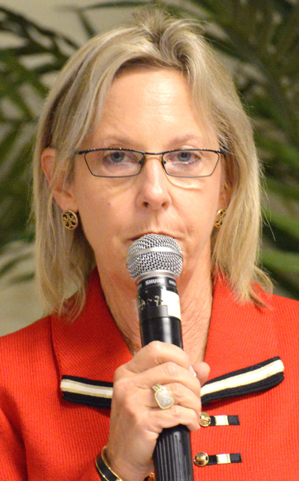
Just as Vero Beach voters began receiving absentee ballots Thursday, the latest letter from Florida Power & Light External Affairs Manager Amy Brunjes also showed up in the mail. The timing is no coincidence.
Not content to allow Vero Beach politics to unfold without her company’s considerable outside meddling, FPL’s master of spin essentially urged voters to support council candidates who are determined to spend millions of dollars in a risky legal battle with the Florida Municipal Power Agency. Perhaps Brunjes’ most egregious misstatement of fact was her assertion that “the future is now in the hands of the elected leaders of Vero Beach.”
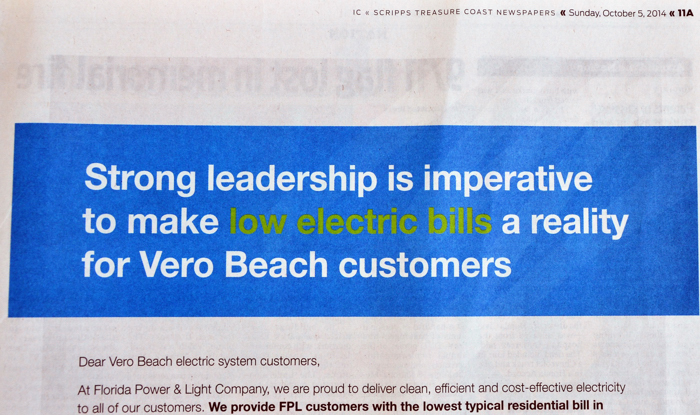
“We believe strong leadership on the City Council is imperative to making further progress on the sale,” Brunjes added.
In her latest politically charged letter, which came disguised as an “update,” Brunjes failed to recount a telling exchange between Councilman Craig Fletcher and City Manager Jim O’Connor during the June 17 Council meeting. Council minutes read: “Mr. Fletcher asked Mr. O’Connor if what he is telling Council is that the sale as they originally envisioned it “dead.” Mr. O’Connor said as they originally envisioned it, yes.”
 Clearly wanting voters to support the three sell-at-any-price-come-hell-or-high-water candidates, FPL’s leading spokesperson, who is also the wife of Scripps Treasure Coast Newspapers Publisher Bob Brunjes, made no mention of the fact that the deal fell apart when the Orlando Utilities Commission determined it could not assume Vero Beach’s position in three FMPA power projects. Concerned to honor existing bond covenants, OUC leaders determined they could not be a part of the deal. OUC’s participation had been the kingpin in a complicated, fragile transaction.


Still, FPL seems determined to find a way to buy Vero Electric as the first step in a larger strategy of expanding the utility giant’s customer base by acquiring other municipal utilities across Florida. While Indian River Shores sues Vero Beach in circuit court, and the County Commission takes its complaints to the Florida Public Service Commission, and the state auditor general conducts an FPL-instigated review of the FMPA, FPL’s deal makers appear to be on vacation. More likely, though, they are busy behind the scenes urging city council candidates Harry Howle III, Pilar Turner and Charlie Wilson to commit to launching a legal battle with the FMPA.
On the campaign trail, Howle has said efforts to push the sale through should include lobbying the Governor and the Legislature to force the FMPA to let Vero Beach out of its contracts. Howle sounds as if he has ripped a page right out of FPL’s playbook.
Applying political pressure is a strategy that has worked so well for FPL in the past that the approach has essentially become the utility giant’s default posture. Heran, Howle, Turner, Wilson, along with their friends at FPL, have lost sight of the fact that ours is a nation of laws, where existing contracts are not obviated through political pressure. (Quite simply, the guarantee that legally binding contracts will be enforced by the courts is what sets the developed world apart. Absent the sanctity of contracts, no one could raise capital, and the economy would grind to a halt.)
To achieve its objective, FPL must now find a way to crack Vero Beach’s contractual obligations to its fellow FMPA members and bondholders. Brunjes would have the recipients of her letter believe she and other FPL leaders wake up every morning asking themselves what they can do to bring lower electric rates to the people of Vero Beach. Needless to say, Brunjes did not explain FPL’s real motivation is achieving greater profits by expanding its customer base.
In her letter, Brunjes also signaled FPL’s determination to hold Vero Beach hostage to a contract, signed by Tracy Carroll, Craig Fletcher and Pilar Turner, that does not expire until December 2016. Never mind that the 2013 contract, as written, simply cannot be executed.
Though Brunjes claimed FPL’s bills are “projected to go down by nearly $2 next year, she did not mention Vero Electric’s recent rate reductions, and she certainly did not allow for the significant steps city leaders are taking to further reduce rates.
In the last election cycle, FPL spent tens of thousands of dollars supporting Tracy Carroll in her failed re-election bid. This time, FPL seems inclined to be a bit more subtle in its meddling in local politics.

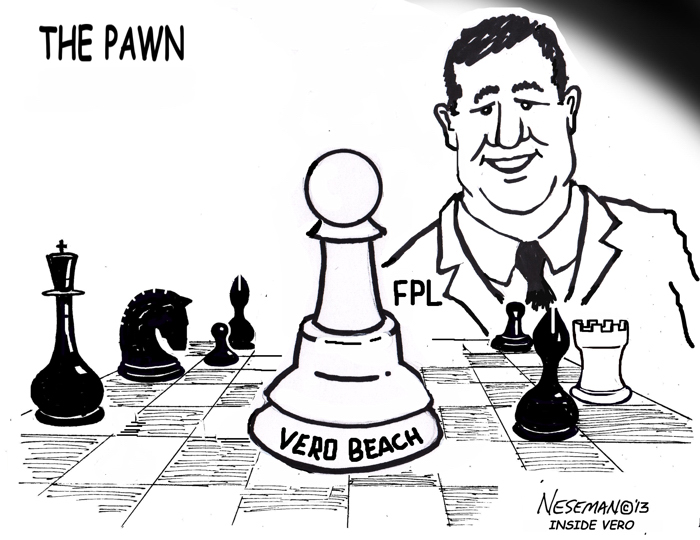
Anyone who still doubts that Vero Beach is anything more than a pawn in FLP’s larger, statewide chess game need only read a so-called “white paper” written by utility activist and FPL apologist, Glenn Heran. The full text of Heran’s paper, which InsideVero obtained as a result of a public records request of Indian River County. Clearly Heran, who deserves to be FPL’s volunteer of the year, has his sights set well beyond Vero Beach.
Heran, like the leaders of the now-defunct Arthur Anderson accounting firm, touts his credentials as a CPA. He, too, offers an outrageous presentation of the “facts.” He ignores the fact that four investor owned utilities in Florida have rates higher than Vero Electric. He ignores the fact that Vero Electric transmission and distribution system is primarily underground and that it serves a densely populated area. Some other municipal utilities serve rural areas and thus have a much higher expense profiles.
Whatever Heran’s “white paper” is, it is not an unbiased presentation of the facts.
Below is the full text of Heran’s white paper:
SUMMARY
Florida Municipal Electric Utilities
Government Run Institutions of Inefficiency
Why Florida should consider selling government run utilities to the private sector and
Why Unprotected Outside customers ought to have freedom to choose a new Electric Utility provider
- Economic Development, 3 million Floridians, currently customers of city government run power, could save $600 million per year.
- Consumer Protection, 600,000 Floridians, who are outside customers, would be protected by the PSC and freed from unregulated municipal electric price monopolies.
- Streamline Local Government
- Proceeds from selling inefficient government run utilities could be used to pay off underfunded pension liabilities, saving taxpayers millions each year.
- Allows local government to refocus on delivery of essential services.
- Eliminates unnecessary government bureaucracies that cannot compete with the private sector.
Vero Beach Electric Utility Case Study
Public’s overwhelming support to Sell Vero Electric to FPL has centered on 2 key concerns: High Rates compared to FPL and No Representation for Outside Customers.
The Rates
- Vero Electric rates are 30% higher than FPL.
- Vero Electric high rates cost the local community over $23 million per year in excessive costs.
- Vero Electric rates, like all Municipals Electric Utilities, are price unregulated.
Outside Customers “Taxation without Representation”
- 61% of Vero Electric customers live outside the city.
- Rates are unregulated with no protection by the PSC or any governing jurisdiction.
- Outside customer rate revenue fund transfers to the City General fund which is the modern day example of “Taxation Without Representation”.
Vero Beach Electric Inefficiency is Common in the State of Florida
- There are 33 City owned electric utilities (Munis) in Florida (not including Reedy Creek in Disney). Serving 1.4 million customers (meters) or 3 million Floridians. Per the FMEA website,
- 25 of the 33 munis have customers who live outside the municipal boundaries (OUC not included). Over 600,000 Floridians are outside customers who have no consumer protection.
- The intent of the law allowing City run electric utilities to be price unregulated was based on city utilities being confined to city limits. The law did not consider cities utilities expanding beyond it city limits that then creates unprotected classes of customers.
- Based on low FPL rates, 3 million Floridians, who are customers of inefficient government run city utilities, pay approximately $600 million more PER YEAR than their fellow Floridians who have FPL.
- $600 million in ratepayer money is lost each year merely to transfer $270 million (direct transfers) to the respective general funds of the provider city.
Florida Municipal Power Agency (FMPA)
- The FMPA is the bureaucracy that binds Floridians to government run power.
- 31 of the 33 city owned electric utilities in Florida are FMPA members.
- Only 20 cities are actually owners (Project Participants) of the FMPA generation assets.
- 97% of all FMPA power is sold to these 20 members with 14 members receiving all their power from the FMPA, and 6 receive part of their power.
- 11 FMPA members receive NO FMPA power, nor own any FMPA assets, yet still vote on the FMPA board.
- The FMPA appears to have no real oversight. It’s board is largely made up of non elected officials ie City Utility Directors and City Managers who have a vested interest in the municipal electric and FMPA bureaucracy existence.
- The FMPA has told member cities that the only way to sell their utility or exit the FMPA is to transfer their FMPA entitlement interest to another city. This requirement so limits the market for this power as to render these FMPA assets worthless.
- The FMPA audited financial statements claim “Zero Equity” in FMPA generation projects. That is simply a GASB (Government Auditing Standards Board) application. It has nothing to do with the economics and Fair Market Valuation of these generation interests. Asset valuation, based on the supply and demand for power, net of FMPA debt, would be important to increase accountability and transparency of the FMPA.
- Members ought to know the real value of these assets and have to option to sell the respective share of their assets outside of the municipal/FMPA system using the sale proceeds to pay off, refund or defease their respective share of FMPA bond liability.
Florida Municipal Electric Association (FMEA)
The FMEA, its director Barry Moline and lobbyist Bill Peoples run the lobbying and public relations for the municipal electric utility bureaucracies and the FMPA.
FULL TEXT
Florida Municipal (Government Run) Electric Utilities
Vero Electric Utility
Since 2008, the Vero Beach and Indian River County public has been engaged in the discussion and action to sell Vero Electric to FPL
Vero Beach has consistently had rates significantly higher than neighboring private sector FPL.
Unlike private sector utilities, Vero Electric rates are price unregulated.
Today, Vero Electric rates are 38% higher than FPL with the expectation by Oct to go to 40% higher.
61% of Vero Electric customers live outside the city. As the Vero Electric territory has no term limit, rates are unregulated and part of the rates fund transfers to the City General fund, Vero Electric is the modern day example of Taxation Without Representation
Vero Beach is not alone in the State of Florida
There are 33 City owned electric utilities (Munis) in Florida (not including Reedy Creek in Disney).
Based on a public records request of these 33 munis in early 2012, they serve 1.4 million customers, where a customer is defined as an electric meter.
An electric meter often serves much more than just one single individual. According to the FMEA website, these 33 muis serve 3 million Floridians.
Not including the OUC, 24 of the 33 munis have customers who live outside the municipal boundaries. Based on customers, ie meters, of the 1.4 million muni customers, 285,000 live outside and have no representation in the rates they pay. That translates into roughly 620,000 Floridians with no consumer protection.
The OUC owns the St Cloud utility, so St Cloud customers are technically outside customers controlled by the OUC. They would need to be added to the above outside customer total.
All 24 munis with outside customers ultimately transfer ratepayer money to their city’s’ general funds. This gives rise to the assertion of “taxation without representation”. Further, these munis often assert permanent territories over these outside customers. Thus, these munis have effectively enslaved 620,000 Floridians who have no representation on these city councils or any protection from the Florida Public Service Commission.
Based on public records, below are the 24 munis showing their outside customers as a % of their total retail customers:
CITY % Outside
- Alachua 3%
- Bushnell 8%
- Clewiston 23%
- Fort Meade 9%
- Fort Pierce 17%
- Green Cove Springs 17%
- Havana 23%
- Homestead 24%
- Jacksonville Beach 59%
- Key West 40%
- Kissimmee 55%
- Lake Worth 37%
- New Symrna Beach 27%
- Ocala 40%
- Vero Beach 61%
- Bartow 30%
- Blountstown 11%
- Gainesville 35%
- Lakeland 57%
- Mount Dora 10%
- Tallahassee 16%
- Wauchula 20%
- Williston 2%
- Jacksonville (JEA) 6%
Again, St Cloud is not included above but is effectively an outside customer of the OUC.
In order to give you an example of the relative inefficiency of these government run utilities, I have included a comparison of their residential and commercial rates compared to FPL, a privately owned, PSC regulated utility, as of June 2013 (see attached, these are excerpts of a larger study I competed based on 2012 public records requests).
Compared to FPL, all 3 million muni customers pay approximately $710 million more PER YEAR than their fellow Floridians who have FPL. They lose $710 million each year merely to transfer $270 million (direct transfers) to the respective general funds of the provider city. Muni advocates claim that such transfers help keep city taxes low. However, as seen in Vero Beach, the sale to FPL has shown that this transfer is not required to fund essential government functions. Rather, it appears clear that the transfer was merely paying for a grossed up government bureaucracy running a utility that could not compete with private sector.
Of the $710 million lost compared to FPL rates, approximately $165 million PER YEAR is lost by the 620,000 Floridians, the outside customers who are deemed permanent prisoners of these munis. These customers often pay the provider city an extra 10% municipal surcharge. Furthermore, of the $270 million in direct general fund transfers, outside customers pay approximately $52 million of that amount.
Florida Municipal Power Agency (FMPA)
The FMPA is a governmental agency (Joint Action Agency) that provides wholesale power to its members.
FMPA owns approximately 1,500 mWs of generation power in a variety of generation sources, (St Lucie FPL, Stanton I &II OUC and ARP).
31 of the 33 city owned electric utilities in Florida are FMPA member cities.
BUT, only 20 cities are actually owners of the FMPA generation assets.
Vero essentially owns a partnership interest in the FMPA. This investment interest must transferred, sold or otherwise disposed of in order to sell Vero Electric to FPL
Through the FMPA, Vero Beach owns 49 mWs of generation capacity in:
- St Lucie Nuclear Unit II (FPL) 12 mWs
- Stanton I Coal (OUC) 21 mWs
- Stanton II Coal (OUC) 16 mWs
The FMPA appears to have no real oversight. Its board is largely made up of non elected officials ie City Utility Directors and City Managers who have a vested interest in the municipal and FMPA bureaucracies existence.
The FMPA audited financial statements claim “Zero Equity” in FMPA generation projects. That is simply a GASB (Government Auditing Standards Board) application. It has nothing to do with the economics and Fair Market Valuation of these generation interests. That valuation, net of FMPA debt, would be an important action to increase accountability and transparency of FMPA activity
Florida Municipal Electric Association (FMEA)
The FMEA, is director Barry Moline and lobbyist Bill Peoples handing the lobbying and public relations for the Munis and the FMPA.
Glenn Heran CPA
 Indian River Guardian
Mark, you are right ,FPL is involving itself in our local elections again this year. The Wilson ,Turner team go back to the worn out FPL playbook in their efforts to get elected. They have no other issue because the Winger, Kramer, Graves majority have done a good job for Vero’s residents. Should the “SELL AT ANY COST GANG” win, the taxpayers of Vero will be the losers. The city has spent close to $2,000,000 in legal fees already only to learn that FMPA and the OUC will NOT do the things necessary to let Vero Electric be sold to FPL. Should Wilson, Turner and Howle be successful we will be spending thousands of dollars only to get the same result. NO SALE!!! One must ask , what are their real motives? Looking back, Wilson started this fiasco to get elected in 2009 by stating the taxpayers would save $90,000,000 or more if the sale was completed; Wilson would ultimately be proven wrong,but he was elected only to be removed from the council by a judge. More recently, Pilar Turner asked all ratepayers to fork over $26,000,000 to FPL, this plan went down in flames as residents rebelled loudly and clearly. What would she do if she had the power to do so?
The Sell No Matter What It Costs Vero folks had their chance. They blew it pretty much by not dealing with the hurdles before getting to the finish line. Of course, I don’t doubt FPL knew there were obstacles insurmountable but why not let us all fight it out – in court or otherwise? Nothing like starting a fight and sitting on the sidelines watching the destruction. Then, moving in for the kill. Or something like that. When we received this latest Brunjes letter, I was ready to sit down and write that lady a letter. After I cooled off, it still seemed like a good idea. Yes, FPL is meddling. If I were really, really wealthy there would be lawsuits to answer the lawsuits of those attempting to bring Vero Beach to its knees. It is imperative we not allow the County nor Indian River Shores nor FPL succeed.
I feel sorry for old FP&L. In the good old days they could have the outcome of the city council all set before the dog and pony show went on at the city council meeting. They have gone from owning 3 city councilors to owning 2 city councilors, to maybe not even having one of their people on the council. At the same time they owned to local news outlets and now the do not have complete control of the media. Oh have things changed since the truth has come out about the figures on the sale. Good bye $156,500,000 Glen Heran lie. Good bye $90,000.00 Charlie Wilson lie. Hello deficit of $26,000,000 plus all the clean up liability truth.