
JANIE GOULD
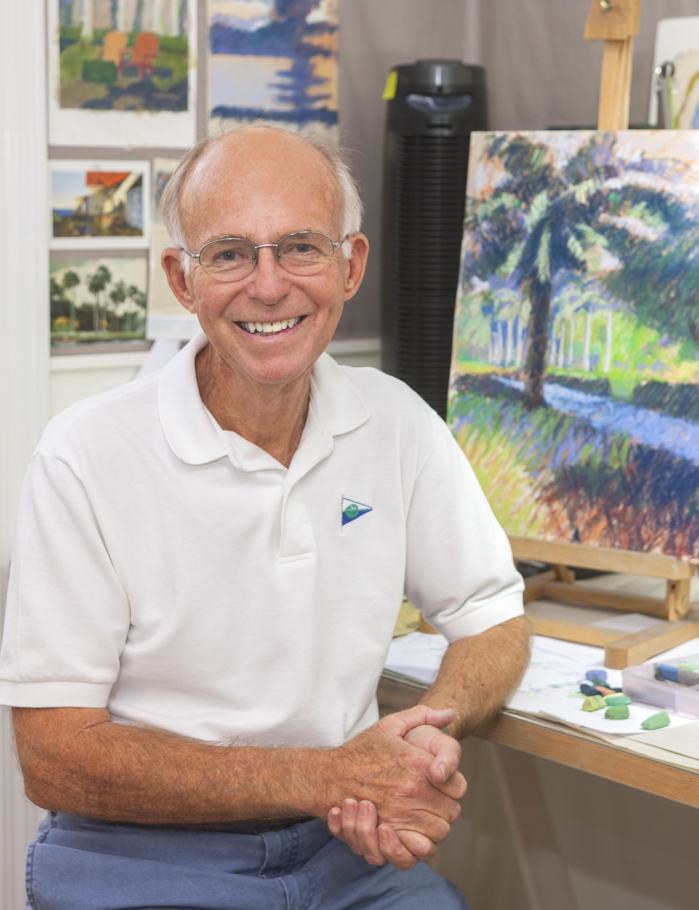
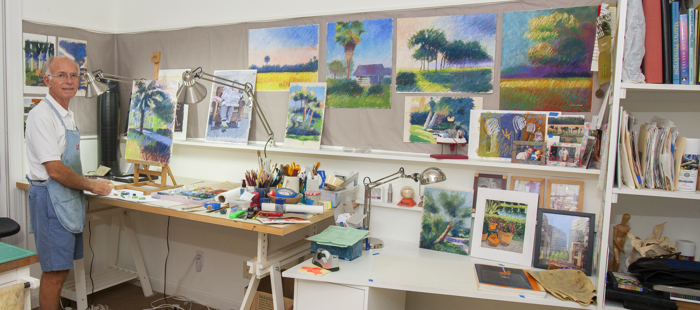
Retired architect and former long-distance sailor George Pillorge’ of Indian River Shores now squints at easels rather than the nighttime sky, as he pursues his passion for painting.
When Pillorge and his wife, Debbie, cruised the Atlantic and Caribbean in their 44-foot Alden sailboat, back in the 1970s, they had to navigate the old-fashioned way, relying on the positions of the sun and stars to guide them. The GPS and other electronic aids to navigation were still relatively unknown.
Pillorge’ retired from RTKL, an international architectural firm based in Baltimore, when he was 55. He was vice chairman of the firm that designed projects around Baltimore’s Inner Harbor, and did the master plan and urban design for Camden Yards, the Baltimore Orioles’ baseball stadium complex.
The couple lived aboard their boat for eight years, and had a “fixer-upper” home in historic Oxford, Md., a sailors’ village on the Chesapeake Bay. It was their retreat during hurricane seasons. One of their favorite ports was St. John in the British Virgin Islands. In 1990, they traded their sailboat in for another “fixer-upper,” a seaside cottage in St. John.
“The views of the sea were endless,” George recalled. “We’d spend the winter fixing up the house and then go to the beach in the afternoon. Debbie got all involved in ham radio and I got involved in drawing and painting. I’d paint little ten-inch watercolors from the boat or the deck of the house.”
Pillorge’ might have been channeling memories from his childhood. Growing up in Ridgewood, N.J., in the 1940s and 50s, he was a devotee of sci-fi comic book characters of the era, when space travel was considered futuristic and almost beyond the realm of possibility.
“I loved to draw when I was a little boy, but at that time I loved to draw airplanes. It was Buck Rogers, Flash Gordon, space ships. I loved that stuff!”
Pillorge’s parents were natives of Brittany, a peninsula in western France. They moved to the United States in 1935, two years before George was born, and the elder Pillorge’ found work as a French chef. Only French was spoken at home, so George didn’t start speaking English until he began kindergarten. He remains an unabashed Francophile, who loves the language, the food, the art, the French islands in the Caribbean, and French names. He and Debbie named their children Marc, Nicole and Michele. Their grandchildren are Camille, Vivienne, Lucille, Brigitte and Yvette.
Pillorge’ considered studying aeronautical engineering after high school, but opted instead for architecture. He earned a degree in architecture at M.I.T. and two master’s degrees at Harvard University. He and Debbie, whom he met on a blind date and married a year later, spent their first year of marriage in Paris. George had received a Fulbright Fellowship to study city planning. Debbie, an accomplished oboist and pianist, studied music. The young couple enjoyed the City of Lights and was happy to travel through Europe with a pup tent and sleeping bag as their accommodations.
Except for two teaching stints, at Harvard and the University of North Carolina at Chapel Hill, George spent his entire professional career, 28 years in all, working in city planning and architecture.
“It was the ‘60s, an optimistic time when we were sure that we could build better cities, better communities,” he said.
After he retired and the couple cruised the seas before selling their sailboat, around 1990, they bought a power boat, which is how they found Vero Beach. They made several overnight stops at the Vero Beach Municipal Marina while motoring up and down the Intracoastal Waterway.
“The marina was wonderful,” Pillorge’ said. “We could walk to the beach or restaurants, or take the bus out to Publix or Wal-Mart for whatever we needed.”
They eventually bought a condominium on the barrier island, then sold it and now own a home that has plenty of space for George’s art studio, Debbie’s oboe and piano practice and visits by their children and grandchildren.
George works at painting with the same cerebral intensity he must have given to designing a hotel. He takes art lessons at the Vero Beach Museum of Art from two highly regarded painters: Dawn Miller, who specializes in pastels, and Deborah Gooch, who has taught him how to paint figures. He’s now taking a course from Gooch on “Abstraction to Realism.”
“This class in moving toward abstraction is very, very challenging for me,” he said. “It’s a different way of thinking. I am an architect and I think structurally, so I need a plan, whereas Deb starts off in a very intuitive way.”
Pillorge’ paints portraits of people in ordinary situations, such as a woman at Starbuck’s who was engrossed in her New York Times, or a little girl playing the piano while a woman stands beside her, or in a subject dear to his heart, a woman making a French-style crepe at the Oceanside Farmers Market. He never goes anywhere without a small camera, always in search of “small things” to paint rather than larger-than-life landscapes.
“Life is an accumulation of small things,” he says, pointing out his scene of two Adirondack chairs positioned in front of an abstract forest scene. Then he shows his painting of two little girls having an art sale in their front yard.
“Can you believe it?” he says with a smile. “They were selling those pictures for 50 cents and they sold so many they came back in the house and scribbled some more!”
Painting with pastels works for him, he said, because he likes to draw.
“Just as you hold a pencil, you hold this piece of chalk and instantly get the mark. You get this color. It’s a wonderful evolution for me from drawing, which I did a lot of as an architect.”
He uses charcoal to start a work in pastel, and then squints at the image he is going to paint.
“When you do that you see the darks and lights and pick out the shapes, which are the first things that go on the canvas,” he said. “I remember in an early class with Dawn Miller, she’d let us start with a photo and then tell us to put it about ten feet away so we couldn’t just stare at it.”
In his studio, he studies his subjects intently before starting to paint.
“If you start to get involved in all the little branches, you’re not going to draw a palm tree,” he said. “It’s really about form and color. You do your homework and then you work on it.”
 Indian River Guardian