
Shores correspondence raises still further question about possible Sunshine Law violations
“What information loop was Haverland referring to? What communication, if any, took place between Shores Council members in advance of that April meeting? What communication took place between McCord, Grealis and representatives of FPL? And, finally, what other communications might be taking place outside the Sunshine? These are questions the State Attorney’s Office should be investigating. After all, the Indian River Shores Town Council is not a homeowners association board of directors. Rather, it is a municipal government, and as such it is subject to and should be governed by the Florida Sunshine Law.”
NEWS ANALYSIS
MARK SCHUMANN
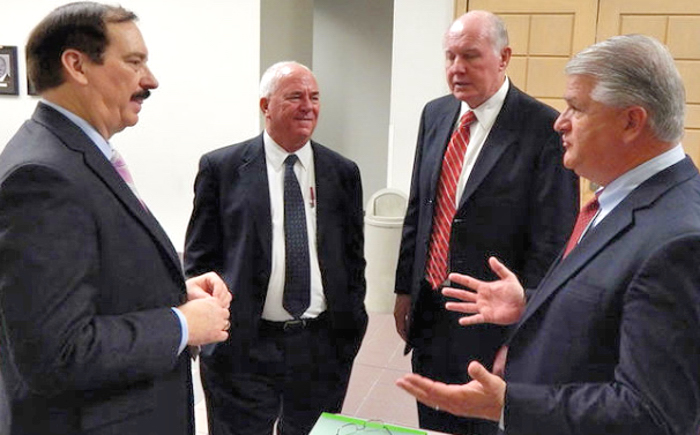
A picture taken by island weekly reporter, Lisa Zahner, raises questions about whether County Commissioners Peter O’Bryan and Tim Zorc were complying with the Florida Sunshine Law when they attended a meeting of the Florida Public Service Commission in Tallahassee today.
Zorc, and O’Bryan, along with County Administrator Joe Baird and County Attorney Dylan Reingold traveled to Tallahassee to represent the County in its petition to the PSC for a declaratory statement of what rights, if any, the County has to force Vero Beach to abandon 60 percent of its electric utility customer base and infrastructure when the franchise agreement between the City and County expires in 2017.
Zorc and O’Bryan are pictured with Baird and the County’s special counsel, Floyd Self, caucusing in the lobby of the PSC. If the four were discussing the matter for which they travelled to Tallahassee, or any other matter that is now or will likely come before the Indian River County Commission, then they may well have been in violation of the Sunshine Law.

Email correspondence between Indian River Shores Town Council member Richard Haverland and Mayor Bryan Barefoot, first reported August 7 by InsideVero, raises still further questions about possible Sunshine Law violations. In another email to a Shores resident, Haverland wrote, “You wouldn’t believe it. When hiring the lawyer came up, Brian (Barefoot) presented it in a ‘vanilla’ fashion so as to not let anyone know. It was already to be voted upon, and Weick (Gerry) said, ‘Is this to hire the electric lawyer?’ Brian said it could cover a number of things. Looks like Weich wasn’t in on the loop.”
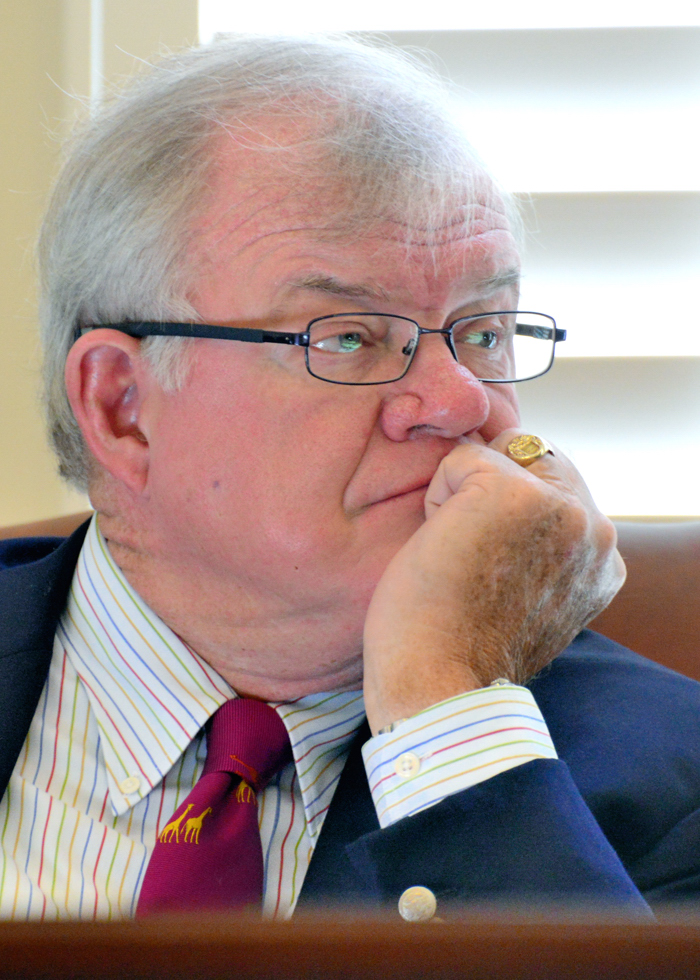
In an April 14 email to Indian River Shores Town Manager, Robert Stabe, Councilman Dick Haverland urged that a special meeting on the hiring of an attorney to handle the Town’s lawsuit against the City of Vero Beach be scheduled for “an extremely inconvenient time — say 7 or 7:30 am.”
“My guess is that no one would notice,” Haverland wrote, “and if they did, they wouldn’t likely attend.”
Haverland also suggested public notice of the meeting be “very unspecific as to the agenda item, like ‘attorney retention.'” That way, Haverland suggested, the meeting “would have a chance of escaping notice.”
Two residents of the Shores, John McCord and Bill Grealis, were, according to Haverland, “driving the process” in vetting prospective law firms the Town might hire in litigating its lawsuit against Vero Beach. In at least one email between Grealis and Haverland, Grealis indicated McCord was in contact with representatives of Florida Power & Light, and was to “hear from FPL shortly on their suggestions.”
Though Grealis and McCord were clearly acting as agents of the Shores Town Council, Town Clerk Laura Aldrich has refused to provide copies of email correspondence they may have had between each other and between representatives of FPL. “Please note that Mr. McCord and Mr. Grealis have not acted in any official capacity but volunteered in their private capacity to gather information for the town,” Aldrich wrote in response to a public records request from InsideVero.
In addition back-and-forth email correspondence, which is on the face of it a violation of the Sunshine Law, what information loop was Haverland referring to? What communication, if any, took place between Shores Council members in advance of that April meeting? What communication took place between McCord, Grealis and representatives of FPL? And, finally, what other communications might be taking place outside the Sunshine? These are questions the State Attorney’s Office should be investigating. After all, the Indian River Shores Town Council is not a homeowners association board of directors. Rather, it is a municipal government, and as such it is subject to and should be governed by the Florida Sunshine Law.
 Indian River Guardian
What kind of idiot votes for these clowns, any ways?
They didn’t seem like “clowns” when they ran for office. I’ve heard it said the person who campaigns and wins an office is not the same person who sits in the chair and makes important decisions. I don’t know. Besides, blanket statements are usually wrong.
It is hard to believe these” esteemed” elected public officials who went to Tallahassee to a PSC meeting didn’t, at some point, discuss the reason they were there.
What if they did not discuss the reason they were there but decided to veer off into a conversation about the lagoon? And, if that were the case, someday down the road they would be voting on matters regarding the lagoon and that would then make that conversation about the lagoon a reason to believe they were breaking the Sunshine Law. So, I guess these guys are smart enough to say that they kept their mouths shut during the entire trip and did not discuss either matter, the utility law suit or the lagoon or anything else that they might have to vote on in the future. I guess they can say anything they want to say because I am sure they think we are all stupid.