
GUEST COMMENTARY
Editor’s note: Deborah Ecker is co-chairman of the Indian River Neighborhood Association Water and Lagoon Committee.
DEBORAH ECKER
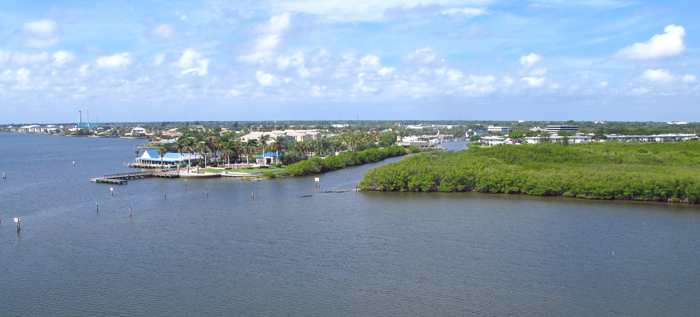
Considering the divisiveness we are experiencing nationally, the fact that locally we are experiencing unity of opinion, on an important subject, is an achievement deserving recognition. That unity is our consensus that the Lagoon’s water quality is deteriorating. And our cities, along with the County, are reflecting our consensus by taking corrective actions.
The most recent action for controlling the Lagoon’s pollutants was taken by the Vero Beach City Council, two weeks ago. They approved the policy for establishment of stormwater Utility. This is the necessary first step for a dedicated funding source to control surface water runoff from streets, neighborhoods, and developments. Currently these flows are a major source of the pollutants flowing into the Lagoon, damaging water quality. The Utility will pay for filtering devices to be installed, and maintained, on the pipes that drain the runoff. Without this source no funds are available to maintain and improve the city’s storm water controls.
While I trumpet the City’s making this move, it could also be said “It’s about time.” It was in 1986 (almost 30 years ago) that the Florida legislature adopted a statute creating utility- funding mechanisms to supplement local resources, or as in the City’s case, entirely pay for construction and management of storm water systems.
Council members had before them an 8-page report from two staffers — Monte Falls, Director of Public Works and William Messersmith, Assistant City Engineer in Public Works. This report documented specific locations throughout the city where storm water improvements are needed. The descriptions of 16 projects are red flags of “Help, Now!” Here are just three examples:
(1) In Vero Isles, there are approximately 15 outlet pipes which discharge directly into the Lagoon without any pollution treatment or abatement. The pipes are over 60 years old, with “open throats” that have no obstructions for floatables and debris.
(2) The upper end of the Royal Palm Place/Royal Park watersheds currently have such limited drainage facilities that the system is “at or over-capacity.”
(3) Inland, Lateral canal E drains 764 acres of ground water. There are 53 outfall pipes without any end-of-pipe treatment facility. This canal drains directly into the Lagoon.
The documentation, accompanying the recommendation for this Utility, is exceptional. Not only are 16 projects identified, the specific problems and remedies are described for each, with estimated costs. Typical remedies are installation of baffle boxes, devices with screens to separate water from debris; and of a new product called Flexi-Pave, made from recycled tires. Sections of this permeable pavement would be placed on top of street drains. Water will flow through, debris will not. What remains will be removed.
Stormwater runoff is one of three major sources of the Lagoon’s problems. The other two, also drainage issues, are from septic tanks and fertilizers. In 2013, the County and cities adopted strong fertilizer regulations. The challenge on the fertilizer front is enforcement. Still to be tackled are the County’s and cities’ abundant, and often old, septic tanks. This was moved forward on November 4th when the City of Vero Beach adopted an Ordinance called the “Step-System” gradually to redress the septic issue.
What is so useful about this storm water Utility is that it provides the means for funding the needed corrections. The city’s first step towards implementation is hiring a consultant to determine how this would work. The tasks require defining the different classes of property involved, and how each will be assessed. Property owners’ fees will be based on the degree to which they are responsible for runoff. For example, properties with paved driveways and parking areas will probably pay more than those with pervious surfaces. It is anticipated that the monthly assessment will be in the range of $3 to $5. No properties will be exempt, even those not required to pay real estate taxes.
It’s this last phase, approval of funding, when our local consensus could be harder to achieve. The Lagoon is becoming a dead body of water. The Lagoon’s recreational, economic and aesthetic values make this city a special place. The spirit and support that produced Council members’ approving this Utility policy must be sustained.
 Indian River Guardian
It is entirely appropriate that a fee–not the taxpayer at large–pay for this. This is a service every bit as much as water and sanitary sewer, and the cost should be paid based on usage.
The fact that it is presently “free” to dump any amount of runoff into public storm sewer offers absolutely no incentive for improvement.
We are years behind other communities on this, and a dedicated funding source with a sunset as proposed is an excellent way to get it done while minimizing risk of creating any “permanent bureaucracy” as some have alleged.
You can be sure that people this passionate about eliminating lagoon pollution will be very persistent, attentive and vocal this funding source be faithfully and efficiently applied, and results obtained.
The Indian River must be saved before it is too late. We owe it to ourselves and future generations to make every effort to SAVE THE INDIAN RIVER. Every political entity which discharges water into the river should have laws it place which can address this most vital issue.