
…and “sovereign municipality” is an oxymoron
COMMENTARY
“One way to build community in Indian River County would be for the Indian River Shores Town Council and the Indian River County Commission to cease their predatory actions against Vero Beach. After dispensing with their high-priced lawyers, the members of the County Commission and the Shores Town Council could then roll up their sleeves and work with Vero Beach officials in their efforts to lower electric rates.”
MARK SCHUMANN
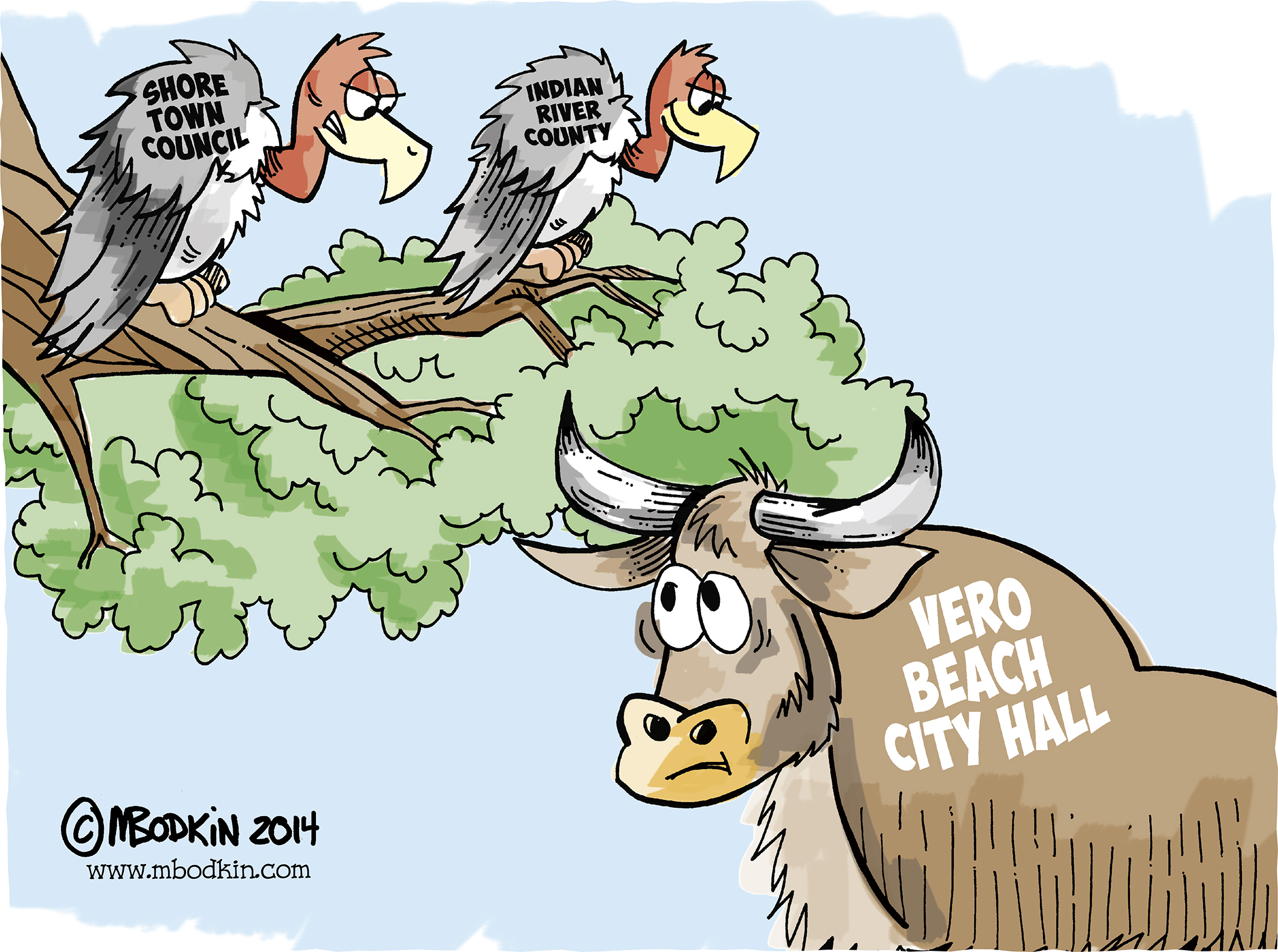 Scripps’ Stuart-based columnist, Rich Campbell, after attending Wednesday’s mediation session between Vero Beach, Indian River Shores and Indian River County, opined about “community,” and the lack of it in Indian River County.
Campbell, who occasionally wanders up from Stuart to cover Indian River County news, centered his column around a comment made by mediator Carol Alvarez, who at one point Wednesday said, “We’ve been saying ‘town,’ ‘city,’ ‘county.’ These are constructs. But this is one community.”
In one sense, Alvarez is correct. The residents of Vero Beach, Indian River Shores and the unincorporated areas of the county surrounding the City of Vero Beach are all part of a larger community. But it is also true that the partnerships, connections, alliances and inter-dependent relationships that make for a healthy community can be strained, even broken. Like ‘town,’ ‘city,’ and ‘county,” community is also a construct, to use Alvarez’s word. Community can, through enough careless abuse, be deconstructed.
Campbell, like his Scripps colleagues, has never grasped the larger issues underlying the power sale saga. If Campbell really understood the lay of the land in Indian River County, he would never have written that Vero Beach is “proving to be more territorial than the others (Indian River Shores and Indian River County).”
Campbell seems unaware of the ways the County has tried to break up Vero Beach’s water and sewer utility in an effort to force the City to sell its profitable, well-run enterprise. The Stuart-based pundit seems clueless to the ambitions of those who would like to see the City of Vero Beach disincorporated.
Defending Indian River Shores for dragging its neighbors into court, Campbell wrote that Shores leaders are “fed up with high utility rates and frustrated by the lack of progress in the city’s proposed sale of its electric utility to Florida Power & Light.”
Before deconstructing that sentence, let’s remind ourselves that Campbell’s publisher, Bob Brunjes, is married to a key FPL vice president.
What constitutes “high” utility rates? Vero Beach’s rates are within the statewide average. They just don’t happen to be “FPL-like.” Many utilities across the Florida, including investor-owned utilities regulated by the Florida Public Service Commission, are charging rates higher than Vero Electric, and certainly higher than FPL. These rate disparities across the state do not give the customers of utilities with higher rates, such as the customers of Duke Energy, legal grounds to sue to become customers of FPL. The Florida Supreme Court has ruled, “An individual has no organic, economic or political right to be served by a particular utility merely because he deems it advantageous to himself.”
Campbell repeated Shores attorney Bruce May’s assertion that the Town is “an independent and sovereign municipality.” “Sovereign municipality” is an oxymoron. Municipal governments, such as the Town of Indian River Shores, the City of Vero Beach and Indian River County are not sovereign, they are creatures of the state, and are limited in their power by state law. One such law is the 1974 “Grid Law,” which gives the PSC, not cities and counties, exclusive authority to determine service territories. This authority is vested with the PSC, in order to insure a reliable and efficient statewide power grid.
The County Commission’s assertion that it should have the right to force Vero Beach to abandon its out-of-city customers and to remove its utility infrastructure from the unincorporated areas of the county is a novel, even bizarre idea opposed by every other utility in Florida, including FPL. If and when the Shores lawsuit makes it to trial, expect Florida’s electric utilities — big and small, public and private — to file briefs in defense of Vero Beach.
Campbell was critical of Vero Beach officials for refusing to accept a proposal from the Shores that would have delayed its lawsuit for six months, so long as the City would concede the merits of the Shores’ case. What else could Vero Beach officials have done but refuse such an unreasonable proposal?
In accusing Vero Beach leaders of “intransigence to keep the town (the Shores) in the city’s electric utility ‘fold’,” Campbell revealed that he is clueless, utterly clueless about the legal, economic and practical consideration which render the breaking up of Vero Electric all but impossible.
Perhaps the most puzzling point Campbell made was his assertion that Vero Electric is owned by its ratepayers. He should call his boss’s wife, Amy Brunjes, FPL’s External Affairs Manager, and ask her if FPL is owned by its ratepayers. The answer, of course, is that FPL is owned by its stockholders. The “stockholders” of Vero Electric are the taxpayers of the CIty of Vero Beach.
Like Campbell, Vero Beach City Councilwoman Pilar Turner does not understand this basic, fundamental fact. “I believe the (electric utility) system is owned by the ratepayer,” Turner told Campbell.
One way to build community in Indian River County would be for the Indian River Shores Town Council and the Indian River County Commission to cease their predatory actions against Vero Beach. After dispensing with their high-priced lawyers, the members of the County Commission and the Shores Town Council could then roll up there sleeves and work with Vero Beach officials in their efforts to lower rates.
 Indian River Guardian
Good news!! I see that the TCPalm is moving to the center of city that it hates the most, Vero Beach. Would they not be better off moving to the places they love the most, the Indian River County complex or to the Indian River Shores town hall complex? Does this mean that their out of city reporters who report the “facts” as the see them, will be moving to the city they are reporting on? Pretty soon the weekly blaster of the city will move right next door so they can better coordinate their attack on the city. Of yeah, wrong zip code for the latter, they would have to rub elbows with the commoners of the city.
A friend shared with me that this reminds him of the story about the little red hen, who will help me build the neighborhoods? (county and shores) not me, who will help me invest in the infrastructure (county and shores) not me, who will help me run the system (county and shores) not me, who will pay the costs and liabilities if we sell, (county and shores) not me, who will charge a franchise fee for doing nothing and throw aways the system to make my friends happy at FPL, (county and shores) Me me me.
Saying the system belongs to the ratepayers sounds like a redistribution of wealth scheme to and ignores the investment and risk the City of Vero Beach has had to take for years.
Councilwoman Pilar Turner recently said she believes Vero Beach’s municipal electric utility is owned by the utility’s 34,000 customers, 60 percent of whom life outside the city limits. This is not the most bizarre statement Turner has ever made, but it is the most socialistic. Karl Marx would be proud of Turner for asserting the customers own the store and for her earlier claim that the store owner has not right to earn a profit.
Once again, history is forgotten by those who dwell outside the Vero Beach City Limits. Perhaps if someone explained to them why FPL did not take on their power-providing from the beginning, it might begin to make sense to them. Then, we can all agree that Vero lost a perfectly good (and greedy) opportunity to annex those areas into the city. With so many of the county’s residents having a Vero Beach mailing address, it must be confusing–especially when it’s time to go vote. And Mrs. Turner doesn’t seem to understand what a municipality is. The “store owner” (Vero) has a right to earn a profit–in this case, that profit goes back into the community. By doing this, the “store owner” (Vero) has been able to give city customers a break on property tax. Maybe TCPalm is looking forward to saving money on property tax?