
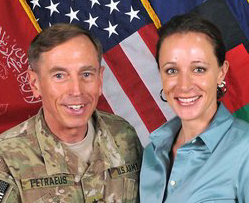
Editor’s note: The New York Times reported Friday that the F.B.I. and Justice Department prosecutors have recommended bringing felony charges against Retired Gen. David H. Petraeus for allegedly providing classified information to his biographer while he was director of the C.I.A. Attorney General Eric H. Holder must now decide whether to seek an indictment against Petraeus. MORE…
Associate Editor Milt Thomas spoke recently with retired General David H. Patraeus, who will be the first speaker in the Emerson Center celebrated speaker series on January 17th. Here are questions and answers from that conversation.
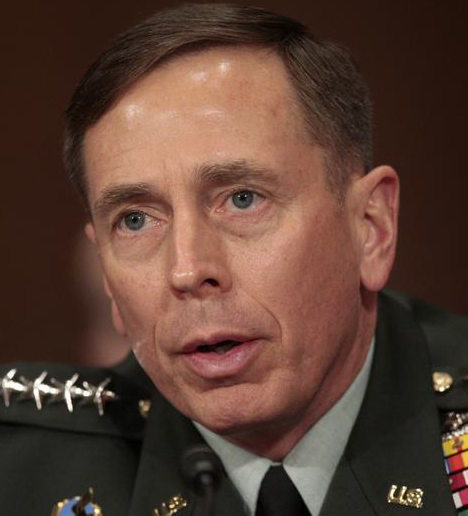
Q: You are a four star general, six straight commands, five of which were in combat including Iraq and Afghanistan, which are still two of the world’s trouble spots in spite of your successful efforts. How do you assess the future of these two countries now?
A: Both of them face considerable challenges, Iraq, I think is generally agreed, was in a pretty good place when we handed off security tasks to the Iraqis, and sadly, a number of the areas of progress, in particular, reconciliation between the central Iraqi government and the Sunni community a number of these areas were undone by actions by the Iraqi government over the last several years. And only now with the new government they have a prime minister who is once again seeking to honor agreements that were made to the Sunni Arab population during the surge and who is seeking to bring the fabric of Iraqi society back together again and who also is seeking to achieve an accommodation with the regional Kurdish government, another important element albeit with considerable autonomy in the Greater Iraq.
Afghanistan is seeing a new leader there as well, President Ashraf Ghani and his chief deputy Abdullah Abdullah, both well known to those who have served over there and highly respected. President Ghani is off to a very fast start. He has launched a number of important initiatives and the Afghan security forces have been the ones doing the vast majority of the fighting, albeit with continued support by coalition elements, particularly in the realm of close air support, some intelligence, surveillance and reconnaissance systems that we have deployed there. Time will tell in Afghanistan whether the political component can efficiently compliment and further the security gains that have been made since the launching of the surge there back in 2010 and certainly our continued support will be very important, as will our renewed support be important in Iraq. Iraq I should note is a situation that will years not months to resolve, but I can see a path forward if and only if the Iraqi political leadership can again achieve the unity and re-establish the fabric of society in a way that was done in the surge, which helped Iraq so much during the subsequent years until,. Unfortunately, those accomplishments were undone by the central government’s actions.
Q: And of course now we have a new player on the combat stage, ISIS or ISIL. This is a different kind of military challenge now, isn’t it?
A: Well, it has become a conventional military force, a terrorist army rather than a terrorist group if you will and the way it achieved quite substantial and rapid battlefield progress reflected the fact that it has really become a force rather than a guerrilla group carrying out tactics. That enabled them to make rapid progress but it then can also become their Achilles heel because conventional forces are much more easily identified and then attacked by a combination of our intelligence and reconnaissance assets and our coalition partners and then our close air support assets as well.
Q: So far it appears the only dependable boots on the ground right now are Kurds…
A: Yes, but I would differ with that a little bit. Without our close air support even the Kurdish Peshmerga were not a match for ISIL toe to toe. In part, to be fair to the Peshmerga they have not had the benefit of combined arms training or of all the different activities we know that are required for a military force to be able to conduct the kind of county-offensive with combined arms, not just light infantry. The kinds of actions required to halt and then to rollback a force like ISIL. Now, with our assistance certainly the Kurish Peshmerga, but also tied in to some of the Sunni Arab tribes that took back the Rabia border crossing between Nineveh Province and Syria in the north, it is a combination of the Iraqi security forces and sadly because they were problematic in the past, Shia militia elements that have come back to life also defeated during the surge but now back on the scene because they are defending Iraq from ISIL. It is a combination of those forces and Iraqi forces that have taken back some areas southwest of Baghdad. But the area west of Baghdad in Anbar Province, very problematic right now. ISIL has not really been halted there and certainly not rolled back in any appreciable manner and that really is a dagger pointed at the heart of Baghdad, albeit one that is unlikely to penetrate the defenses around Baghdad, but the threat is real as is the threat inside Baghdad itself where various elements of ISIL are carrying out terrorist activities, certainly not conventional military activities that are killing significant numbers of Iraqis.
Q: You have been credited with reshaping American military doctrine during your tenure. What do you think are most significant changes you implemented?
A: Well, it was always a team effort and I was very fortunate to have some very experienced and thoughtful combat veterans that were all part of the team that drafted the counterinsurgency manual and more importantly put the big ideas of that manual into action. And the fact is, in Iraq now, what is required to deal with ISIL and the associated Sunni insurgents that have come back to life is a comprehensive civil, military and counterinsurgency campaign, but one in which the Iraqis carry out some of the most challenging tasks, those of the conventional military force that clears and then holds areas that can be rebuilt, the tasks that involve reconciliation with those elements of society that have been alienated, the Sunni Arab part of society and the regional Kurdish government, and then carries out the rebuilding and local institution restoration tasks. All of these we had to do during the surge because the Iraqis completely lacked the capability and the country was literally in flames and about to go up in smoke. That is not the case right now despite the horrific levels of violence, despite the security challenges, the threat posed by ISIL. The Iraqis with our support when it comes to helping them develop the intelligence picture, plan operations, coordinate them and then support during execution through close air support in particular, they can indeed carry out the tasks largely required by boots on the ground and so forth in the conventional military tasks that again we had to perform during the surge because had we not done that the country again would have gone up in smoke. And I do think that is possible. I can see how this ends if you will. In Iraq there will be greater devolution most likely to some of the Sunni Arab provinces and perhaps further to the regional Kurdish government, there will be agreement between Baghdad and the Kurdish government on distribution of oil revenue and a few other very important areas that require resolution. I think that is doable but again we should be patient with this, persistent, and we have to demonstrate will because there is a psychological component to this in addition to all the other factors that are involved.
Q: Sorry, General, but we’ve run out of time, but we will look forward to seeing you on Saturday, January 17th at the Emerson Center.
 Indian River Guardian
Great work, thanks.