
JANIE GOULD
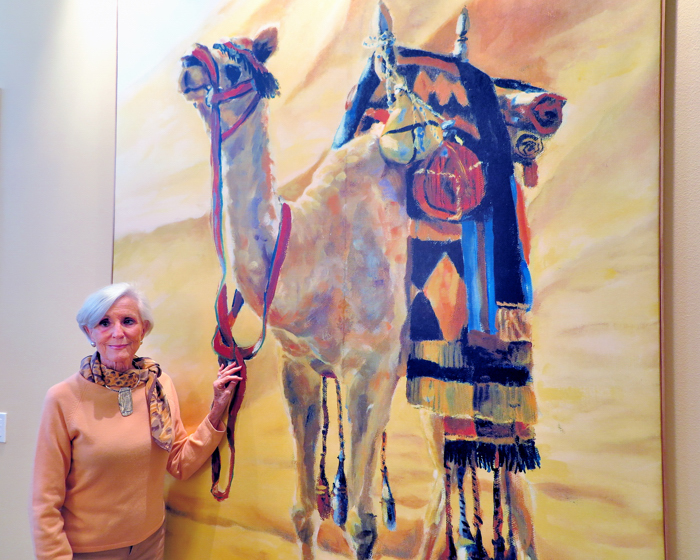
Painter and former art teacher Sara Shankland uses a high-tech material that resembles clay to create one-of-a-kind pieces of silver jewelry, from a pendant that is reminiscent of an Alexander Calder mobile to motifs of the Southwest and romantic images of birds and sea life.
During the past eight years, Shankland has created more than 750 pieces of jewelry. She sells them at major shows such as Under the Oaks, the Vero Beach Art Club’s festival that’s coming up in March at Riverside Park.
“The material is everything,” she said. “It was invented by the Mitsubishi Corp. in Japan around 1990. Someone there came up with the idea of pulverizing pure silver to the consistency of powder to which they have added an emollient. It comes to me packed in plastic and foil as a ball of clay. A ball of clay that is pure silver. Absolutely mind bending!”
She shows what she can do with the product known as Precious Metal Clay by rolling it out on a piece of freezer paper, adding a bit of oil to prevent it from sticking, and using a PVC pipe – “one of Lowe’s finest” — as her rolling pin. She uses a needle-like tool to cut the shape she wants. The clay that is cut away is quickly put back in its plastic bag so it won’t dry out.
She has other implements, both simple and serious, in her tool kit to make sure the process works the way she intends.
“I use two stacks of playing cards to serve as a guide to insure the same thickness overall that I want,” she said.
Then she can press shapes such as leaf patterns into the clay. She has a button collection that she also utilizes to add texture to the pieces. She can thin the clay to a paste that can be painted in multiple layers on leaves, twigs and other natural objects. When fired in the kiln the leaf burns away leaving a perfect replica of itself. These are then incorporated with other elements to create a unique piece of jewelry.
She can wad the clay piece up and start over if she isn’t satisfied with her progress.
‘It’s just an amazing material,” she said.
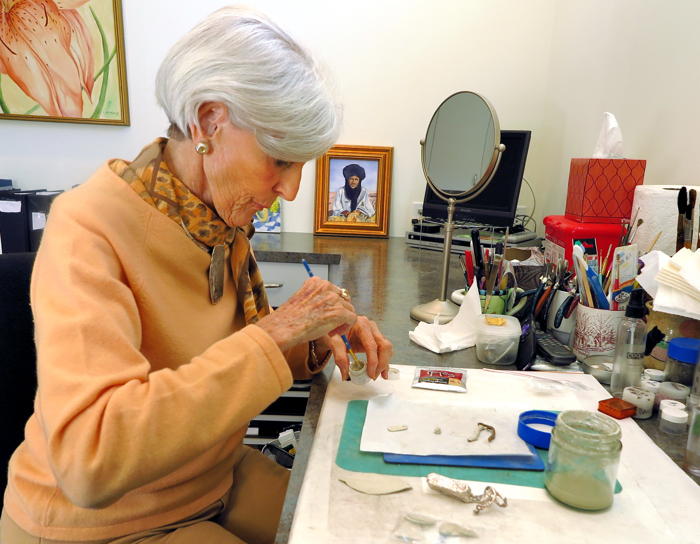
Then, the piece has to dry completely before it can be fired in her kiln. The kiln heats to 1,475 degrees F., and the piece will be fired for 30 to 45 minutes.
“The longer it stays in the kiln, the harder it becomes,” she said. “You want every molecule of the silver to grab onto another and become a hard metal. It’s hard to believe that gooey clay becomes a hard metal, but it does.”
After the piece has been removed from the kiln and cooled, its surface appears to be dull and powdery.
“If you could see a cross section of the piece it would look like a forest of fir trees. What I have to do is to brush the piece with a steel wire brush. That’s the first step in work hardening. It forces those fir trees to lie down and adhere to the piece. It starts to shine.”
Then, she puts the piece in a rubber tub with small pellets of stainless steel, distilled water and a burnishing compound. The tub is covered and sealed shut, put on its side and placed in the rotating tumbler where the constant motion of the steel shot finishes work hardening and shining the piece.
“It is a little noisy but does the job,” she said.
She utilizes pearls, turquoise, jade, coral, Murano glass and other precious and semiprecious materials to create her finished products. Sometimes she works with 24K gold that starts as a clay as well. She paints it on a finished but unfired piece of silver. As gold needs an oxygen environment in order to fuse to the silver, it cannot be fired in the kiln. Instead she fires the piece with a crème brule’ torch like those that pastry chefs use to brown fancy desserts. The finished 24 K gold-fused silver is called vermeil.
Shankland carefully selects the chain, neck ring or collar that best suits the style of the pendant that she created. Those elements are made by silver-smithing and are .925 sterling silver. The bail or the hook or ring through which the pendant is suspended from its chain has to be the correct size so the chain will slide through it easily. These have to be made and bonded to the pendant with thinned clay “paste.”
A native of Huntington, WV, Shankland earned two bachelor degrees, in fine arts and in science of education, at the University of Cincinnati. She took graduate courses in English literature at Marshall University in West Virginia.
She taught general art and art history at the high school level and painting to adult evening classes in New Jersey and in Alexandria, VA. Later, she did graphic design work and some painting. Her paintings are representational, not abstract. She does landscapes and still lifes in oils in a style she describes as “painterly,” meaning the paint is applied rather loosely.
Shankland and her husband, Bill, were drawn to Vero for retirement because of the Vero Beach Museum of Art. Sara has taken classes at the museum in painting, glass fusing and print making. About eight years ago, she was intrigued by a class in Precious Metal Clay.
She expects to take 200 pieces of jewelry to the Under the Oaks show. She’s sold about 90 every year that she has had a booth there.
She learned from her daughter, also an artist, how to deal with “designers’ block,” the periods of time when it’s hard to get motivated to return to the studio.
“My daughter told me she always has something half-finished in her studio,” she said. “She’s absolutely right. You are jump-started. When I go back to work on it, one idea leads to another. The piece evolves while I work on it. It’s a very organic process. I think this is true for all artists. People sometimes think of art as divine inspiration. It’s hard work. Sometimes I think my own artistry is a facility rather than a grand talent. I do know that what I like to do and do well, other people like too.”
She still likes to paint and hopes to return to that eventually, “especially now, since I have this wonderful studio at home! What it’s done has put a lot of responsibility on me to use it.”
 Indian River Guardian