
Editor’s note: Sean Sexton will appear this Thursday, February 19th as guest lecturer in the Emerson Center Florida Humanities Series where he will talk about the history of Florida’s cattle culture. Admission is free.
MILT THOMAS
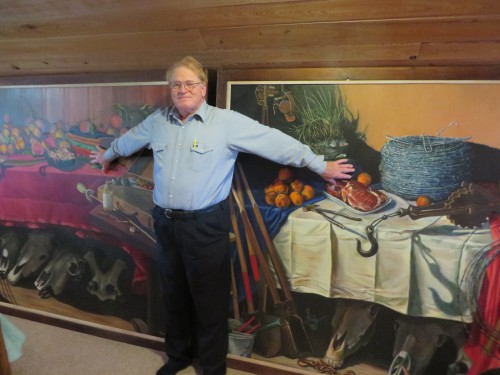
Certainly not Sean Sexton. He goes back every day to Treasure Hammock Ranch, where he raises cattle just like his father, the late Ralph Sexton, did before him. He’s hobbled a bit these days with sciatica, but lying in bed he loves the view out his window, the 600-acre ranch that is unchanged since his grandfather, local legend Waldo Sexton, purchased it back in 1943. One reason it is unchanged is the conservation easement created in 2006 by the Indian River County Commission that ensures the ranch will never be developed into anything other than what it is now.
“Nothing much has changed here over the years,” says Sexton. It’s a great life for me. I was always a solitary soul, not socialized, and during my childhood there was hardly anybody here. I started working with my dad at the age of five and I’m still at it.”
But Sexton is not a one-dimensional cowboy living a life that has almost disappeared from the American landscape. He is, as most local people know, an artist, writer and poet, not exactly on any career path for a lifetime cattle rancher.
“I always liked to draw. I did a drawing in first grade that went up on the door to Mrs. Loy’s classroom at Rosewood Elementary School. Everybody told me from that moment on that I was an artist.”
But it would have to wait. After graduating from Vero Beach High School in 1972, Sexton continued his education at Santa Fe Community College in Gainesville. “I was one of about 80 students and our professors were dropouts from UF, either not eligible for tenure or too radical for the regimen over there. They wanted us to be socialized as well as educated and had us keep journals of our experiences.”
Now he had two pastimes, drawing and writing. He actually started painting around 1979 after graduating from the University of Florida. “It took five years because I had to come home every fall and plant rye grass to feed livestock during the winter.”
The college experience was life altering because while his primary focus was working on the ranch, it provided material for him to fulfill his passion for art and the written word. His book of poetry, Blood Writing (Anhinga Press, 2010) is filled with verses about life on a cattle ranch. Not only is he truly a cowboy, but he is truly a cowboy poet. He is frequently a guest at the National Cowboy Poetry Gathering in Elko, Nevada. (Baxter Black, a frequent contributor on NPR is probably the most famous cowboy poet.) Sexton previously wrote a book about his grandfather, Waldo’s Mountain: a Brief History of a Small Elevation (Waterview Press, 2002).
But Sexton is also a cowboy artist in the truest sense. “I like to paint from nature, not from photos. When I am out on the ranch, I carry a sketchbook with me at all times.”
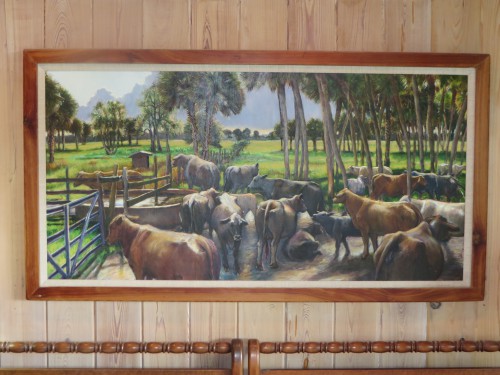
He has one painting hanging over his bed that features a herd of cattle. Obviously, they weren’t all posing in position long enough for him to paint them. “That painting took an entire season to finish, working on it only when I had time. I might paint one standing in a certain position, then copy one in that attitude but another position. You can see that the group represents several attitudes repeated to fill the scene. I actually painted this one on the back of a truck and would drive out to the same spot the same time of day.”
Sexton is now working in ceramics as well, depicting cattle scenes in each of his pieces. His wife, Sharon, is also an artist at the Tiger Lily Studio and Gallery in downtown Vero and he uses the kiln there to finish his works.
Primarily though, Sexton is a cattle rancher. “Cattle ranching today is much different than in the past. Grain-fed beef is the industry standard now and grain does not grow well in Florida. Back when I was a kid there were 25 meat packing plants in Florida. Now there’s one.”
But the industry has also become very segmented and Florida is the largest state for raising feeder calves. “There are more 500-head lots of calves in Central Florida than anywhere else in the world. We raise them to a 5-600 pound weaning weight, then they are sent out west and put on wheat, alfalfa or tall grass prairie. Finally, they are sent to feed lots. It takes seven pounds of grain to produce one pound of weight gain.”
Sexton is very involved with the Florida Cattleman’s Association, where he is the District Four state director. “I’m your personal representative in the cattle industry,” he says with a smile.
While it may seem to be a stretch reconciling his rancher credentials with his fine arts reputation, it makes total sense to Sean Sexton. It’s not just his way of making a living, it’s his way of making a life.
 Indian River Guardian
Absolutely delightful story. Great job with your life Sean. You are quite a guy.